The Science of Lysenkoism
In 1948 a Soviet agronomist persuaded the state to outlaw an entire branch of biology. The reasons it worked, and the reasons it is hard to dismiss cleanly, say something uncomfortable about how belief survives.
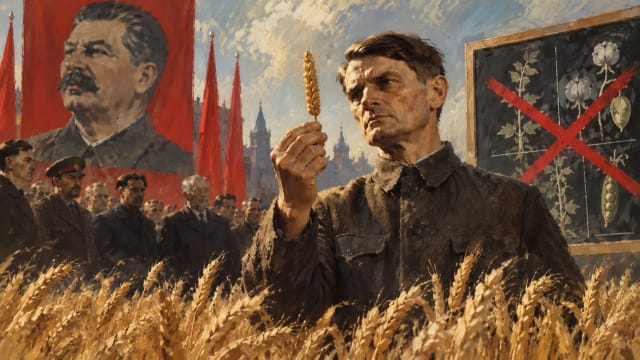
In August 1948 a session of the Lenin Academy of Agricultural Sciences in Moscow ended with an announcement that stunned its audience. Trofim Lysenko, the agronomist who dominated Soviet biology, told the delegates that his report had been approved by the Central Committee of the Communist Party. Within days the teaching of classical genetics in the Soviet Union was effectively closed, and the science of Mendel was labelled bourgeois and foreign.
Lysenko had risen on a promise that suited a hungry state. Born to a peasant family in Ukraine, he claimed that crops could be trained by exposure to cold and moisture, and that the traits acquired in this way would pass to their offspring. Soviet leaders wanted harvests and not hereditary theory, and a man who spoke of remaking nature by will and effort sounded closer to socialist ambition than scientists who counted peas and fruit flies. Josef Stalin gave him steady backing.
The cost fell on those who disagreed. Nikolai Vavilov, a botanist who had gathered one of the largest seed collections in the world, was arrested in 1940 and died in prison in Saratov in 1943. Many other geneticists lost their posts. Crops did not obey the doctrine, but the doctrine did not need the crops to obey. It needed only that no one with authority could say so.
Crops did not obey the doctrine, but the doctrine did not need the crops to obey.
The usual lesson is simple. Politics corrupted science, and when Nikita Khrushchev was removed from power in 1964 the protection around Lysenko faded and Soviet biology slowly rejoined the world. That lesson is true but incomplete. Many of Lysenko's supporters were not cynics. They believed that Mendelian genetics treated living things as fixed machines, and that an organism shaped by its surroundings was a more hopeful idea. The hope was real. What failed was the arrangement that shielded it from test.
Modern research has complicated the story in an unwelcome way. The field of epigenetics has shown that some chemical marks on genes, shaped by experience, can be passed on across a small number of generations in certain organisms. Admirers of Lysenko have occasionally cited this as a vindication. Biologists reply that these effects are limited, unstable, and nothing like the rapid transformation of wheat that Lysenko promised. They are probably right. Yet the episode leaves a troubling thought. A theory can be wrong in every claim that mattered and still brush against something true, and from the inside a persecuted truth and a protected error can sound exactly alike.
Discussion
Sign in to join the discussion.
More in Genetics
Would a Fourth Dimensional Being Be a God?
A thought experiment in higher dimensions asks whether what looks like a miracle might simply be reality viewed from a geometry we cannot perceive.

Why Humans Have the Largest Penis Among All Primates: An RC Inspired by IIM Indore
Desmond Morris had a simple answer. Modern biology has a more complicated one. What changed between 1967 and now reveals as much about science as it does about human anatomy.

The Biggest Problem with Time Travel Is Not Time
What if the biggest obstacle to time travel isn't physics but identity? Before bending spacetime, we may need to answer who actually travels.

Why Einstein Failed His Exams: An RC Inspired by IIM Indore
The story of Einstein failing his exams has survived a century of correction. The reason it survives tells you more about human psychology than it does about Einstein.