The Mathematician Who May Have Found the Highest Mountain and Was Never Named for It
The measurement of Mount Everest was a collective achievement of Indian computers, surveyors and explorers. Who deserves the credit, and what it means to discover a mountain that people already knew, are questions the numbers cannot settle.
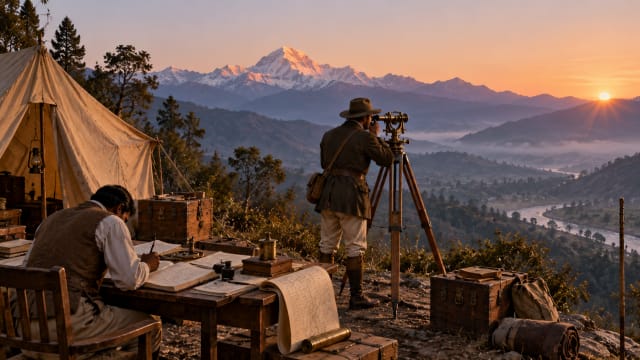
In 1856 the Survey of India announced that a mountain it had been calling Peak XV stood 29,002 feet above the sea and was the highest on Earth. The Surveyor General, Andrew Waugh, proposed that it be named after his predecessor, Sir George Everest, who had objected, according to a letter reported to the Royal Geographical Society, that the name could not be written in Hindi nor pronounced by the people who lived near it. The objection was set aside, and the name was formally adopted in 1865. A story long told in India adds a second twist. It says that the person who first recognised Peak XV as the world's highest was not a British officer but a Bengali mathematician, Radhanath Sikdar. The question for an essay on science and empire is not simply whether the story is true, but what it reveals about how knowledge is credited, and who is counted as having discovered anything.
The Great Trigonometrical Survey began in 1802 under William Lambton, who set out to measure an arc of the earth's surface across the Indian peninsula, and it was carried north by Everest, who served as Surveyor General from 1830 to 1843. Everest recruited Sikdar, a mathematically gifted young man trained at the Hindu College in Calcutta, to work as a computer, the term then used for a person who carried out the long calculations that turned angles measured in the field into distances and heights. Sikdar rose in time to lead the computing office, a rare post for an Indian in a department dominated by British officers.
Discussion
Sign in to join the discussion.
More in History of Science

Would a Fourth Dimensional Being Be a God?
A thought experiment in higher dimensions asks whether what looks like a miracle might simply be reality viewed from a geometry we cannot perceive.
Why Humans Have the Largest Penis Among All Primates: An RC Inspired by IIM Indore
Desmond Morris had a simple answer. Modern biology has a more complicated one. What changed between 1967 and now reveals as much about science as it does about human anatomy.

The Biggest Problem with Time Travel Is Not Time
What if the biggest obstacle to time travel isn't physics but identity? Before bending spacetime, we may need to answer who actually travels.
Why Einstein Failed His Exams: An RC Inspired by IIM Indore
The story of Einstein failing his exams has survived a century of correction. The reason it survives tells you more about human psychology than it does about Einstein.