The Baby Who Was Born in a Dish and the Experts Who Objected
The first baby conceived outside a human body arrived in 1978 to eminent warnings of harm. Fifty years on, the objections look less like caution than like a prediction that failed.
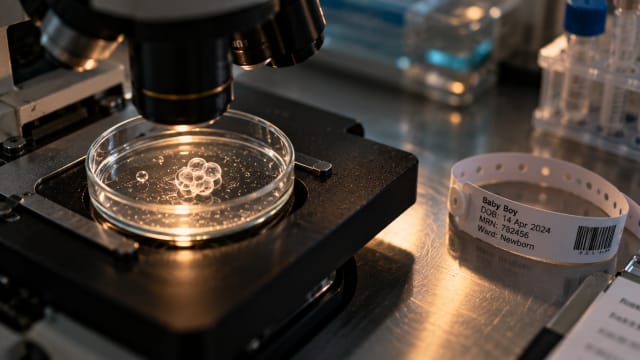
Louise Brown was born on 25 July 1978 at Oldham General Hospital in England, and she was the first person conceived outside a human body. Her mother, Lesley, had blocked Fallopian tubes and had tried for nine years to conceive. The treatment that changed her life had been developed by the physiologist Robert Edwards and the obstetrician Patrick Steptoe, who had been working on it for years. Their method collected eggs, fertilised them in a laboratory dish and returned the embryo to the mother.
The path was not easy. Reports of the early work say that, among 282 women who entered the programme, doctors attempted 457 egg collections. Only 167 of these led to fertilisation. Twelve embryos were implanted, five produced pregnancies, and Louise was the only live birth.
Many eminent figures opposed the research. Some of them were Nobel laureates, and they called it scientifically worthless, unnecessary and ethically questionable. The objections combined scientific doubt with moral alarm, and the debate was carried on in the press as well as in journals. The Medical Research Council refused to fund it. When Louise was born, about a hundred journalists gathered at the family's door.
Edwards received the Nobel Prize in Physiology or Medicine in 2010. Steptoe had died in 1988, and the prize is not awarded after death, so the man who had worked beside him for years could not share it. By then millions of children had been born through in vitro fertilisation.
The story is often told as the triumph of a technique over its doubters. It can also be told as a reminder that early objections to a technique, however sincere, were often wrong in their prediction of harm. Critics had feared that something would go wrong with the children. The children grew up.
Discussion
Sign in to join the discussion.
More in Human Reproduction
Would a Fourth Dimensional Being Be a God?
A thought experiment in higher dimensions asks whether what looks like a miracle might simply be reality viewed from a geometry we cannot perceive.

Why Humans Have the Largest Penis Among All Primates: An RC Inspired by IIM Indore
Desmond Morris had a simple answer. Modern biology has a more complicated one. What changed between 1967 and now reveals as much about science as it does about human anatomy.

The Biggest Problem with Time Travel Is Not Time
What if the biggest obstacle to time travel isn't physics but identity? Before bending spacetime, we may need to answer who actually travels.
Why Einstein Failed His Exams: An RC Inspired by IIM Indore
The story of Einstein failing his exams has survived a century of correction. The reason it survives tells you more about human psychology than it does about Einstein.