The Eight-Glass Myth
The instruction to drink eight glasses of water daily is repeated with the confidence of a law of nature. A search for its source turned up a single sentence that lost its second half.
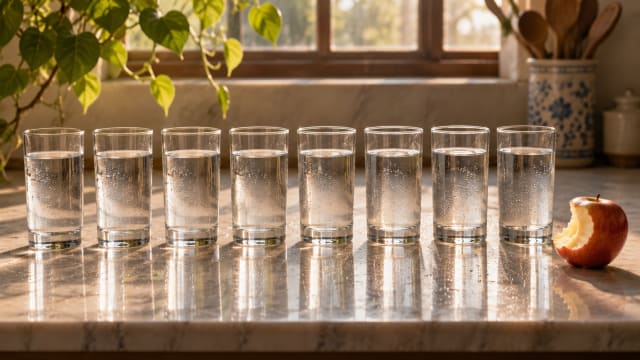
The advice to drink eight glasses of water a day is repeated in schools, offices and gyms with the confidence of a law of nature. In 2002 the kidney physiologist Heinz Valtin of Dartmouth Medical School published an invited review in the American Journal of Physiology and reported that he could find no scientific studies supporting it. A rule so familiar with no obvious source invites the obvious next question, which is where it came from.
Valtin suspected an old recommendation from the Food and Nutrition Board of the National Research Council, which suggested about one millilitre of water for each calorie of food. For an adult eating around two thousand calories that works out at roughly two litres, close to eight glasses. The same passage, however, went on to say that most of this quantity is contained in prepared foods. The second sentence appears to have dropped away while the first travelled on, and that leaves a new puzzle, which is why one half of a statement survives better than the other.
One reason may be that the number is easy to remember and easy to act on. A glass is a countable unit, and counting turns a vague goal into a daily habit. Advice that can be ticked off tends to outlast advice that must be judged. Another reason is that water is cheap, safe and pleasant, so the rule seemed to cost nothing even when it was unproven. That brings up a further question, which is whether it really does cost nothing.
Advice that can be ticked off tends to outlast advice that must be judged.
The answer is mostly yes, with exceptions. Valtin concluded that most healthy adults in temperate climates already drink enough, since thirst and ordinary meals supply what the body needs, and that coffee, tea and other drinks count towards the total. Higher intakes can matter in hot weather, during strenuous exercise or for people prone to kidney stones. At the far end, drinking excessive quantities can cause water intoxication, which has in rare cases led to confusion and death. A harmless rule can become harmful when it is followed past the point of need.
None of this shows that drinking water is unimportant. It shows only that a precise quantity was attached to a general truth without a measurement behind it. Why precision so often wins public trust over honest ranges, even when the precision is borrowed, is a question that the history of this rule raises and does not settle.
IPMAT verbal practice
This passage is written in the IPMAT style. Its 6 questions are just below in exam mode.
Discussion
Sign in to join the discussion.
More in Medicine & Health

The Sugar Dose That Was Never Given
Parents who thought their sons had eaten sugar saw wilder behaviour, though no sugar was served. The finding raises a question about how much of what adults observe is brought in from their own expectations.

The Placebo That Knew It Was a Placebo
Patients in a 2010 Harvard trial were handed a bottle labelled placebo and told that the pills held no medicine. Many of them improved anyway, and medicine has not yet agreed on why.

The Chemistry of Belief
Explore the placebo effect and how belief, psychology and modern medicine together shape healing, pain and human biology.
Would a Fourth Dimensional Being Be a God?
A thought experiment in higher dimensions asks whether what looks like a miracle might simply be reality viewed from a geometry we cannot perceive.