The Bridge That Resonance Did Not Break
The collapse of the Tacoma Narrows Bridge is taught as a lesson in resonance. Two engineers argued in 1991 that the lesson was wrong.
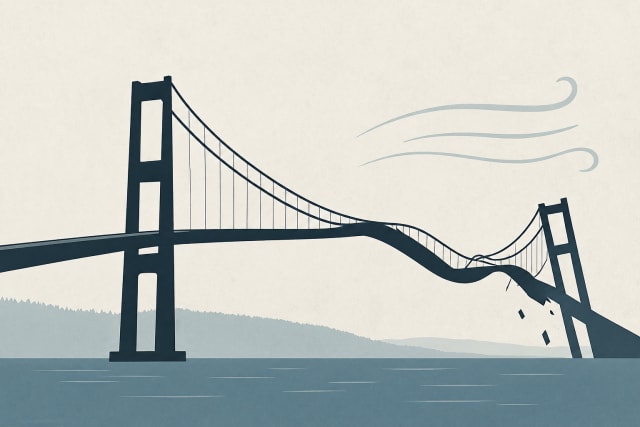
On 7 November 1940 the Tacoma Narrows Bridge in Washington twisted itself apart in a wind of about forty miles an hour, and film of the collapse became a staple of physics classrooms. Many textbooks explained it as resonance, with the wind pushing the deck at its natural frequency until the swings grew too large to survive.
In 1991 the engineers Billah and Scanlan surveyed those textbooks and objected. A steady wind has no rhythm to match. What twisted the deck was flutter, in which the motion of the deck altered the airflow around it, and the altered airflow fed the motion in turn. The error persisted for half a century, perhaps because a simple story that looks right is rarely checked by those who retell it. Why it was so rarely checked remains unclear.
Discussion
Sign in to join the discussion.
More in Physics

The Hot Water That Froze First
A Tanzanian schoolboy, Aristotle and Descartes all reported that hot water can beat cold water to ice. Two thousand years later, nobody can say whether they were right.

Why Einstein Failed His Exams: An RC Inspired by IIM Indore
The story of Einstein failing his exams has survived a century of correction. The reason it survives tells you more about human psychology than it does about Einstein.

The Biggest Problem with Time Travel Is Not Time
What if the biggest obstacle to time travel isn't physics but identity? Before bending spacetime, we may need to answer who actually travels.

The Person In The Mirror is Not You
Why the person in the mirror is not you. Explore the science of light, consciousness, time, memory, and human identity.