The Hot Water That Froze First
A Tanzanian schoolboy, Aristotle and Descartes all reported that hot water can beat cold water to ice. Two thousand years later, nobody can say whether they were right.
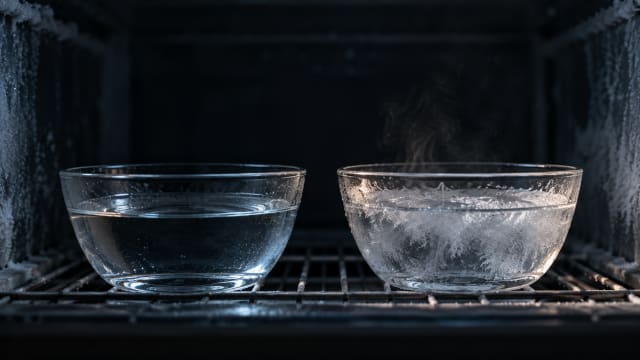
In 1963 a schoolboy named Erasto Mpemba was making ice cream at a secondary school in Tanzania. The rules required students to boil the milk, let it cool and then freeze it. Short of freezer space and short of patience, Mpemba slid his mixture in while it was still hot. It froze before his classmates' batches did. His teacher was unimpressed and the class mocked him. Years later a visiting physicist named Denis Osborne repeated the trial, and the two published a paper in 1969 that gave the puzzle Mpemba's name.
The observation was far older than the boy. Aristotle noted in his Meteorology that water previously warmed tends to freeze faster. Francis Bacon and René Descartes repeated the claim centuries later, and none of them could say why. The pattern is telling. An observation that offends intuition but resists a tidy experiment is noticed, dismissed and rediscovered by every generation.
The offence to intuition is genuine. Cooling seems to follow a simple logic in which a hotter body must pass through every temperature at which a cooler body begins. For hot water to win, it must shed heat faster along the way, or the two samples must differ in some respect beyond temperature. Physicists have offered many candidates. Evaporation shrinks the hot sample. Convection carries heat to the surface more efficiently. Dissolved gases escape as water warms, which may alter how ice forms. Cold water may also supercool, staying liquid below zero for longer. Each candidate explains some experiments and fails others.
The difficulty is that almost every variable in a kitchen freezer changes with the water's starting temperature. Hot containers melt the frost beneath them and improve contact with the shelf. Thermometers placed in different positions record different moments as the moment of freezing. Even the meaning of freezing is contested, since the surface may form ice while the core stays liquid. A race with no agreed finish line cannot produce a clean winner.
The difficulty is that almost every variable in a kitchen freezer changes with the water's starting temperature.
Skeptics draw a sharp conclusion from this. In 2016 the researchers Henry Burridge and Paul Linden ran careful trials and found no reliable effect once temperature was measured consistently, and they suggested that earlier reports reflected loose measurement. The reply is only partial. In 2020 a team using a single microscopic bead held in a laser trap showed that a system can relax to a cold state faster when it starts hotter. That result concerns a bead and not a glass of water, so the kitchen puzzle stays open, but it shows that the underlying logic is not forbidden by physics.
The larger lesson concerns how a fact becomes a fact. Science trusts phenomena that can be reproduced on demand, yet philosophers, cooks and schoolboys have reported this one for over two thousand years without anyone fully capturing it. Perhaps it is a real process hiding behind experimental noise. Perhaps it is a family of unrelated effects that share a name because they share a surprise. The boy's puzzle has outlived every answer offered to it, which raises the possibility that it was never one puzzle to begin with.
Discussion
Sign in to join the discussion.
More in Physics
The Bridge That Resonance Did Not Break
The collapse of the Tacoma Narrows Bridge is taught as a lesson in resonance. Two engineers argued in 1991 that the lesson was wrong.
Why Einstein Failed His Exams: An RC Inspired by IIM Indore
The story of Einstein failing his exams has survived a century of correction. The reason it survives tells you more about human psychology than it does about Einstein.

The Biggest Problem with Time Travel Is Not Time
What if the biggest obstacle to time travel isn't physics but identity? Before bending spacetime, we may need to answer who actually travels.

The Person In The Mirror is Not You
Why the person in the mirror is not you. Explore the science of light, consciousness, time, memory, and human identity.