The Runway Without Planes: An RC Inspired by IIM Indore
Islanders in Vanuatu built airstrips and waited for planes that never came, and the world learned to laugh at them. The joke may reveal more about the laughers than about the waiting.
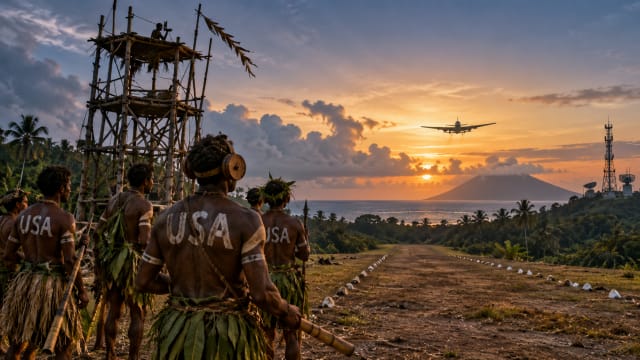
Every year on 15 February, villagers on the island of Tanna in Vanuatu march in formation with bamboo rifles and the letters USA painted across their chests, honouring a figure named John Frum. The movement took shape in the late 1930s and grew during the Second World War, when tens of thousands of American troops landed on nearby islands and unloaded more goods in a season than local people had seen arrive in a lifetime. The soldiers then left and the goods stopped. Followers cleared airstrips, raised towers of wood and wore carved headphones, waiting for the planes to return.
Outsiders supplied a name for this. Cargo cult entered anthropology in the 1940s, and in 1974 the physicist Richard Feynman made it a joke at a Caltech commencement, using it to describe research that copies the outward form of science while missing its substance. The islanders became a standing emblem of confused ritual and cause. A runway without engineers, the image suggests, will never summon a plane, and the lesson is delivered with a smile that asks nothing further of the listener.
The mockery assumes that the islanders reasoned badly, and that assumption deserves a closer look. Wealth in their world arrived in crates whose makers never appeared. The foreigners who owned it seemed to do no work to produce it, and they obtained it through paperwork, drills and radio talk. The islanders came from societies where goods moved through ceremony and obligation, and from that background they drew an inference that fitted the evidence. If foreign wealth flowed from rites, then rites were what must be copied.
Seen this way, the movement was an experiment. People formed a hypothesis, built an apparatus to test it and refined the apparatus when nothing arrived. Many such movements also carried a political edge, since cargo stood for more than objects. It meant dignity, equality and an end to being served last, and the goods were imagined as rightfully theirs and withheld by colonial powers. The islanders were running a test whose logic the visitors had never taken the trouble to examine.
The islanders were running a test whose logic the visitors had never taken the trouble to examine.
A critic will reply that a theory which survives decades of failed predictions is no theory at all, and that Feynman's point stands. The objection has force. Belief that never updates is dogma, and some followers did wait across generations. Yet the objection proves less than it seems to. Prophecies in these movements were revised, abandoned and revived, and followers on Tanna have long disagreed about what John Frum promises. Meanwhile established sciences also protect favoured ideas with auxiliary explanations whenever evidence refuses to cooperate. The difference is one of degree, and degree is harder to judge from outside.
The deeper trouble is that every society, including the one that laughs, runs on causal beliefs it has never checked. Few people who flip a switch could explain the grid behind it, and most extend trust to experts whose rituals of credentials and procedure would look strange to a stranger. Cargo cults raise the awkward question of who decides that one set of unexplained rites counts as engineering and another as superstition. The answer may owe less to evidence than to who happened to be holding the cargo. The islanders still wait, and the airstrips on Tanna go on asking the visitors a question that none of them has yet answered, which is what exactly they were doing there.
Discussion
Sign in to join the discussion.
More in Anthropology

The Ghost Ancestors
Ancient humans can vanish without leaving a single bone. Yet fragments of their DNA continue telling a story that archaeology never could.

Why Witchcraft Never Left Us
Witchcraft is less about magic and more about the human need to impose meaning on uncertainty, revealing how ritual persists even in modern rational life.

Why Humans Kiss
A kiss seems simple, but beneath it lies an interplay of biology, culture, and memory. How a human reflex evolved into one of our deepest emotional language?
Where Power Begins at the Mother
A reflective exploration of matriarchy that challenges the idea of power as dominance, revealing instead a system rooted in continuity, care, and the quiet endurance of human relationships.