Why Witchcraft Never Left Us
Witchcraft is less about magic and more about the human need to impose meaning on uncertainty, revealing how ritual persists even in modern rational life.
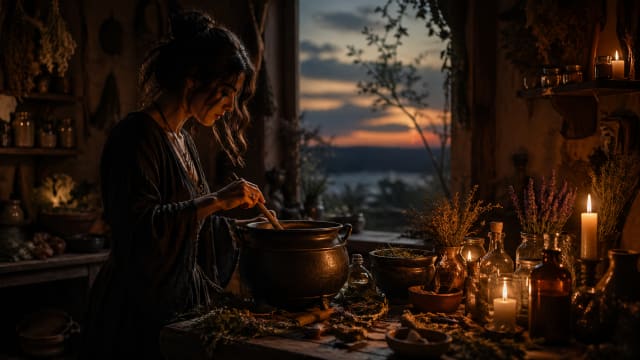
A woman stirs a pot at dusk. The flame is low, the room quiet, the air heavy with the smell of herbs. Nothing supernatural occurs, yet the moment feels charged. Someone, somewhere, would call this witchcraft. The word endures because it captures something we have never quite outgrown. Witchcraft is not only about spells or the occult. It is about the human urge to shape uncertainty into intention. When the world feels unstable, we search for ways to steady it. We reach for small actions that promise a sense of control, even if that promise is fragile.
Across history, societies have treated this impulse with both fear and fascination. In medieval Europe, people accused others of witchcraft not because magic had been proven, but because misfortune demanded explanation. A failed harvest or a sudden illness could not remain random. It needed a cause, and often a culprit. The idea of the witch offered both. It gave chaos a face and turned uncertainty into a story that people could grasp. Fear made the invisible visible, and belief turned suspicion into certainty, even when evidence was thin.
Anthropologists have noticed a pattern that feels almost universal. Ritual tends to appear where knowledge reaches its limits. Farmers perform rites when weather becomes unpredictable. Sailors develop superstitions when the sea refuses to be controlled. In such moments, ritual acts as a bridge between ignorance and hope. It does not change the external world in any measurable way, but it changes how people endure it. The act itself becomes meaningful. It offers comfort, structure, and a sense of participation in events that would otherwise feel distant and indifferent.
It is tempting to believe that modern life has left all this behind. We trust science, data, and reason to guide us. Yet the old patterns have not disappeared. They have simply changed form. We check our phones again and again before an important result, as if attention might influence outcome. We rely on lucky objects, fixed routines, or personal habits that feel too meaningful to break. Some might argue that this comparison stretches the idea too far, since many routines are grounded in evidence and improve performance. That is true. Discipline and habit can be rational and useful. But the line shifts when belief grows stronger than proof, when a routine feels necessary even without clear reason, when breaking it creates unease that logic cannot resolve.
The deeper truth is simple and slightly unsettling. Witchcraft has never depended on supernatural power. It depends on the human mind. We are built to search for patterns, to resist randomness, to tell stories that make the world feel ordered. A ritual works not because it changes reality, but because it changes our relationship to it. That shift can influence behaviour, and behaviour can shape outcomes in subtle ways. So the woman at dusk is not a figure from a distant past. She is a reflection. Each of us carries some version of that quiet act, repeating gestures and holding beliefs to steady ourselves, hoping that in a world without guarantees, our actions still matter, even when we cannot fully explain why.
Discussion · 1
The Quiet Logic of Witchcraft Witchcraft Uncertainty into intention, looking for control To put blame on someone for the unwanted happenings Ritual Try to act as bridge b/w ignorance and hope. To make comfort, structure and sense of participation in events. Modern times it didn't disappear but transform into something else. Like checking mobile phones. Routines are good but problematic when you feel uneasy if it breaks. Human mind search for patterns just to resist randomness to make stories that feel ordered and hope in this random world our action matters.
Sign in to join the discussion.
More in Anthropology

The Runway Without Planes: An RC Inspired by IIM Indore
Islanders in Vanuatu built airstrips and waited for planes that never came, and the world learned to laugh at them. The joke may reveal more about the laughers than about the waiting.

The Ghost Ancestors
Ancient humans can vanish without leaving a single bone. Yet fragments of their DNA continue telling a story that archaeology never could.

Why Humans Kiss
A kiss seems simple, but beneath it lies an interplay of biology, culture, and memory. How a human reflex evolved into one of our deepest emotional language?
Where Power Begins at the Mother
A reflective exploration of matriarchy that challenges the idea of power as dominance, revealing instead a system rooted in continuity, care, and the quiet endurance of human relationships.