The Bridge That Changed Sex In Translation
German poets call bridges fragile, Spanish poets call them strong. The same object, the same world, only the grammar changes.
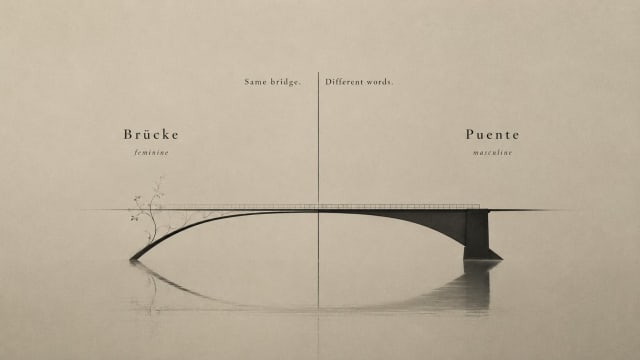
A translator working from German into English pauses over a single line describing a bridge. In the original, the bridge is elegant, slender, almost fragile, described with the same tenderness a German poet might use for a woman. Translated into Spanish, the same bridge in a different poem becomes sturdy, towering, and strong. Nothing about the bridge has changed. Only the grammatical gender of the noun that names it has, feminine in German, masculine in Spanish.
It seems implausible that something as arbitrary as a grammatical category, a rule with no connection to biology or physics, could shape how fluent speakers imagine a steel and concrete structure. A bridge has no sex. Yet when researchers asked German and Spanish speakers to describe the same objects using adjectives, the words each group reached for tracked the grammatical gender of the noun in their own language with striking consistency, even though every participant was simply describing something they could see with their own eyes.
Grammatical gender itself is largely an accident of linguistic history. Most Indo European languages inherited a system in which every noun, whether animate or not, was sorted into classes originally called masculine, feminine, and sometimes neuter, sorted not by any real property of the object but by patterns of sound and inflection inherited from a much older parent language. A key is grammatically feminine in German and masculine in Spanish for reasons that have nothing to do with what a key actually is.
This is where the same word gender becomes confusing, since it names both this arbitrary grammatical sorting system and the social and biological category applied to living beings, two domains sharing a label but not necessarily a mechanism. When Lera Boroditsky and colleagues asked speakers of both languages to describe a key, German speakers, for whom the word is masculine, reached for words like hard, heavy, and useful, while Spanish speakers, for whom the word is feminine, reached for words like intricate, tiny, and lovely.
The same word gender becomes confusing, since it names both this arbitrary grammatical sorting system and the social and biological category applied to living beings, two domains sharing a label but not necessarily a mechanism.
A skeptic could reasonably object that this proves nothing about how speakers actually perceive keys, only that grammatical agreement makes certain adjectives easier to reach for in the moment, since German adjectives modifying a masculine noun and Spanish adjectives modifying a feminine noun are grammatically pulled toward different endings, making some words simply more fluent to produce, a matter of linguistic convenience rather than altered thought.
Later studies attempted to test this by moving outside language production entirely, using nonverbal tasks such as pairing objects with male or female voices, or measuring how quickly bilingual speakers associated objects with gendered concepts in each of their languages. The effect weakened but did not disappear, suggesting grammatical gender leaves some residue in conceptual association beyond mere convenience of word choice, though far short of the dramatic claim that language rigidly determines thought.
The pattern extends beyond bridges and keys into how cultures have long personified abstractions, death, wisdom, justice, and time appearing as male or female figures in myth and art with a consistency that often, though not always, tracks the grammatical gender of the word for that concept in the local language. Whether grammar first taught human minds to imagine the world as gendered, or whether an older tendency to gender the world first shaped the grammar that later inherited it, remains a question no bridge, key, or myth can settle on its own.
Discussion · 1
Passage about grammer, how a same object can feminine in one lang and masculine with other. Then authors proposed some studies with check what is happening. At end of this author conclude with gender though is first then we think of on that
Sign in to join the discussion.
More in Gender & Identity

Madonna's Greatest Invention Was Madonna
Madonna's greatest creation was not a song or an album but herself. Her career reveals how identity is crafted, revised and performed over time.

The Modern Man Must Perform Strength Without Signalling Danger
An essay on modern masculinity, social expectations, emotional self-monitoring, and the conflict between strength and harmlessness.
The Compressive Binary: Gender as a Coordinating Structure of Reality
Gender acts as a compressive system that simplifies human interaction, enabling coordination while quietly erasing nuance and individuality.

Sex vs Gender
A sharp, philosophical distinction between biological sex and social gender, clarifying how body and identity intersect—and why the difference matters.