The Cobra Effect Was a Rat Problem
The most quoted warning about bad incentives concerns snakes in Delhi that nobody has been able to find. The rats of Hanoi, which did exist, made the same point and were forgotten.
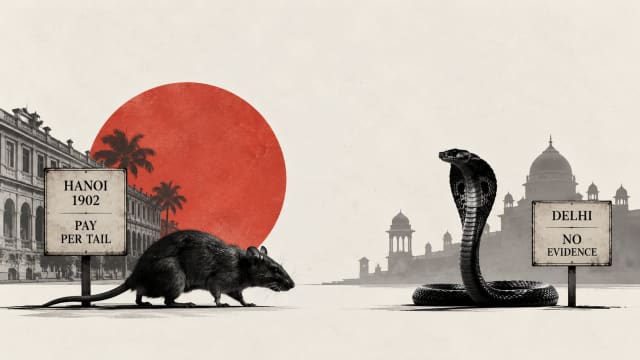
In 1902 the French colonial authorities in Hanoi had a rat problem that their own engineering had created. The new sewers of the European quarter, built to make the district modern and clean, gave rats a sheltered road into kitchens and bedrooms. The administration hired Vietnamese rat catchers, found the wage bill too high, and offered a small payment for every rat tail handed in.
The catchers did what the payment asked of them. Soon officials noticed rats running through the streets with no tails. Some hunters had cut off the tail and released the animal so that it could breed and produce more tails. Others, it was said, raised rats on purpose. The scheme was abandoned within months, and the rats remained.
The episode is now remembered as the cobra effect, a tale about a bounty on cobras in colonial Delhi that led people to breed the snakes. The economist Horst Siebert gave the idea that name in a book of 2001, and economists, journalists and policy advisers have repeated the tale ever since as proof that incentives bite back. Yet the historian Michael Vann searched the archives and published his findings in 2003. He found the rats of Hanoi well documented. The cobras of Delhi he could not find at all.
This is awkward for the moral. The story is told to warn against rewarding the proxy and not the goal, and the rat tail fits that warning perfectly. But the better known version spread because it was neat, with a snake that is more frightening than a rat and a ruler who is more foolish than a clerk. A parable about distorted incentives became popular partly by distorting the facts to win attention.
A parable about distorted incentives became popular partly by distorting the facts to win attention.
A defender of the tale would say that its accuracy hardly matters, since the principle is sound. Real cases are easy to find, from schools that raise scores by teaching to the test to firms that meet sales targets by shipping goods early. The sociologist Donald Campbell stated in 1976 that the more a quantitative indicator is used for decisions, the more it will be corrupted. Whether the cobras lived or not, the lesson stands.
That reply is partly right and leaves something out. When a story becomes the standard example of a rule, its repetition begins to count as evidence for the rule, and people stop checking the cases. The rats left records, and the cobras left only a lesson. Which of the two has done more to shape the decisions of governments is a question that no archive holds the answer to.
Discussion
Sign in to join the discussion.
More in Behavioural Economics

The Supersonic Jet and the Money Already Spent
Continuing a failing project looks irrational until the cost of stopping is counted.

Losing Feels Worse Than Winning Feels Good: An RC Inspired by IIM Indore
Losses hurt twice as much as gains feel good. Kahneman and Tversky called this loss aversion. Economics has not been the same since.

The Paragraph That Moved The Market
A central bank governor says a few sentences about the future, and prices shift before any policy actually changes. Why does mere belief move an economy?

How Great Teams Are Deliberately Built?
Businesses often chase star performers, yet enduring success belongs to teams that cultivate trust, amplify one another's strengths, and never stop learning.