The Horned Helmet That No Viking Ever Wore
The most famous piece of Viking costume has never turned up in a Viking grave. Its real home is the nineteenth century stage, and its survival is stranger than its origin.
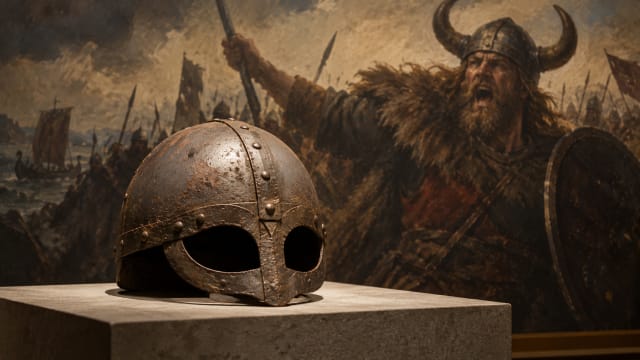
The Viking in the popular imagination wears a helmet with two curving horns. He appears on football scarves, in comic strips and on the packaging of countless products. The image is so familiar that its absence from the archaeological record comes as a shock. No horned helmet has been confirmed from any Viking grave.
What archaeologists have found is plainer. The Gjermundbu helmet, discovered in a burial mound in Norway in 1943 and dated to about the tenth century, is a rounded iron cap with a guard around the eyes and nose. It is often described as the best preserved helmet of the Viking Age. It has no horns, and the wider evidence from carvings and small figures suggests that most raiders fought bareheaded or wore simple caps of leather or iron.
The horns come from later centuries. In the 1820s the Swedish artist Gustav Malmström is credited with illustrating an epic poem drawn from Norse saga with horned and winged headgear. In 1876 the costume designer Carl Emil Doepler dressed the singers of Richard Wagner's Ring cycle at Bayreuth in similar helmets. Wagner's operas drew on Norse and Germanic myth, and a generation of audiences left the theatre carrying an image that would soon cross into painting, advertising and film.
There is a footnote that complicates the neat story of a modern invention. Horned helmets did exist in Scandinavia, but far earlier. Two ceremonial helmets found in a Danish bog at Veksø, usually dated to the Bronze Age, carry curved horns. They predate the Viking raids by well over a thousand years, and they were probably worn for ritual and not for combat.
No horned helmet has been confirmed from any Viking grave.
A practical objection also tells against the horn. A projecting horn on a helmet gives an opponent something to catch, or a way to turn a blow, which is a liability in close fighting. Warriors who lived by raiding had little reason to carry a handicap for decoration.
Why the myth endured is a puzzle of a different kind. The evidence has been available for decades and museums repeat it, yet the image persists. Perhaps the horns are less a mistake about the Vikings than a statement about those who need them to look dangerous, and a statement of that kind is not corrected by finding a helmet.
Discussion
Sign in to join the discussion.
More in History of Ideas
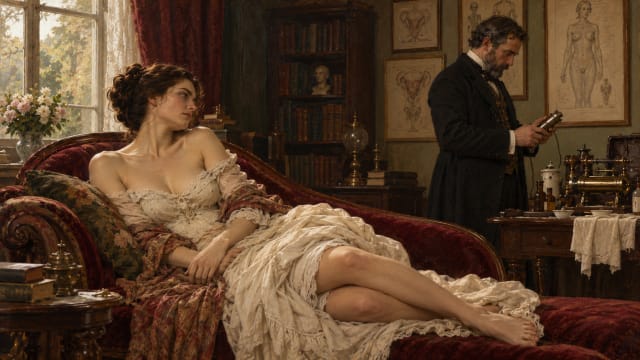
The Machine That Cured Nothing - An RC Inspired by IIM Indore
A popular story says Victorian doctors invented the vibrator to treat hysterical women. The tale has been repeated in films, plays and classrooms, and its own evidence is far thinner than its fame.
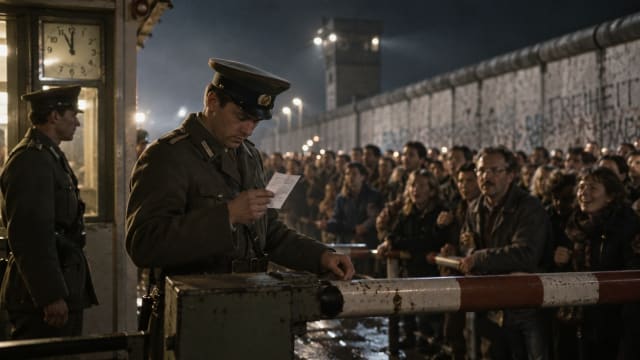
Why the Berlin Wall Fell Because of a Miscommunication: An RC Inspired by IIM Indore
Gunter Schabowski had not been briefed. The decision he announced had not been implemented. The gates he declared open were still closed. Within hours, the Berlin Wall had ceased to exist.

The Search Before the Search
The Greenbrier Ghost helped reopen a murder case. What followed reveals a deeper truth about evidence, belief, and knowledge.

The Soldier Who Didn't Know the War Was Over: An RC Inspired by IIM Indore
Hiroo Onoda fought in the Philippine jungle until 1974, twenty-nine years after Japan surrendered. He was not deluded. He was doing exactly what a loyal soldier should do.