The Press Did Not Start the Reformation: An RC Inspired by IIM Indore
The printing press spread the Reformation. It did not cause it. The soil was prepared long before Gutenberg printed a single page.
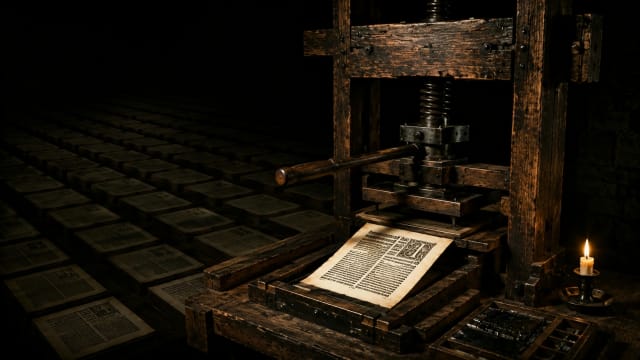
The standard account of the Protestant Reformation gives Gutenberg almost as much credit as Luther. Without the printing press, the argument runs, Luther's Ninety-Five Theses would have remained a local provocation rather than becoming a continental crisis. The technology spread the ideas, and the ideas changed Europe. It is a satisfying story. It is also incomplete.
The printing press existed for sixty years before the Reformation began. Gutenberg completed his Bible in 1455. Luther nailed his theses to the door of the Wittenberg church, or more likely circulated them by letter, in 1517. In those six decades, the press printed psalters, legal documents, classical texts and devotional literature. It did not produce a reformation. The technology was present. The transformation was not.
This is the first difficulty with the technological explanation. A tool does not choose what it amplifies. The printing press spread whatever people wanted to print and whatever other people wanted to read. For most of its early history, what people wanted to read was not Protestant theology. The press served the existing order as efficiently as it later disrupted it. Cardinals commissioned printed books. Popes issued printed indulgences. The same technology that spread Luther's arguments also spread the Catholic responses to them.
The deeper problem is that the causal story runs backwards. Ideas do not spread because a medium exists. A medium spreads ideas that people are already prepared to receive. Luther's arguments found an audience not because the press made them available but because existing conditions had made parts of Germany ready to hear them. Clerical corruption had been accumulating as a grievance for generations. The sale of indulgences had become an open scandal. Political tensions between German princes and Rome had been building for decades. The soil was prepared before the seed arrived.
Consider what happened to Jan Hus, who made similar arguments about clerical authority and scripture nearly a century before Luther. Hus was burned at the Council of Constance in 1415. He had no printing press. But he also had no princes willing to protect him, no network of urban merchants who had grown suspicious of Church finances, and no popular movement ready to translate theological argument into political action. The argument existed. The conditions for it to survive did not.
A medium spreads ideas that people are already prepared to receive. The soil was prepared before the seed arrived.
What the printing press actually did was accelerate and extend a transformation that was already underway. Once the Reformation had begun, the press became indispensable. It allowed Luther to respond to opponents faster than the Church could organise its replies. It created a reading public that could follow theological debate across city and national boundaries. It made the Reformation harder to suppress. But acceleration is not the same as causation.
This distinction matters beyond the specific history of the sixteenth century. Every generation discovers a new technology and attributes to it transformations that were already in motion. The technology becomes the explanation because it is visible and dramatic. The underlying conditions that made the transformation possible are harder to see and less satisfying to describe. But the press did not give Europe the Reformation. Europe was already becoming a place where the Reformation was possible. The press made sure it could not be stopped.
Discussion · 1
According to passage, Ideas are spread among people only when existing condition are prepared to receive the idea, Arrival of technology does not reform or transform the idea it may help in accelerate and extend the transformation of idea.
Sign in to join the discussion.
More in Modern History

The Emperor Who Was Not Short
For two centuries the autopsy figure has been cited as proof that Napoleon was small. A look at the units, the cartoons and the nicknames tells a different story.

The Queen Who Never Offered Cake
Her most famous sentence was probably never hers. The story of how it stuck says more about the people who believed it.

Why the Berlin Wall Fell Because of a Miscommunication: An RC Inspired by IIM Indore
Gunter Schabowski had not been briefed. The decision he announced had not been implemented. The gates he declared open were still closed. Within hours, the Berlin Wall had ceased to exist.

The Search Before the Search
The Greenbrier Ghost helped reopen a murder case. What followed reveals a deeper truth about evidence, belief, and knowledge.