The Cartography of Heat
How cities became climate systems. Inside the hidden science of urban heat, Local Climate Zones, and the future of sustainable cities.
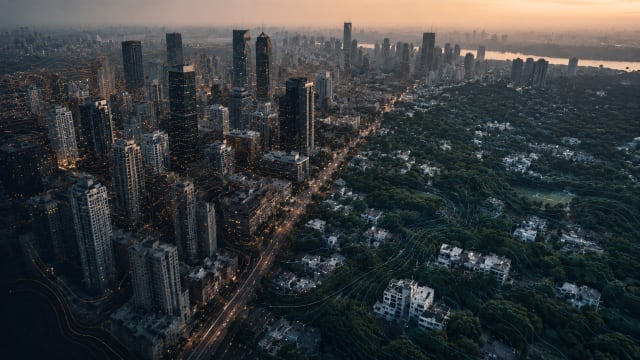
By midnight, the city still glows. Glass towers leak heat into the air like slow-burning furnaces. Asphalt continues to radiate warmth hours after sunset. Air conditioners hum from apartment blocks while traffic crawls beneath fluorescent billboards. Yet only a few kilometres away, beneath clusters of trees and lower buildings, the night feels gentler. The breeze moves differently there. Concrete loosens its grip on the day. Two neighborhoods belonging to the same city begin to resemble separate climates.
For decades, urban planners understood this phenomenon in broad terms. Cities trapped heat because they replaced soil with steel, vegetation with asphalt, and shade with vertical density. The Urban Heat Island effect became one of the defining environmental signatures of modern urbanization. Yet the deeper problem was not merely physical. It was conceptual. Scientists lacked a language precise enough to describe how cities actually behaved.
The city was not one climate system. It was a mosaic of competing thermal worlds.
Traditional land classifications flattened urban life into crude categories such as residential, industrial, or commercial. From the perspective of climate modeling, these labels were strangely primitive. A narrow district filled with reflective glass towers behaved differently from a sprawling neighborhood of low-rise housing, even if both were technically urban. Wind patterns shifted between them. Heat retention changed. Moisture evaporated differently. The city was not one climate system. It was a mosaic of competing thermal worlds.
The Local Climate Zone framework emerged from this realization. Instead of treating urban space as a bureaucratic map, it treated it as a physical organism. Neighborhoods could now be classified according to density, building height, surface roughness, vegetation, and thermal behavior. A compact high-rise district became climatically distinct from an open low-rise settlement in the same way a desert differs from a forest. The framework transformed cities into something readable.
What appears technical at first glance was quietly philosophical. Classification systems shape perception. A society can only govern what it can recognize. Medieval maps organized the world through kingdoms and empires because political power defined reality. Industrial cities later organized themselves through roads, factories, and property grids because commerce became the dominant logic of urban life. Climate change is forcing another transformation. Cities increasingly need to understand themselves through flows of heat, shade, airflow, and survivability.
A society can only govern what it can recognize.
Critics of the Local Climate Zone approach point out that it remains an approximation. More advanced geometry-based systems can capture urban details with far greater precision. In wealthy regions equipped with sophisticated spatial databases, climate simulations often achieve a higher level of realism. Yet this criticism misses the larger achievement of the framework. Precision matters little if only a handful of cities can afford it.
The power of the Local Climate Zone model lies in portability. It allows researchers in rapidly growing cities across Asia, Africa, and Latin America to build meaningful climate simulations using globally accessible tools. That democratization matters because the future of climate vulnerability belongs increasingly to the urban Global South. The most severe heat stress will not emerge in carefully regulated European capitals. It will unfold in dense megacities where infrastructure struggles to keep pace with population growth.
The modern city once symbolized humanity’s victory over nature. The warming planet is quietly reversing that illusion.
Modern urban life has always depended on invisible systems. Sewage networks made industrial cities survivable. Electrical grids extended human activity beyond daylight. Climate modeling may become the next hidden infrastructure shaping urban civilization. Governments already use simulations to decide where trees should be planted, where ventilation corridors must remain open, and which districts face the highest thermal risk. Entire neighborhoods may soon be redesigned according to how they breathe rather than how they look.
Perhaps that is the strangest implication of all. The modern city once symbolized humanity’s victory over nature. Steel conquered distance. Concrete disciplined geography. Glass towers announced independence from climate itself. Yet the warming planet is quietly reversing that illusion. Cities are being forced to rediscover the atmosphere around them.
In the future, urban survival may depend less on how efficiently cities expand and more on how intelligently they cool.
Discussion
Sign in to join the discussion.
More in Climate Change

When the Ice Remembers Nothing
Explore how melting polar caps are reshaping climate, coastlines, and civilisation in this powerful essay on global warming and Earth’s future.

When Whales Learn to Sing: An RC Inspired by IIM Indore
Whale songs reveal how isolation, imitation and migration can create, preserve and erase cultural differences within animal populations.

The Animal With a Thousand Plans
The honey badger is often portrayed as the animal kingdom's fearless rebel. Yet its greatest strength is neither aggression nor toughness.

Nature Does Not Speak. We Do.
How does language shape our understanding of nature? Discover why animal behaviour, evolutionary biology and human perception are deeply intertwined.