When the Ice Remembers Nothing
Explore how melting polar caps are reshaping climate, coastlines, and civilisation in this powerful essay on global warming and Earth’s future.
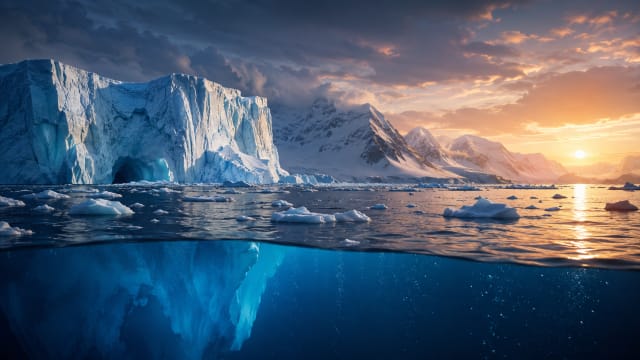
At the top of the world, the ice used to behave like memory. It lingered. It endured winters, empires, extinctions. Ancient air slept inside it in tiny blue chambers, preserving the breath of mammoths and volcanic centuries. Today, that memory leaks into the sea. A glacier cracks somewhere in Greenland with the sound of artillery, and the noise is not metaphorical. Ice really does explode when it dies. We imagine climate change as a gradual warming, a polite rise in temperature measured in decimals. But the melting of the polar caps is less like a fever and more like the loosening of Earth’s architecture. Something foundational is shifting beneath modern life, even if supermarket shelves and city traffic continue to pretend otherwise.
The poles are not remote decorations at the edges of the atlas. They are the planet’s cooling system. White ice reflects sunlight back into space, regulating temperature through a simple physical truth called albedo. Remove the ice and the darker ocean absorbs more heat, which melts more ice, which absorbs more heat still. A feedback loop begins to spin like a flywheel. The Victorian imagination pictured nature as stable and balanced, a great clockwork held together by divine precision. Yet climate systems behave less like clocks and more like avalanches. They remain still for decades, then suddenly move all at once. Scientists now warn that parts of Greenland and West Antarctica may approach irreversible tipping points within this century, thresholds after which recovery becomes nearly impossible on human timescales.
Some argue that the planet has always changed. Ice ages came and went long before factories, airplanes, or SUVs. This is true, but it misses the scale and speed of the current transformation. Past climate shifts unfolded across millennia. The modern thaw unfolds across a human lifetime. A child born today may see Arctic summers nearly free of sea ice before middle age. The distinction matters because civilisation itself is built on climatic predictability. Ports, farms, cities, insurance systems, migration patterns, even political borders assume stable coastlines and seasons. The real danger of melting ice is not simply drowning land. It is drowning certainty. When weather patterns destabilise, food prices rise, migration accelerates, and governments begin managing emergencies instead of futures.
There is also something psychologically revealing about the poles. Most humans will never stand on Antarctic ice or watch a polar bear cross fractured water, yet the image unsettles us deeply. Perhaps the poles function as a kind of planetary subconscious. They are distant, cold, invisible to ordinary life, and therefore easy to ignore until they begin surfacing in dreams and disasters. Floods in Mumbai, fires in Canada, heatwaves in Europe, cyclones in the Indian Ocean: these feel local, but they are tied together by invisible atmospheric threads. The Earth is less a collection of nations than a single breathing system wearing many flags.
The old maps once marked dangerous regions with dragons. Our age marks them with melting coastlines and temperature graphs. Yet the strangest part of the crisis is not scientific ignorance. We understand the mechanics remarkably well. The deeper problem is temporal. Human beings evolved to fear the immediate wolf, not the statistical future. Ice melts slowly enough to feel unreal until suddenly a city floods, a harvest fails, or a season arrives out of order. The polar caps are vanishing not merely because carbon traps heat, but because modern civilisation mistakes delay for safety.
The greatest catastrophes often begin in silence. Perhaps that is the final lesson hidden in the ice.
Discussion · 2
Summary: The ice at the top of the world is melting due to climate change which is affecting the fundamental architecture of our planet. Some people argue that the planet has always changed hence undermining the scale of current scenario. Perhaps, the poles are distant, cold and invisible to ordinary life therefore easy to ignore. But we do understand the mechanics of the problem; it’s just that humans have evolved to fear the immediate wolf rather than the statistical future. TONE: Critical, analytical
Melting polar caps reveal how climate change destabilises Earth’s cooling system and threatens civilisation itself. The essay argues that rising temperatures endanger not only coastlines but also economic, political, and psychological stability. By linking distant ice loss to global disasters, it portrays humanity’s greatest weakness as mistaking delayed consequences for safety. \
Sign in to join the discussion.
More in Climate Change
The Cartography of Heat
How cities became climate systems. Inside the hidden science of urban heat, Local Climate Zones, and the future of sustainable cities.
When Whales Learn to Sing: An RC Inspired by IIM Indore
Whale songs reveal how isolation, imitation and migration can create, preserve and erase cultural differences within animal populations.
The Animal With a Thousand Plans
The honey badger is often portrayed as the animal kingdom's fearless rebel. Yet its greatest strength is neither aggression nor toughness.
Nature Does Not Speak. We Do.
How does language shape our understanding of nature? Discover why animal behaviour, evolutionary biology and human perception are deeply intertwined.