The Pasture Hardin Imagined and the Commons Ostrom Found
A famous parable says shared resources are doomed, yet villages in India and elsewhere have long proved otherwise, and the hardest cases are the ones nobody can see.
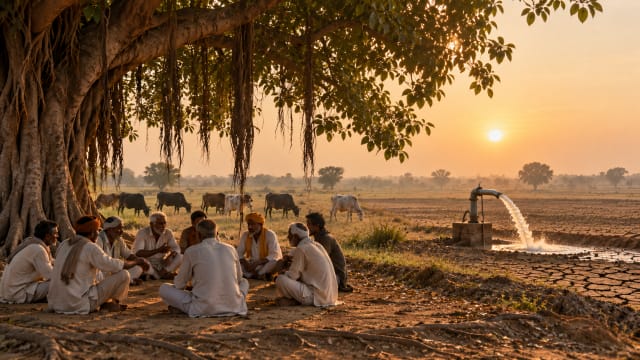
In December 1968 the biologist Garrett Hardin published an essay in the journal Science that gave economics and ecology one of their most quoted phrases. The tragedy of the commons described a pasture open to all, in which each herder gains the full benefit of adding one more animal while the cost of overgrazing is shared among everyone. Reason, Hardin argued, leads every herder to the same ruinous conclusion. Freedom in a commons, he wrote, brings ruin to all.
The parable travelled far beyond biology. It was used to justify the privatisation of grazing land, the state control of forests and fisheries, and, in Hardin's own hands, coercive limits on population. Its logic was seductive because it required no villains. Ordinary rational behaviour, multiplied, was enough to empty a pasture. For policy makers in newly independent states anxious about forests, water and land, it offered a tidy principle, namely that whatever belongs to everyone will be spoiled, so it should belong to someone.
Discussion
Sign in to join the discussion.
More in Ecology

The Cane Toad Programme and the Beetles It Missed
A species flourished in a new land, and some called that a success. The beetles it was brought to fight tell another story.

The Last Ash Tree: An RC Inspired by IIM Indore
A fungal disease is erasing Europe's most familiar tree. What ash dieback reveals about the limits of knowing and caring about the natural world.

The Building That Behaves Like an Ecosystem
Discover how ecological prototypes, living walls, and regenerative architecture could transform sustainable cities by turning buildings into ecosystems.

The Day Mountains Stopped Being Angry
How science transformed a living world of angry mountains and speaking rivers into a universe of objects, and what humanity lost in the process.