The Last Ash Tree: An RC Inspired by IIM Indore
A fungal disease is erasing Europe's most familiar tree. What ash dieback reveals about the limits of knowing and caring about the natural world.
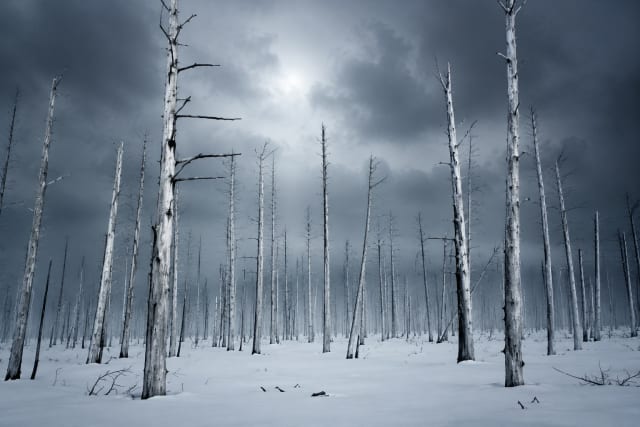
In the early 1990s, a forester in Poland noticed that ash trees were dying. The leaves curled and blackened. The crowns thinned. By the time researchers identified the culprit, a fungus called Hymenoscyphus fraxineus carried on fallen leaf litter, which had already reached Denmark, Sweden, the Baltic states. By the time Britain confirmed its first case in 2012, the disease had become a continent-wide emergency. Europe was losing its ash trees, and almost nobody had noticed.
This is not a story about ignorance. Europe's foresters knew the ash intimately. Fraxinus excelsior common ash had been catalogued, painted, coppiced, celebrated in Norse mythology as Yggdrasil, the world tree holding the cosmos together. The ash was not unknown. It was, in a specific way, too known: known as furniture, as tool handles, as the wood that bends without breaking. It was known for what it produced, not for what it was. And that distinction, it turns out, matters enormously when a species begins to disappear.
Ash dieback kills between 70 and 90 percent of affected trees. The mechanism is straightforward. The fungus overwinters in dead leaves, releases spores in summer, infects the tree through its leaves and then colonises the vascular tissue, cutting off water and nutrients. Young trees die within a few years. Older trees resist longer but rarely survive a decade of repeated infection. What makes the disease particularly difficult is that it spreads on wind-borne spores, travels faster than any conceivable quarantine, and has no reliable chemical treatment. The fungal pathogen arrived from Asia, where native ash species had evolved resistance over millennia. European ash had none.
The ash was not unknown. It was, in a specific way, too known: known as furniture, as tool handles, as the wood that bends without breaking.
The counterargument runs as follows. Species have always gone extinct. Ecosystems have always shifted. The ash may decline, but other trees will fill the canopy gaps. Birch and sycamore are already colonising the clearings. Ecologists call this succession, and they tend to regard it without the sentimentality that characterises public responses to individual species. The problem with this argument is that it mistakes a process for an outcome. Succession takes decades. In the interval, ash-dependent species including the ash bark beetle, the bullfinch that feeds on ash keys, and the lesser spotted woodpecker that nests in ash deadwood lose the specific conditions they require. What replaces ash is not equivalent to ash.
There is a deeper difficulty here, and it concerns the relationship between naming and preserving. Taxonomists have named roughly 1.5 million species. Estimates of total species on Earth range from 8 million to one trillion, depending on whether microbes are included. The species we have named are, broadly, the ones we have decided matter. They matter because they are large, or beautiful, or economically useful, or because they happen to exist in regions where scientists work. The ash qualified on several counts. It still died.
What ash dieback exposes is not a failure of knowledge but a failure of relationship. The tree was documented without being understood as a system. Its role in maintaining soil moisture, in providing a particular quality of dappled shade that certain ground flora require, in sustaining the specific decay ecology of veteran ash woodland these were known to specialists and invisible to everyone else. Conservation biology has a term for this: the shifting baseline syndrome, in which each generation accepts the depleted natural world it inherits as the normal one. The ash forests of 2050 will be the baseline for people born in 2040.
Researchers have identified ash trees with natural resistance to H. fraxineus. Roughly one in a hundred survives infection. Seed banks have been established. Breeding programmes are underway. If the disease does not mutate faster than the resistance can be selected for, there may be ash trees in European forests a century from now. They will be different trees, shaped by a catastrophe their predecessors could not survive. Whether that constitutes the same species, ecologically speaking, is a question the ash cannot answer and the scientists have not settled.
Discussion · 1
According to the passage, Foresters noticed that ash tree were dying with a fungal infection called-Hymenoscyphus fraxineus which had already reached almost everywhere in Europe. People had known this tree for what it produced not for what it was and that turns out it matters most when it begins to disappear. some said that these shift in ecosystem is natural, one species replace the other but the real problem is that it take decades to replace so it also harms the species which were dependent on the disappearing species. Taxonomist have named millions of species and there are estimate that millions are more to name but human only name species which are economically useful or visibly aesthetic, Ash tree dieback exposes is not a failure of knowing but failure of relationship. conservation biology has a term for this: the shifting baseline syndrome, in which each generation accepts the depleted natural world it inherits as the normal one.
Sign in to join the discussion.
More in Ecology
The Pasture Hardin Imagined and the Commons Ostrom Found
A famous parable says shared resources are doomed, yet villages in India and elsewhere have long proved otherwise, and the hardest cases are the ones nobody can see.
The Cane Toad Programme and the Beetles It Missed
A species flourished in a new land, and some called that a success. The beetles it was brought to fight tell another story.
The Building That Behaves Like an Ecosystem
Discover how ecological prototypes, living walls, and regenerative architecture could transform sustainable cities by turning buildings into ecosystems.
The Day Mountains Stopped Being Angry
How science transformed a living world of angry mountains and speaking rivers into a universe of objects, and what humanity lost in the process.