The Man in the Jar Who Claimed the World as His City
A philosopher said to have lived in a jar once called himself a citizen of the world. More than twenty three centuries later the phrase still cannot be pinned to a single meaning.
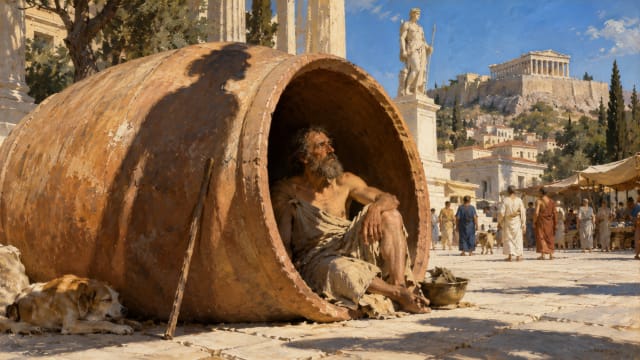
Asked where he came from, Diogenes of Sinope is reported to have answered that he was a citizen of the world. The word he is said to have used was kosmopolites, and the story comes from Diogenes Laertius, a biographer who wrote more than five centuries after the philosopher died in about 323 BCE. The anecdote is now the founding line of cosmopolitanism, the view that human beings belong to a single community wider than any city or state.
The tradition around him is theatrical. Diogenes is said to have been exiled from Sinope, to have lived in a large jar in Athens and to have asked Alexander the Great to stand out of his sunlight. Whether any of this happened is uncertain, but the stories agree on a character who refused the ordinary rewards of belonging.
The phrase is a joke before it is a doctrine. A polites was a member of a polis, a city with laws, assemblies and obligations, whereas the kosmos had none of these. To call oneself a citizen of the whole world was to claim a membership that carried no duties and could be revoked by no one. It was also an insult to neighbours who were proud of their own cities.
The phrase is a joke before it is a doctrine.
The Stoics took the joke seriously. Zeno of Citium, who studied with the Cynic Crates, built a philosophy in which all rational beings share a common law of reason. Centuries later the Stoic Hierocles pictured moral concern as a set of concentric circles, with the self at the centre, then family, neighbours, fellow citizens and finally all humanity, and urged that the outer circles be drawn steadily inward.
Whether Diogenes meant any of this is the difficulty. One reading treats his words as a refusal, a way of saying that no city had earned his loyalty. Another treats them as an invitation, a way of saying that decent life requires obligations to strangers that no city can supply. The first makes him a citizen of nowhere. The second makes him an early voice for the claim that every human being is a neighbour.
The evidence cannot settle the matter. A single line, preserved by a writer who never met him, has been asked to carry an entire ethics, and each age has heard in it what it needed. The question that remains is whether a phrase can mean everything its later admirers want and still have meant something different, and perhaps something smaller, to the man in the jar.
Discussion
Sign in to join the discussion.
More in Cosmopolitanism

The Phenomenology of Embarrassment
Embarrassment is not shame. It is not guilt. It is the moment the self discovers, with retroactive mortification, that it has been visible all along, and that visibility was never chosen.

Moral Luck
Two men drive home equally drunk. Only one kills a child. Philosophy calls the gap between them moral luck.

Why Krishna Is the Most Philosophically Dangerous Character in Indian Literature
Krishna lies, cheats and engineers deaths. The Mahabharata calls him the fullest embodiment of dharma. This is not a contradiction. It is the most demanding position in Indian moral philosophy.

What Kevin Carter Really Captured
A haunting reflection on Kevin Carter’s photograph, moral distance and the unsettling transformation of human suffering into spectacle.