Brahmaganita v1.0: A Philosophy of Patterned Existence
A philosophical exploration of Brahmaganita, where mathematics becomes a lens to uncover patterns, balance, and the hidden structure of reality.
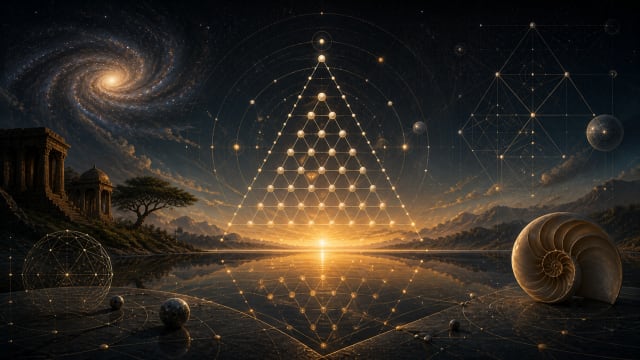
A number repeats itself until it becomes a square. A triangle of integers unfolds until it begins to resemble a universe. The ambition of Brahmaganita v1.0 lies in this transformation. It treats mathematics not as a toolbox but as a philosophy of patterned existence. It begins with a shift in definition. Mathematics is presented as the study of the behaviour of expressions, a connective fabric across domains rather than a set of isolated techniques. What seems like arithmetic at first glance slowly opens into a way of seeing, where calculation becomes perception and numbers begin to behave like ideas.
From this opening a clear thesis emerges. Reality becomes intelligible because it is structured through recurrence. The seven sutras ranging from the Base Square Principle to Brahma Darpan are not merely shortcuts for calculation. They attempt to extract stable patterns from apparent complexity. When a number gathers around a base or mool its deviations begin to follow predictable forms. When coefficients arrange themselves into the Brahma Tribhuj they encode expansion and growth within a single structure. In each case the suggestion remains consistent. Multiplicity resolves into pattern. The scattered becomes structured and the irregular begins to reveal an underlying rhythm.
From Method to Meaning
This position depends on a deeper premise. If distinct mathematical processes such as squaring expansion integration and symmetry can be reduced to recurring structures then those structures cannot be accidental. They must be foundational. The text moves steadily from method to meaning and from example to generalisation. What appears at first as technique begins to resemble ontology. The ALP constant reframes change as a ratio of the initial which suggests that transformation is always relational. The Root Procedure reverses the direction of inquiry and reconstructs causes from results. It implies that understanding lies not only in forward calculation but in recovering the structure behind outcomes. Even the idea of balance returns again and again as if equilibrium is not a property of equations alone but of existence itself.
What appears as calculation gradually reveals itself as a way of seeing.
The Objection of Invention
An objection presents itself. One may argue that these patterns belong to representation rather than reality. Mathematics in this view compresses the world into forms that the human mind prefers. The elegance of a triangle or a constant may reflect cognitive bias rather than truth. Another system might yield a different structure. No single pattern needs to claim universality. This skepticism is not trivial. It forces a reconsideration of whether mathematics discovers order or merely imposes it.
Yet the strength of this framework lies in convergence. Across the sutras unrelated problems tend to produce similar structures. Symmetry appears around points. Balance emerges between opposing terms. Accumulation proceeds through discrete steps. These recurrences are not imposed but observed. The same structural logic reappears in number theory algebra and geometry. If invention were the source one would expect divergence. Instead repetition becomes the dominant feature. The patterns do not scatter across domains but echo through them.
The Compression of Reality
This leads to a quiet inversion. Mathematics no longer functions only as a descriptive language. It begins to act as a compressive one. It does not simply map reality. It reduces it to its most stable forms. The sutras behave less like instructions and more like lenses through which complexity becomes order. Each idea compresses a wide range of phenomena into a single structural insight, suggesting that simplicity is not the absence of complexity but its most refined expression.
What follows is not a method but a stance. To engage with Brahmaganita is to treat every calculation as a trace of structure and every result as evidence of balance. The wager is simple yet demanding. Beneath the noise of numbers lies an economy of form. To perceive it is not to simplify the world but to encounter it with greater precision. In that recognition mathematics ceases to be an external discipline and becomes an internal orientation, a way of aligning thought with the hidden order of things.
Discussion · 1
The passage says math is more than solving sums. It helps us see patterns in things around us. Many problems follow similar rules and show order. Math connects ideas and makes complex things simple. It helps us understand the world better by showing hidden structure and balance in everything.
Sign in to join the discussion.
More in Indian & Eastern Philosophy

The Phenomenology of Embarrassment
Embarrassment is not shame. It is not guilt. It is the moment the self discovers, with retroactive mortification, that it has been visible all along, and that visibility was never chosen.

Moral Luck
Two men drive home equally drunk. Only one kills a child. Philosophy calls the gap between them moral luck.

Why Krishna Is the Most Philosophically Dangerous Character in Indian Literature
Krishna lies, cheats and engineers deaths. The Mahabharata calls him the fullest embodiment of dharma. This is not a contradiction. It is the most demanding position in Indian moral philosophy.

What Kevin Carter Really Captured
A haunting reflection on Kevin Carter’s photograph, moral distance and the unsettling transformation of human suffering into spectacle.