Why Humanity Invented the Afterlife
Why do humans believe in an afterlife? A philosophical essay on death, memory, religion and humanity’s refusal to accept oblivion.
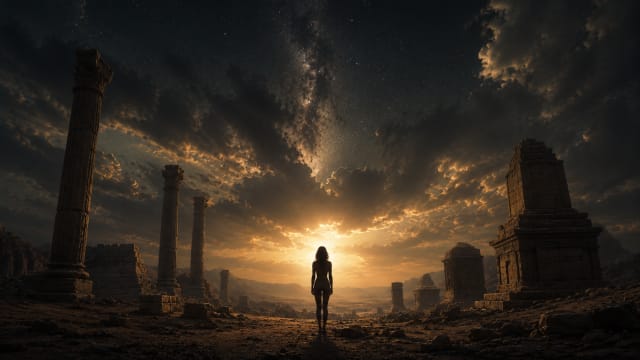
Death enters human life quietly at first. A child notices that adults lower their voices inside hospitals. Flowers begin appearing beside framed photographs. Someone who once occupied a chair at dinner no longer arrives. Then comes the bewildering contradiction adults repeat with complete sincerity. They say the dead are gone. Moments later they insist the dead are still with us.
Civilization begins inside that contradiction.
Every culture in history has invented some form of afterlife because the human mind struggles to accept its own disappearance. Ancient Egyptians filled tombs with bread, jewelry and servants because they imagined death as a continuation of earthly existence. Greeks pictured pale souls wandering through Hades. Christians imagined heaven and hell. Hindus envisioned rebirth through endless cycles. Vikings dreamed of Valhalla where warriors fought and feasted forever. Different languages, different rituals, different gods, yet all arriving at the same emotional conclusion. Human life cannot simply vanish.
The afterlife may reveal less about what happens after death and more about what it means to be human.
This universality is difficult to ignore. Human societies disagree about nearly everything. They fight wars over territory, morality and truth. Yet across continents and centuries, civilizations independently produced stories about life beyond death. The afterlife may therefore reveal less about what happens after death and more about what it means to be human.
Consciousness possesses a strange limitation. It can imagine darkness, silence and emptiness, but it cannot truly imagine its own nonexistence. A person trying to picture being dead still remains mentally present enough to imagine the scene. The mind cannot step outside itself to experience absence directly. Perhaps this is why extinction feels psychologically unnatural. We understand death intellectually while resisting it emotionally.
Some thinkers argue that religions created the afterlife mainly to regulate society. Heaven rewarded obedience while hell threatened punishment. Kings could control actions through law, but religion controlled thoughts through eternity. The idea proved extraordinarily effective. Fear of endless suffering and hope for eternal reward shaped moral behavior more powerfully than armies often could.
There is truth in this argument, yet it remains incomplete. The afterlife survived not merely because it controlled populations, but because it comforted grief. A mother lowering her child into the ground does not seek abstract philosophy. She seeks continuity. The promise that separation is temporary softens the brutality of loss. Religion became persuasive because it addressed an emotional wound logic alone could not heal.
Human beings alone seem unable to emotionally cooperate with nature’s law of endings.
Modern societies often claim to have outgrown these beliefs. Science explains consciousness through biology and reduces human beings to chemistry, neurons and electrical signals. Yet the emotional instinct behind the afterlife remains remarkably intact. Even people who reject religion speak of loved ones watching over them. They say the dead live on in spirit. Funeral speeches still describe people as being somewhere rather than nowhere.
Perhaps human beings never truly stopped believing in transcendence. They merely changed the language surrounding it.
The deeper irony is that the afterlife represents humanity’s rebellion against nature itself. The universe appears governed by impermanence. Stars collapse. Oceans dry. Species disappear. Entire civilizations sink into dust. Nature accepts endings without apology. Human beings alone seem unable to emotionally cooperate with that law.
So they resist.
They build pyramids against oblivion. They write scriptures against silence. They carve names into stone because memory feels like a small victory over decay. Every graveyard contains evidence of this resistance. The dead are not merely buried. They are described as beloved, remembered and eternal. Language itself becomes a defense against disappearance.
Perhaps this explains why discussions about the afterlife persist even within technological and scientific societies. Beneath every theological debate lies a simpler human fear. Consciousness feels too intimate, too vivid and too miraculous to simply dissolve into nothingness. Love especially appears incompatible with annihilation. Human beings can tolerate pain more easily than they can tolerate meaninglessness.
That may be the real foundation of the afterlife. Not arrogance. Not superstition. Not even religion.
Only the stubborn human refusal to believe that love, memory and consciousness can vanish completely into the dark.
Discussion · 1
Religion are created to give hope. This essay it explain with the idea of afterlife. Like it .. ✨
Sign in to join the discussion.
More in Philosophy of Religion
The Phenomenology of Embarrassment
Embarrassment is not shame. It is not guilt. It is the moment the self discovers, with retroactive mortification, that it has been visible all along, and that visibility was never chosen.
Moral Luck
Two men drive home equally drunk. Only one kills a child. Philosophy calls the gap between them moral luck.
Why Krishna Is the Most Philosophically Dangerous Character in Indian Literature
Krishna lies, cheats and engineers deaths. The Mahabharata calls him the fullest embodiment of dharma. This is not a contradiction. It is the most demanding position in Indian moral philosophy.

What Kevin Carter Really Captured
A haunting reflection on Kevin Carter’s photograph, moral distance and the unsettling transformation of human suffering into spectacle.