The Madman Who Spoke to the Wrong Audience
The most famous sentence in modern philosophy is usually heard as a victory cry, yet the parable that contains it is addressed to people who were not grieving at all.
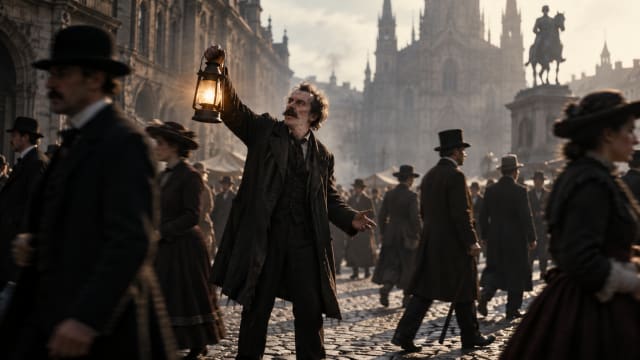
In 1882, in a book titled The Gay Science, Friedrich Nietzsche published a short parable about a man who lit a lantern in the bright morning, ran into a marketplace and cried out that he was looking for God. The crowd, made up largely of people who did not believe in God, laughed. One asked whether God had got lost, and another whether he had emigrated. The man stared at them and said that God was dead and that all of them, himself included, were the killers.
The line is now among the most quoted in philosophy, and it is nearly always read as a boast. It is taken for the triumphant announcement of an atheist who had won the argument. The text does not support this. The madman is not addressing believers, who might be shocked, but unbelievers, who are comfortable. His grief is aimed at their ease. They have abandoned the foundation of their moral and intellectual world and carry on with the day as though the floor beneath it were still there.
Nietzsche's worry was practical. If the idea of God had supported belief in truth, in a common morality and in the purpose of history, then its loss would not remove those things quietly but unsettle all of them. The madman asks what sponge could wipe away the whole horizon, and what festivals of atonement would be needed. Then comes the detail that is often dropped. He concludes that he has come too early, that the event is still on its way and has not yet reached human ears. The death had happened, but its meaning had not.
The death had happened, but its meaning had not.
Interpreters have disagreed about how far the madman speaks for Nietzsche. Some hold that the passage is a diagnosis and not a celebration, with Nietzsche urging readers to face the consequences. Others note that he writes elsewhere in the same book with something like exhilaration of open seas and a new dawn, so that both moods live side by side. The madman is, after all, a character, and Nietzsche gave him a lantern lit in daylight, an image that is as comic as it is solemn.
What remains is a question the passage refuses to answer. If the crowd could not hear the news because it did not yet understand what it had lost, it is not clear when, or whether, the hearing begins. A century and a half later the marketplace is still full, the lantern is still burning in the light, and nobody can say whether the laughter was ignorance or a form of wisdom.
Discussion
Sign in to join the discussion.
More in Thinkers & Theories

The Phenomenology of Embarrassment
Embarrassment is not shame. It is not guilt. It is the moment the self discovers, with retroactive mortification, that it has been visible all along, and that visibility was never chosen.
Moral Luck
Two men drive home equally drunk. Only one kills a child. Philosophy calls the gap between them moral luck.
Why Krishna Is the Most Philosophically Dangerous Character in Indian Literature
Krishna lies, cheats and engineers deaths. The Mahabharata calls him the fullest embodiment of dharma. This is not a contradiction. It is the most demanding position in Indian moral philosophy.

What Kevin Carter Really Captured
A haunting reflection on Kevin Carter’s photograph, moral distance and the unsettling transformation of human suffering into spectacle.