Why Death May Be Necessary for Life and Evolution
Explore why death may be essential for life through evolution, biology, cancer, aging and the hidden role mortality plays in sustaining nature.
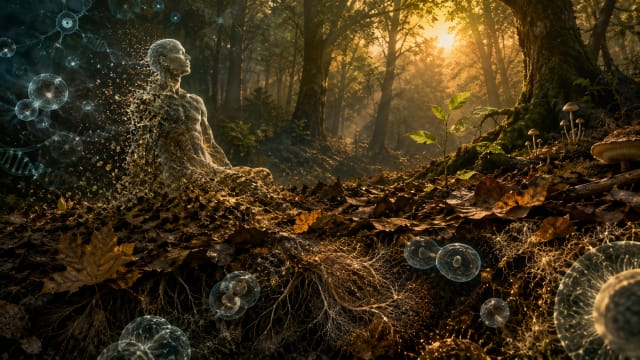
A salamander grows back a lost limb because thousands of its cells know when to disappear. Human fingers emerge inside the womb because the tissue between them quietly destroys itself. Even now, as you read this sentence, millions of your cells are dying with astonishing discipline. Life resembles less a monument carved in stone and more a city under constant renovation.
Biology calls this process programmed cell death. The idea sounds grim at first. Yet without it, complex life would collapse almost immediately.
Modern civilization treats death as nature’s greatest mistake. Medicine tries to delay it. Technology entrepreneurs dream of escaping it. Entire industries promise longer youth, younger skin and sharper minds. The assumption behind these efforts feels natural. If life is good, then endless life must be better. Biology tells a stranger story.
The Republic of Cells
A cell that refuses to die becomes dangerous. Cancer begins when cells stop obeying the body’s instructions. Instead of making room for the larger organism, they continue dividing without restraint. A tumour is not simply excessive growth. It is selfishness at the cellular level. The body survives only because most cells accept limits on their own existence.
The body survives only because most cells accept limits on their own existence.
This may be the hidden bargain behind all complex life. Multicellular organisms became possible only when individual cells surrendered absolute freedom. Your body is less a kingdom ruled by a central authority and more a fragile republic held together by cooperation. Each cell performs its role, reproduces when necessary and disappears when its work is complete. Death is not an interruption of the system. Death is part of the system itself.
Nature’s Method of Renewal
The same principle governs the natural world beyond the body. Forests renew themselves because old trees fall and allow sunlight to reach younger growth. Predators remove weak prey and prevent ecological collapse. Even extinction shapes the future of life. The disappearance of dinosaurs opened ecological space for mammals to flourish. Nature rarely preserves its creations forever. It abandons old experiments and improvises new ones.
Some thinkers argue that death is simply a technical flaw waiting to be solved. Aging appears, after all, to result from accumulated cellular damage. If science repairs enough damage, perhaps humans could live indefinitely. The dream of immortality no longer belongs entirely to mythology. Laboratories already explore gene editing, cellular rejuvenation and biological reprogramming.
Nature rarely preserves its creations forever. It abandons old experiments and improvises new ones.
Yet immortality carries problems that rarely appear in futuristic fantasies. Evolution depends on turnover. Species adapt because generations replace one another. A population of immortal organisms might eventually become trapped inside outdated biological designs. The environment changes while the genome stands still. What begins as survival could end as stagnation.
The Creative Function of Mortality
Human culture follows a similar pattern. Scientific revolutions often emerge when younger generations challenge inherited assumptions. Artistic movements grow by rejecting the tastes of the past. Political systems transform because older structures eventually loosen their grip on society. Civilizations renew themselves partly because no generation remains forever.
None of this makes death emotionally easier. Biology explains mechanisms but offers little comfort. The cell undergoing programmed death does not understand the organism it helps sustain. Humans may occupy a similar position inside systems larger than ourselves. We glimpse only fragments of the wider patterns that shape life across centuries and ecosystems.
Still, biology reveals an unexpected dignity inside mortality. Death may not merely be the price paid for living. It may be the force that keeps life adaptive, creative and open to change. A forest survives because leaves fall. A species survives because generations pass. A body survives because cells know when to disappear.
Perhaps life endures not because it defeats death, but because it has learned how to use it.
Discussion · 1
Life continues because old things make space for new things. Cells die so the body stays healthy, old trees fall so new plants can grow, and new generations bring fresh ideas. Death is not only an ending. It is also a natural process that helps life grow, change and survive.
Sign in to join the discussion.
More in Biology
Why Humans Have the Largest Penis Among All Primates: An RC Inspired by IIM Indore
Desmond Morris had a simple answer. Modern biology has a more complicated one. What changed between 1967 and now reveals as much about science as it does about human anatomy.
Are Humans the Most Sexual Organisms on the Planet? An RC Inspired by IIM Indore
Most animals mate seasonally. Humans do not. The question is not why humans have more sex. It is what human sexuality has become, and why it looks less like animal mating and more like language.

Polyamory
Is monogamy a biological destiny or a cultural invention? A philosophical exploration of polyamory, love, evolution, and the arithmetic of romance.
Would a Fourth Dimensional Being Be a God?
A thought experiment in higher dimensions asks whether what looks like a miracle might simply be reality viewed from a geometry we cannot perceive.