The Eclipse That Made Einstein Famous
Two telescopes disagreed during the 1919 eclipse, and one was set aside. A century of argument asks whether that choice rescued a great theory or flattered it.
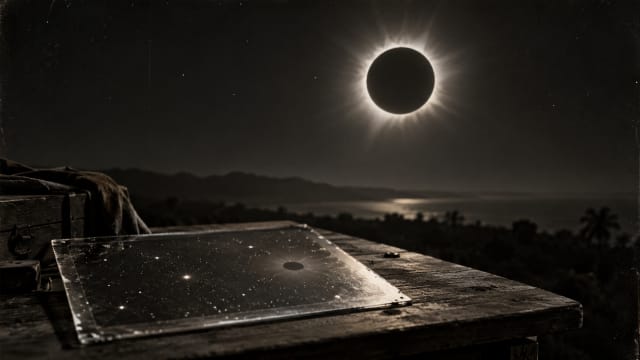
On 29 May 1919 the Moon covered the Sun for a few minutes, and two British expeditions waited in the shadow. Arthur Eddington, then director of the Cambridge Observatory, was on the island of Príncipe off western Africa, and the Astronomer Royal, Frank Dyson, had organised a second party at Sobral in Brazil. Their task was to photograph stars near the darkened Sun and see whether their light was bent. Newtonian gravity predicted a shift of about 0.87 arcseconds. Einstein's general relativity predicted about 1.75, nearly double the Newtonian figure.
The numbers that came back were messy. Cloud covered the sky at Príncipe, and Eddington could use only five stars, which gave 1.61. At Sobral one telescope gave 1.98, while another gave 0.93 and was set aside because its focus had slipped. In November 1919 the results were announced as a confirmation of Einstein, and Einstein became a public figure almost overnight.
A reasonable doubt followed. The result that fitted the theory was kept, and the one near Newton's figure was discarded. In 1980 the historians John Earman and Clark Glymour argued that Eddington had suppressed evidence that clashed with his hopes, and the charge of cooked data has travelled ever since. The suspicion has a respectable logic, and it deserves a fair hearing. A convenient exclusion costs something, because no one can later check what the excluded data would have said.
A convenient exclusion costs something, because no one can later check what the excluded data would have said.
Later work has not been kind to the charge. Daniel Kennefick's review of the letters between Eddington and Dyson suggests that Dyson, not Eddington, made the first call to exclude the 0.93 plates, and that Eddington rejected a proposal to average all three results, which would have given weight to the flawed telescope. In 1978 staff at the Royal Observatory in Greenwich measured the Sobral plates again with modern computer methods and obtained 1.55, with an uncertainty of 0.34, which supported the decision to discard the other set.
Yet an acquittal of Eddington does not make the evidence strong. The Príncipe plates have not survived to be measured again, and the Príncipe result rested on five stars seen through cloud, a small sample on which to rebuild physics. The physicist Clifford Will notes that the bending of light was not firmly confirmed until measurements of quasars in the 1960s. The honest account is that the 1919 result was probably right, and that it could not by itself have shown as much as it was said to show.
That raises a question about the way knowledge becomes public. In 1919 relativity gained a worldwide audience on a result built from a handful of stars at one site and a single usable telescope at the other. The theory was elegant, it belonged to Einstein, and the Newtonian alternative had been tested to its limits and found short. None of these is evidence from a telescope, yet all of them helped, and public acceptance ran ahead of the measurements.
If the data were this slender, the public confidence of 1919 needs another explanation. It is unclear whether the theory persuaded people because it had survived a test or because the test had been announced as its triumph before anyone could repeat it.
Discussion
Sign in to join the discussion.
More in History of Science
The Mathematician Who May Have Found the Highest Mountain and Was Never Named for It
The measurement of Mount Everest was a collective achievement of Indian computers, surveyors and explorers. Who deserves the credit, and what it means to discover a mountain that people already knew, are questions the numbers cannot settle.
Would a Fourth Dimensional Being Be a God?
A thought experiment in higher dimensions asks whether what looks like a miracle might simply be reality viewed from a geometry we cannot perceive.
Why Humans Have the Largest Penis Among All Primates: An RC Inspired by IIM Indore
Desmond Morris had a simple answer. Modern biology has a more complicated one. What changed between 1967 and now reveals as much about science as it does about human anatomy.

The Biggest Problem with Time Travel Is Not Time
What if the biggest obstacle to time travel isn't physics but identity? Before bending spacetime, we may need to answer who actually travels.