Before Evolution, Geometry Chose the Winners
Long before natural selection shaped life, the geometry of space had already determined which organisms could exist and which never could.
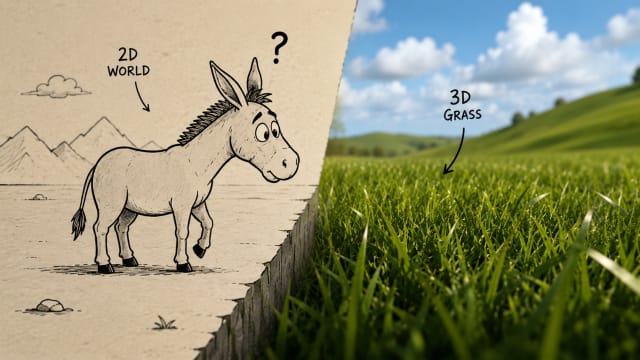
Every organism is an answer to a geometric question. Before evolution experiments with eyes, wings or brains, it inherits a stage whose dimensions determine which experiments are even conceivable. Natural selection is often described as the architect of life's complexity, yet it resembles a master renovator working within a building whose floor plan was drafted long before biology appeared. The deepest constraints on life may therefore arise not from genes or chemistry, but from geometry itself.
Stephen Hawking popularized this intuition through a deceptively simple thought experiment. Imagine a creature confined to a perfectly two-dimensional universe. It may crawl, reproduce and even evolve a mouth. Yet the moment it develops a digestive tract, a profound topological problem emerges. The tube connecting mouth and anus partitions the body into disconnected regions, leaving no possibility for nerves, blood vessels or other tissues to pass from one side to the other without intersecting the gut. The difficulty is not merely anatomical. It is mathematical. A two-dimensional world offers no "above" or "below" through which independent structures can bypass one another.
Evolution did not invent complexity. Geometry merely allowed it.
This insight rests upon ideas that long predate Hawking. The nineteenth-century mathematician Camille Jordan proved that every simple closed curve divides a plane into an interior and an exterior, a result now known as the Jordan Curve Theorem. What appears as an abstract proposition in topology quietly governs the architecture of any hypothetical flat organism. In two dimensions, separation is remarkably easy, while reconnection becomes remarkably difficult. Three-dimensional space dissolves this constraint because it introduces an additional degree of freedom. Blood vessels can loop around intestines, nerves can weave through muscle, and organs can occupy overlapping regions without violating one another's integrity.
The implication reaches well beyond biology. Hermann Weyl argued that geometry is the science of the possibilities of space rather than merely its measurements, and those possibilities determine the organization of every sufficiently complex system. Urban planners solve traffic congestion by constructing flyovers rather than endlessly widening roads. Electrical engineers stack conductive layers inside printed circuit boards because a single plane cannot accommodate billions of crossing connections. Neuroscientists such as Olaf Sporns describe the human brain as an intricate three-dimensional network whose efficiency depends upon preserving connectivity while minimizing wiring costs. Again and again, complexity emerges not by eliminating intersections but by escaping them.
One might object that Hawking's argument merely reflects terrestrial biology. After all, why should alien organisms require digestive tracts, circulatory systems or nervous systems? The objection deserves serious consideration, yet it ultimately strengthens the broader claim. Any conceivable life must still obey the topology of the universe it inhabits. Whether information travels through neurons, electromagnetic fields or mechanisms entirely unknown to us, its pathways must negotiate the constraints imposed by dimensionality. Geometry does not prescribe the chemistry of life, but it establishes the menu from which chemistry must choose.
The physicist and mathematician Roger Penrose has frequently argued that mathematics possesses an uncanny explanatory power because physical reality repeatedly conforms to abstract structures rather than merely approximating them. Hawking's flat creature illustrates precisely this relationship. Evolution does not negotiate with geometry. It submits to it. Long before DNA replicated itself, before Darwinian selection rewarded advantageous mutations, and before consciousness reflected upon its own existence, the universe had already distinguished between the impossible and the merely improbable.
This perspective subtly inverts one of biology's most celebrated narratives. We usually imagine evolution as the force that transformed simplicity into complexity through countless generations of experimentation. Yet evolution itself rests upon a prior generosity. The universe did not merely furnish matter and energy. It furnished enough dimensions for complexity to exist without collapsing under its own architecture. Before natural selection could choose the fittest organisms, geometry had already chosen the possible ones.
Discussion
Sign in to join the discussion.
More in Mathematics

Abraham Wald and the Missing Bullet Holes
The statistician Abraham Wald is credited with telling the military to armour the parts of its bombers that showed no bullet holes. The advice sounds backwards until a reader asks which planes were never seen.

The Number Europe Refused
Indian mathematicians were calculating with zero by the seventh century. Europe's bankers banned the numerals that carried it, and the word for it still holds the suspicion.
The Mathematician Who Said No - An RC Inspired by IIM Indore
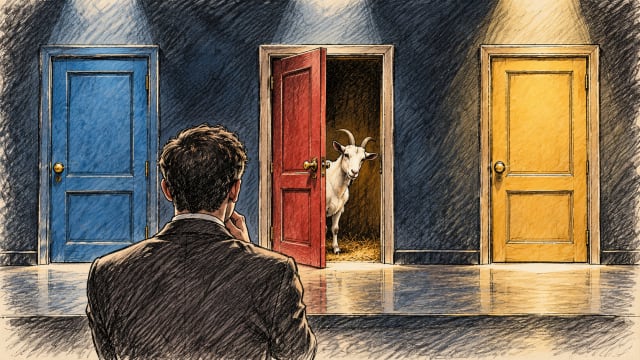
In 1990 a magazine columnist gave a correct answer to a game show puzzle and was buried in angry letters from people with doctorates. The mistake that followed reached the greatest mathematicians too.
Would a Fourth Dimensional Being Be a God?
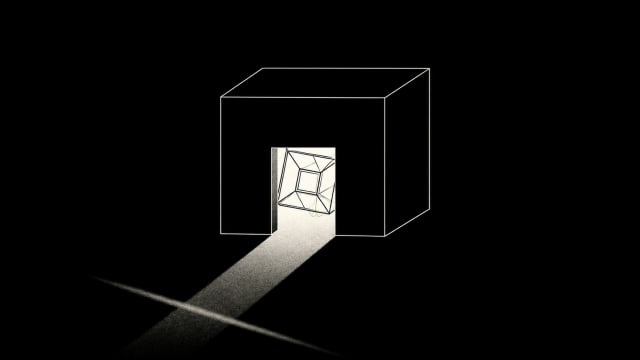
A thought experiment in higher dimensions asks whether what looks like a miracle might simply be reality viewed from a geometry we cannot perceive.