The Mathematician Who Said No - An RC Inspired by IIM Indore
In 1990 a magazine columnist gave a correct answer to a game show puzzle and was buried in angry letters from people with doctorates. The mistake that followed reached the greatest mathematicians too.
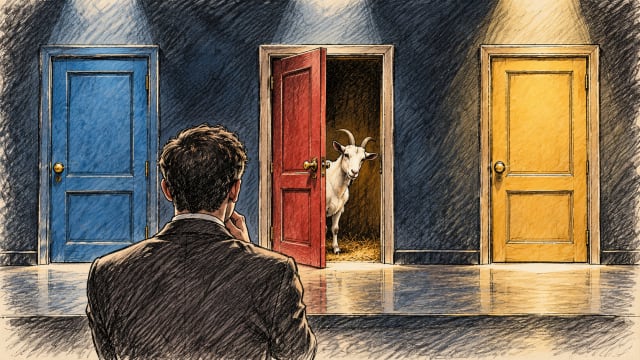
In September 1990 a columnist named Marilyn vos Savant answered a reader's question in Parade magazine about a game show. A contestant faces three doors, with a car behind one and goats behind the other two. He picks a door, and the host, who knows where the car is, opens another door to reveal a goat and offers him a chance to switch. She said he should switch, since switching wins two times in three. Thousands of letters arrived, many from readers with doctorates, and a large share of them told her she was wrong.
The objection feels obvious. Two doors remain and one hides the car, so the odds must be even. The intuition is not foolish, because it follows a rule that serves well in countless situations where equal options carry equal chances. Even Paul Erdős, among the most prolific mathematicians of the twentieth century, reportedly rejected the answer when it was put to him. Accounts say he accepted it only after seeing a computer simulation, and even then without being pleased.
The answer survives because the host's action is not random. The contestant's first pick has a one in three chance of being right, and nothing the host does can change that. The remaining two thirds sits on the other two doors. The host always removes a goat from that pair, and so he pushes the whole two thirds onto the one door left standing. Imagine a hundred doors and a host who opens ninety eight of them, and the pull toward switching becomes hard to resist.
The puzzle also hangs on a detail that most retellings skip. If the host opens a door at random and merely happens to reveal a goat, the odds really do fall to even. The same visible events carry different weight as evidence depending on what the host knew and intended, and no amount of staring at the two closed doors reveals which situation holds. Information lives in the process and not in the scene.
Information lives in the process and not in the scene.
Critics reply that the argument works only when the rules are stated precisely, and that the original wording left the host's behaviour implicit. The point is fair, and several mathematicians made it at the time. Yet the reply is only partial. If the answer turns on an unstated assumption about another mind, then the intuition was not merely careless. It was answering a different question from the one that was asked, and it did so without noticing the substitution.
The episode troubles for reasons beyond games. Trained minds failed, and failed with confidence, in a domain where they had every tool to succeed. A simulation settled the matter, but it settled it without satisfying the feeling that two doors must mean even odds, and that feeling has not gone away in those who accept the result. People who know the answer still report that it seems false. Which of the two minds, the one that calculates or the one that senses, deserves to be trusted as a witness is a question that the doors do not answer.
Discussion
Sign in to join the discussion.
More in Mathematics

Abraham Wald and the Missing Bullet Holes
The statistician Abraham Wald is credited with telling the military to armour the parts of its bombers that showed no bullet holes. The advice sounds backwards until a reader asks which planes were never seen.
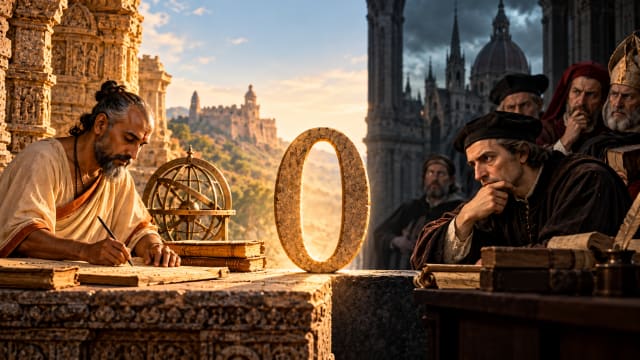
The Number Europe Refused
Indian mathematicians were calculating with zero by the seventh century. Europe's bankers banned the numerals that carried it, and the word for it still holds the suspicion.
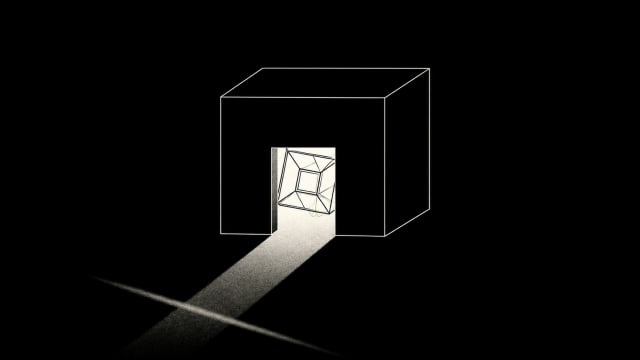
Would a Fourth Dimensional Being Be a God?
A thought experiment in higher dimensions asks whether what looks like a miracle might simply be reality viewed from a geometry we cannot perceive.
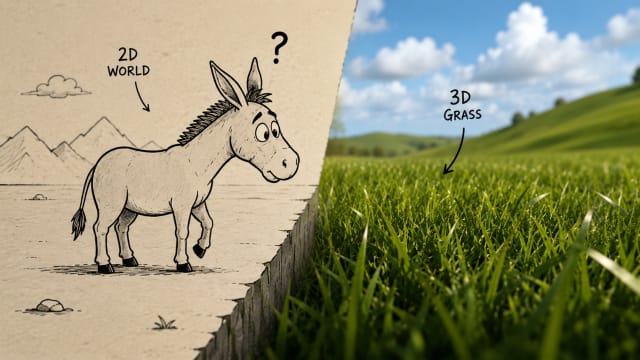
Before Evolution, Geometry Chose the Winners
Long before natural selection shaped life, the geometry of space had already determined which organisms could exist and which never could.