I Thought Everyone Saw the World This Way
A reflective essay on teenage love, mathematical thinking, and why I instinctively translated people, emotions, and the world into algebra.

When I was sixteen, I proposed to a girl with an algebraic equation. "If I am a function of x and you are a, then f(a) equals zero." It landed with all the emotional warmth of a failed proof by contradiction. She stared at me with an expression that oscillated somewhere between anthropological curiosity and mild concern. I, meanwhile, was quietly congratulating myself for having unified romance and algebra into a single elegant statement.
In retrospect, she was probably wondering whether I required psychiatric intervention more urgently than companionship. For years I blamed the rejection on her inadequate appreciation of mathematics. Only later did I entertain the more parsimonious hypothesis that most people do not regard functional notation as an acceptable substitute for flirting. The episode has since become family folklore, but it also revealed something far stranger than ordinary teenage awkwardness. I genuinely believed equations were a perfectly natural way to communicate affection. I was not performing mathematics. I was thinking in it.
That proposal was merely the most conspicuous symptom of a much older cognitive habit. Geometry had already colonised my perception. Staircases decomposed into right triangles before they became staircases. Ceiling fans announced rotational symmetry before they became appliances. Window grills insisted on becoming coordinate systems despite the architect's complete indifference to analytic geometry. Cracks on classroom walls resembled imperfect tessellations waiting for completion. Algebra proved even more invasive. Friendships became functions whose outputs depended on trust. Arguments resembled underdetermined systems with inconveniently missing variables. Success looked suspiciously like an optimisation problem constrained by time.
Whenever something confused me, I was less interested in what had happened than in the hidden relationship that generated it. Reality appeared to possess an invisible mathematical substructure and I regarded it as my civic duty to reverse engineer it.
I was not trying to mathematise the world. My perceptual machinery had apparently reached that conclusion long before I became aware of it.
For the longest time I assumed everyone inhabited this peculiar epistemic landscape. I imagined my classmates mentally factorised conversations and diagonalised classrooms with the same effortless regularity that they tied their shoelaces. Discovering otherwise was an ontological shock. Most people remembered school through friendships, cricket matches or embarrassing report cards. I remembered it through Euclidean constructions and symbolic manipulation.
Modern neuroscience offers an intriguing possibility. The brain does not function as a passive recording device. It continuously compresses overwhelming sensory information into economical predictive models. Every mind performs this compression differently. Some privilege stories. Others privilege music, colours or faces. Mine appeared to privilege invariants, symmetry and abstraction. Mathematics was never confined to textbooks because it had already become the grammar through which I organised experience.
People often ask when I fell in love with mathematics as though there must have been a memorable teacher, a miraculous classroom revelation or an inspirational Olympiad medal. I never know how to answer because the question presupposes a beginning. Falling in love implies an earlier state of indifference, and I cannot remember such a state. I remember only believing that equations could express affection as naturally as poetry and wondering why everyone else seemed linguistically underprepared. Perhaps talent is less about acquiring an extraordinary ability than about refusing to abandon an unusual childhood way of seeing. Education did not teach me mathematics. It merely informed me that the strange language I had been speaking all along already possessed axioms, notation and a remarkably large community of equally peculiar people.
Discussion · 6
The author naturally viewed everything through mathematics, from relationships to everyday objects, because that was how his mind understood the world. The passage concludes that talent is less about learning something new and more about preserving a unique way of seeing the world that existed since childhood.-10
Exactly! The distinction I wanted to explore was between learning a discipline and discovering that it has always been your way of making sense of the world. Mathematics gave structure and notation to an instinct that preceded formal education. Thank you for capturing the central idea so succinctly!
Since consciousness, the author could detect patterns and hidden relationships in day to day life and everyday objects and always considered that everyone perceived in the same way. Through education, he learnt his way of thinking also had notations, and languages for the same things and other people who also viewed the world the same way. So he thought that everyone in the world actually perceived it the same way. But using his personal anecdote of a proposal when he realised that this wasnt the case, he was naturally quite shocked and baffled at the linguistic unpreparedness of the other people.
You've understood the broad idea, though I must confess that "linguistic unpreparedness" is a rather magnificent way of describing my teenage inability to flirt. The realisation wasn't merely that other people lacked the vocabulary of mathematics, but that they might not perceive the world through mathematics at all. Thank you for reading so thoughtfully!
I would like to ask only one question: is the story true, Mr. ALP? Because it better be true, for the questions are a total disaster here, only 1 correct of 4 😭.
Unfortunately, yes. The girl, the equation, and the catastrophic failure of my romantic methodology were all real. The questions, however, are a separate mathematical problem. 😭
Sign in to join the discussion.
More in Mathematics

Abraham Wald and the Missing Bullet Holes
The statistician Abraham Wald is credited with telling the military to armour the parts of its bombers that showed no bullet holes. The advice sounds backwards until a reader asks which planes were never seen.

The Number Europe Refused
Indian mathematicians were calculating with zero by the seventh century. Europe's bankers banned the numerals that carried it, and the word for it still holds the suspicion.
The Mathematician Who Said No - An RC Inspired by IIM Indore
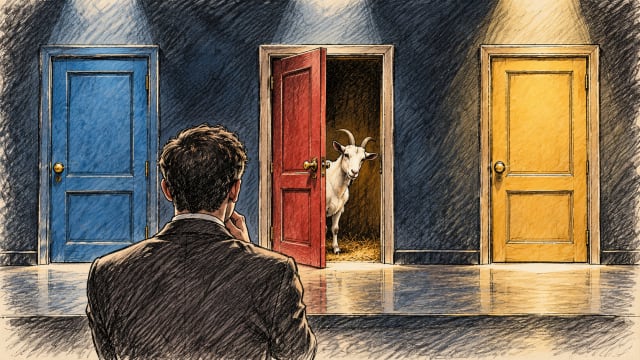
In 1990 a magazine columnist gave a correct answer to a game show puzzle and was buried in angry letters from people with doctorates. The mistake that followed reached the greatest mathematicians too.
Would a Fourth Dimensional Being Be a God?
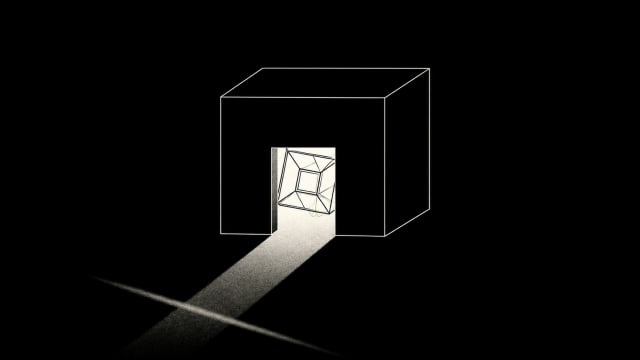
A thought experiment in higher dimensions asks whether what looks like a miracle might simply be reality viewed from a geometry we cannot perceive.