The Canals of Mars That Began as a Translation
A single Italian word, rendered one way in English, helped persuade a generation that Mars was crossed by the works of engineers.

In 1877 Mars came unusually close to the Earth, and the Italian astronomer Giovanni Schiaparelli turned the telescope of the Milan observatory towards it. He drew faint straight lines across the reddish surface and named them canali, an Italian word that can mean channels or grooves as readily as canals. English reports rendered the word as canals, and a single translation choice carried an implication Schiaparelli had not stated. A channel can be natural. A canal is dug.
The implication found a champion in Percival Lowell, a wealthy Bostonian who founded an observatory at Flagstaff, Arizona, in 1894 largely to study the planet. In books such as Mars and Its Canals, published in 1906, Lowell argued that the lines were irrigation works built by intelligent beings to carry meltwater from the polar caps across a drying world. His drawings were detailed and his prose was confident, and a public already fascinated by the idea of neighbours in space listened.
The scientific community was less convinced. The naturalist Alfred Russel Wallace published a book in 1907 arguing that Mars was too cold and too dry to support complex life. Many astronomers with larger telescopes could not see the lines at all. A common explanation, still widely accepted, is that the eye tends to join faint, scattered markings into continuous lines, so the canals were products of observation rather than of engineering. Schiaparelli himself is reported to have been cautious about calling the features artificial.
English reports rendered the word as canals, and a single translation choice carried an implication Schiaparelli had not stated.
The matter was settled by machines in 1965, when the American spacecraft Mariner 4 flew past Mars and sent back pictures of a cratered surface under a thin atmosphere, with no sign of life. No canal appeared. The episode remains a favourite warning in science, though it can be told in two ways. One version blames a mistranslation. The other blames the human appetite for pattern, which would have found its canals in any language.
Discussion
Sign in to join the discussion.
More in Space & Astronomy

The Signal That Wrote Its Own Exclamation
For seventy two seconds in 1977 a telescope heard something that has never come back. An astronomer's one word reaction gave it a name.

The Wall That Astronauts Could Not Find
For generations schoolchildren learned that the Great Wall of China can be seen from space. The first Chinese astronaut returned with a different report.
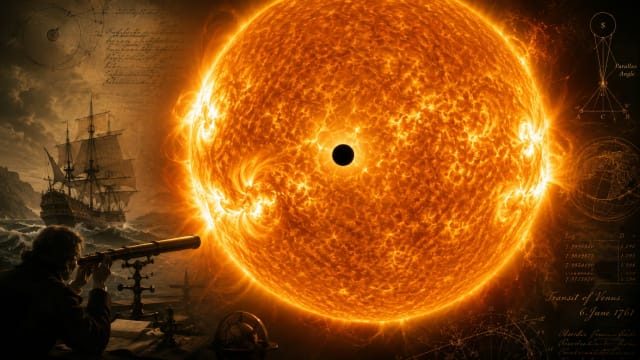
Chasing Shadows
A tiny shadow sent astronomers across oceans, empires into competition and science into a new age. The transit of Venus reveals the power of curiosity.

The Backup Planet Paradox
Is Mars colonization humanity's ultimate insurance policy, or a costly distraction from Earth's problems? Explore the backup planet paradox.