Chasing Shadows
A tiny shadow sent astronomers across oceans, empires into competition and science into a new age. The transit of Venus reveals the power of curiosity.
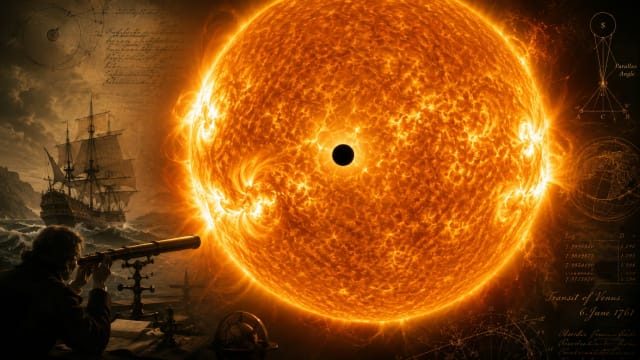
On 5 June 2012, millions pointed telescopes at the Sun to watch what looked, at first glance, like a flaw. A tiny black dot drifted slowly across its brilliant face. To most observers, it was underwhelming. To astronomers, it was one of the rarest spectacles in nature. The next transit of Venus would not occur until 2117. It is difficult to imagine a less dramatic event. No eclipse darkened the sky. No comet blazed overhead. There was only a planet, silently crossing the Sun.
Yet this fleeting shadow once inspired one of the greatest scientific enterprises in history.
By the eighteenth century, astronomers understood the architecture of the Solar System but not its scale. Johannes Kepler had revealed how the planets moved, but nobody knew the actual distance between Earth and the Sun. Humanity possessed the map but not the ruler.
The solution lay in the transit of Venus. Edmond Halley realised that observers stationed across the globe could measure tiny differences in the planet's path across the Sun and use parallax to calculate the astronomical unit. The mathematics was elegant. The logistics were extraordinary.
Governments financed expeditions to remote corners of the world. James Cook sailed to Tahiti to observe the transit. French astronomer Guillaume Le Gentil spent years travelling, only to miss one transit because his ship could not provide a stable observation and another because clouds obscured the Sun. He returned home after eleven years to discover he had been declared legally dead.
All this for a black dot that would disappear within hours.
The obsession seems almost irrational. Why would civilizations spend fortunes, risk lives and cross oceans to answer a question with no obvious practical value? The immediate answer is that the observations transformed the Solar System from a beautifully proportioned diagram into a measurable reality. For the first time, astronomers could assign real distances to the planets. The universe suddenly acquired scale. But that only explains what the transit achieved, not why so many believed the pursuit itself was worthwhile. The criticism is timeless. Why invest scarce resources in distant planets when societies face poverty, disease and war? Fundamental science often appears to be an expensive luxury.
History suggests otherwise.
Faraday's experiments with electricity seemed useless before they powered modern civilization. Einstein's theories of space and time became essential to GPS. Quantum mechanics evolved from abstract speculation into the foundation of computers, lasers and medical imaging. Again and again, humanity has profited from questions that once appeared to have no practical purpose. Perhaps this is because usefulness is a poor measure of importance. Practical questions improve the world we already inhabit. Curious questions enlarge the world we are capable of imagining.
The transit of Venus belongs to that second tradition.
Its greatest legacy was not a number measured in kilometres but a demonstration that knowledge itself could justify extraordinary effort. Rival empires, competing for land and influence, found themselves participating in the same scientific enterprise. Sailors, mathematicians, craftsmen and monarchs all contributed to answering a question that promised neither wealth nor military advantage. They acted as though understanding the universe possessed value in its own right. Today, spacecraft and radar have rendered the transit scientifically unnecessary. The tiny shadow no longer determines the scale of the Solar System. It survives instead as a reminder of an older scientific spirit, one willing to wait generations for an event lasting only a few hours.
Before invention comes curiosity. Before curiosity comes wonder.
We often say necessity is the mother of invention. The transit of Venus suggests a different lineage. Every civilization leaves monuments to its power in roads, palaces and machines. Far less visible are the monuments to its curiosity: observatories on distant islands, impossible calculations and perilous voyages launched in pursuit of a shadow. That tiny black dot never changed the Sun.
It changed the way humanity measured the heavens, and perhaps more importantly, the way it measured itself.
Discussion · 1
hmm it looked on surface that it was cosmos related article instead it was a philosophical one questions were also very nice they were not easy . these type of essays are much needed in prep
Sign in to join the discussion.
More in Space & Astronomy
What Dark Matter Tells Us About Scientific Knowledge: An RC Inspired by IIM Indore
Dark matter has never been directly observed. We are nonetheless highly confident it exists. The gap between these two facts reveals something important about how science actually works.
The Backup Planet Paradox
Is Mars colonization humanity's ultimate insurance policy, or a costly distraction from Earth's problems? Explore the backup planet paradox.
What If the Earth Stops Spinning?
What would happen if the Earth stopped spinning? Explore the science, climate chaos, and hidden forces that make life on our planet possible.
Gravity Is the Story of Love
As physicists explore the Big Rip, a deeper question emerges. Is gravity merely a force, or the universe's oldest form of connection?