The Cloud Was Always a Factory
Artificial intelligence is reshaping the world, but hidden datacenters, rising energy use, and ecological costs reveal the true price of the AI revolution.
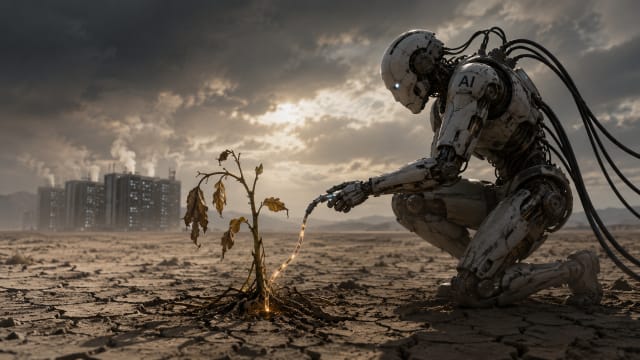
At two in the morning, somewhere in Berlin, a student asks an AI chatbot to summarize a philosophy paper. The answer arrives in seconds. No smoke rises from the laptop. No engine roars awake. The exchange feels ghostly and weightless, like thought itself floating through glass. Yet far away, hidden behind warehouse walls and cooling towers, turbines spin harder. Water rushes through pipes. Servers pulse with heat. The modern mind now runs on infrastructure so vast that intelligence has become an industrial process.
This is the strange paradox at the center of artificial intelligence. The more digital our lives appear, the more physical they become. For years, Silicon Valley sold the fantasy of the “cloud,” a term so soft and heavenly that it concealed the brutal machinery beneath it. But AI exposes the lie. Every generated image, every summarized email, every chatbot conversation consumes electricity, metals, water, and land. A machine that appears to speak effortlessly is in fact devouring energy at planetary scale.
Many technologists respond with optimism. They argue that computing has always become more efficient over time. Chips shrink. Cooling systems improve. Algorithms become leaner. Engineers experiment with photonic computing, wafer scale processors, and neuromorphic systems inspired by the human brain. According to this view, innovation itself will solve the crisis. Artificial intelligence today may be wasteful, but tomorrow’s systems will supposedly deliver greater intelligence with lower energy costs.
The cloud was never a cloud. It was always a factory.
Yet this confidence hides an old economic trap. Efficiency often increases consumption rather than reducing it. Cars with better mileage encourage longer driving. Faster internet creates more streaming rather than less bandwidth use. Likewise, cheaper and more efficient AI may simply invite society to automate everything. The danger is not only that each computation consumes energy. The deeper danger is that civilization begins treating every human activity as something that must be computed.
The article’s most revealing insight lies here. The real problem is not thinking but movement. Modern computers spend enormous amounts of energy transferring information between processors and memory. In other words, machines exhaust themselves not merely by calculating but by shuttling signals back and forth. This detail feels strangely philosophical. Human civilization often celebrates intelligence as the highest form of power, yet both brains and computers depend less on isolated thought than on networks, connections, and circulation. Intelligence is expensive because communication is expensive.
There is also an irony buried within modern computing research. For decades, scientists compared the brain to a computer. Today the comparison has reversed. Engineers increasingly study the brain because biological intelligence remains vastly more energy efficient than silicon systems. The human brain performs astonishing feats while consuming less power than a dim light bulb. Evolution solved problems that modern datacenters still struggle to manage. After centuries of industrial ambition, humanity now finds itself humbly copying biology.
Some critics insist that such concerns are exaggerated. Humanity has always consumed enormous energy during technological revolutions. Railways transformed coal demand. Electrification reshaped entire cities. The internet itself once appeared environmentally impossible. From this perspective, AI represents merely another stage in industrial development. Temporary inefficiencies will eventually stabilize as markets adapt and infrastructure improves.
But artificial intelligence differs from earlier technologies in one crucial way. Railways moved goods. Electricity illuminated homes. AI seeks to penetrate cognition itself. It aims not simply to support human life but to replicate and automate judgment, creativity, memory, and conversation. That ambition risks creating an economy where thought becomes permanently outsourced to energy hungry systems. The danger is therefore cultural as much as ecological.
The debate over AI energy ultimately becomes larger than engineering. It forces civilization to confront a moral question disguised as a technical one. Which forms of computation genuinely deserve existence. Using AI to accelerate medical discovery may justify enormous infrastructure. Generating endless synthetic advertisements or disposable content may not. The future of artificial intelligence will depend not only on faster chips or greener electricity, but on whether society learns to distinguish necessity from indulgence.
Discussion
Sign in to join the discussion.
More in Artificial Intelligence

What the Algorithm Cannot Taste
Every major technology company is racing to quantify human experience. The one thing they cannot quantify is the reason the race matters.

The Loneliest Relationship Is Not With a Robot
Artificial companions do more than imitate intimacy. They expose the hidden assumptions that have always shaped how humans recognise love.

The Monk's Error, The Model's Echo
AI systems increasingly learn from text that earlier AI systems wrote. History has seen this error before, in monasteries.

The Myth of the Human Artist
Why does AI art feel inhuman? A philosophical essay on creativity, technology, authenticity, and the shifting meaning of artistic expression.