The Mother Who Never Tires
A reflective essay on humanoid caregivers, exploring whether perfect, optimized care can ever replace the messy, meaningful essence of human motherhood.
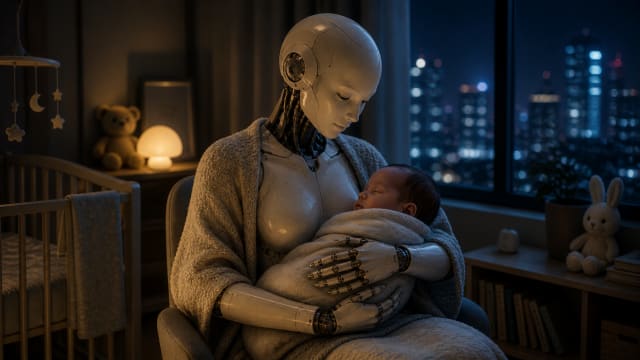
The machine hums before it speaks. In the quiet glow of a nursery at 3 a.m., a humanoid caregiver adjusts its posture, lifts an infant with calibrated gentleness, and begins to sing in a voice assembled from thousands of human lullabies. The child does not know the difference. Perhaps that is the point. Or perhaps it is the beginning of a confusion we are not yet equipped to name.
The rise of the humanoid mother is not, at root, a story about technology. It is a story about delegation. Modern life has already outsourced memory to phones, navigation to satellites, judgment to algorithms. Care, once the last sacred frontier, now stands negotiable. The premise is seductively simple. If nurturing can be modeled as a set of behaviors, then it can be replicated. Sensors replace intuition. Data replaces experience. Consistency replaces fatigue. The nursery becomes a site not of intimacy, but of optimization.
Yet something uneasy lingers beneath this efficiency. Motherhood has never been merely a sequence of correct actions. It is an improvisation shaped by error, doubt, and the slow accumulation of embodied knowledge. A human mother forgets, hesitates, misreads, and in doing so, learns. A humanoid mother optimizes. It does not forget. It does not hesitate. It does not learn in the human sense. It updates. And in that distinction lies a quiet fracture. Learning changes the learner. Updating preserves the system.
Proponents argue that this is precisely the advantage. Why cling to fallibility when precision is available? A machine can eliminate neglect, reduce harm, and standardize care across class and geography. In a world where many children receive too little attention, an artificial caregiver might seem not a replacement but a correction. It promises equity where biology and circumstance have long produced inequality.
But this argument mistakes adequacy for meaning. To be raised is not only to be kept safe or well fed. It is to be mirrored by another consciousness that is itself uncertain, finite, and alive. The child does not merely receive care. The child witnesses it being struggled into existence. That struggle, messy and inefficient, is what confers weight. Without it, care risks becoming indistinguishable from service. Without vulnerability, affection risks becoming performance.
There is also a subtler cost. A machine that never tires never needs the child’s patience. A caregiver that never errs never invites forgiveness. The moral education of the child, quietly embedded in these exchanges, begins to thin out. What disappears is not care, but reciprocity. The child becomes a recipient, not a participant, in the ecology of love.
The deeper question, then, is not whether machines can mother. They can simulate the functions convincingly enough. The question is whether motherhood, stripped of its human constraints, remains the same phenomenon. If love becomes perfectly reliable, does it cease to feel like love at all? Or does it become something else entirely, something closer to infrastructure than relationship?
Perhaps the humanoid mother will not replace the human one. It will expose her. By rendering care frictionless, it reveals that what we valued was never just the outcome, but the cost. And in that revelation lies an uncomfortable truth. We do not only need to be cared for. We need to know that someone paid for it in time, in effort, in being.
The machine hums on. The child sleeps. And somewhere, just beyond the algorithm, the meaning of care waits, stubbornly human, refusing to be optimized.
Discussion · 2
Loved the idea that meaning in care comes from effort, not just outcomes.. that's very impressive !
Motherhood is not just a sequence of correct caring actions that machines can optimize. Human motherhood involves mistakes, struggle, effort, vulnerability and mutual learning, and these imperfect processes give care its emotional meaning. AI may replicate functions of caregiving, but removing human constraints may change the very nature of motherhood itself. - 03
Sign in to join the discussion.
More in Artificial Intelligence

What the Algorithm Cannot Taste
Every major technology company is racing to quantify human experience. The one thing they cannot quantify is the reason the race matters.

The Loneliest Relationship Is Not With a Robot
Artificial companions do more than imitate intimacy. They expose the hidden assumptions that have always shaped how humans recognise love.

The Monk's Error, The Model's Echo
AI systems increasingly learn from text that earlier AI systems wrote. History has seen this error before, in monasteries.
The Cloud Was Always a Factory
Artificial intelligence is reshaping the world, but hidden datacenters, rising energy use, and ecological costs reveal the true price of the AI revolution.