The Prize Gandhi Never Won
The Norwegian Nobel Committee considered Gandhi five times and never honoured him. Its reasons were serious, and they may say more about the meaning of peace than about the man.
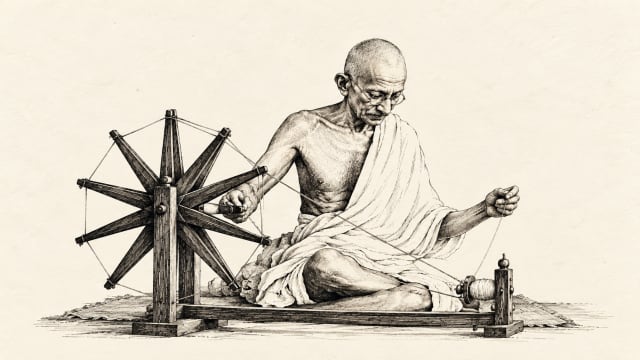
The Norwegian Nobel Committee considered Mohandas Gandhi for its Peace Prize five times between 1937 and 1948 and never awarded it to him. When he was shot in January 1948, his name was still before the committee. Later that year it announced that no prize would be given, and its explanation pointed to the absence of a suitable living candidate. The century's best known apostle of peace never held the world's best known prize for peace, and the blank year that followed his death has been argued over ever since.
The committee's reasons were not frivolous. Its adviser in 1937 admired Gandhi's sincerity yet doubted that a leader so devoted to one nation's cause, and so given to sudden reversals, belonged among the laureates of peace. The doubt had some basis in events. In 1922 Gandhi halted a nationwide campaign after a mob killed policemen at Chauri Chaura, an act that his followers read as discipline and his critics as caprice. A movement that could be switched off by one man's conscience looked to outsiders less like a movement than a mood.
Later nominations met a different obstacle. By 1947 India had been partitioned, and a committee that prizes neutrality faced a candidate who stood at the centre of the greatest dispute of the age. While communal killing spread across the subcontinent, Gandhi walked through the villages of Noakhali and fasted in Calcutta, and the violence in that city subsided. These were acts of peacemaking by any ordinary measure. Yet they were also the acts of a participant, undertaken by a man who belonged to one of the sides and who never pretended otherwise.
A deeper difficulty lay in the method itself. Gandhi's satyagraha did not avoid confrontation. It courted arrest, broke laws on purpose and made the injustices of rulers impossible to ignore. A prize designed to honour the end of conflict is awkward with a man whose method required conflict to be made visible. Reconciliation, in his view, could only follow a truth that the oppressor had first been forced to see, and the committee was looking for reconciliation while he was producing disturbance.
A prize designed to honour the end of conflict is awkward with a man whose method required conflict to be made visible.
Defenders of the committee can add that prizes reward outcomes and that Gandhi's outcomes were mixed, since independence was won and a subcontinent was torn in two. The reply is only partial. In 2006 the committee's own secretary called the omission the greatest in its history, and the decision to leave 1948 empty suggests that members felt something similar at the time. A body that would rather award nothing than award someone else has implicitly conceded that the first name was the right one.
The episode leaves a strange asymmetry. Most laureates are remembered because the prize was given to them. Gandhi is remembered partly because it was not, and the absence now draws more attention than many presentations ever have. A prize meant to name who deserves honour ended by marking someone it could not classify. Whether that failure belongs to the man, whose purposes outran every category, or to the category, which has never decided whether peace means calm or justice, is a question that the committee's blank year only restates.
Discussion
Sign in to join the discussion.
More in Indian History
What Did 1947 Actually Free Us From?
India's Independence ended colonial rule in 1947, but did it make Indians truly free? An essay on sovereignty, inequality and the unfinished meaning of freedom.
The Silence Around Draupadi
A powerful reflection on Draupadi’s humiliation, memory, rage, and moral clarity in the Mahabharata through a modern philosophical lens.

The Golden Sparrow: A Diagnostic of Indian History
Explore why India was called the Golden Sparrow and how wealth, culture and political fragmentation shaped Indian history for centuries.

When Knowledge Burned: The Fall of Nalanda
Nalanda’s burning erased more than books. It shattered a living tradition of knowledge, showing how fragile the continuity of thought truly is.