The Silence Around Draupadi
A powerful reflection on Draupadi’s humiliation, memory, rage, and moral clarity in the Mahabharata through a modern philosophical lens.
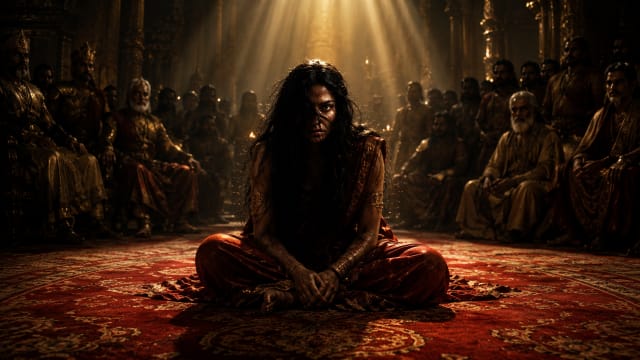
Imagine standing in a room where everyone knows a crime is happening, yet nobody moves. Not because they are weak, but because they are calculating. Their careers. Their loyalties. Their comfort. Draupadi stood in such a room long before modernity invented boardrooms and parliaments and social media spectatorship. A queen dragged by her hair into a royal court while the wisest men of her civilization stared at the floor like failed philosophers. The Mahabharata calls it an episode. History should call it a diagnostic.
People often romanticize Draupadi into abstraction. Divine beauty. Fiery woman. Catalyst of war. But the terrifying thing about Draupadi is not her grandeur. It is her clarity. She sees through the decorative language of power. Kingdoms speak of dharma until dharma becomes inconvenient. Husbands speak of honor until honor demands sacrifice. Elders speak of wisdom until wisdom risks status. Draupadi watches the entire moral architecture of Hastinapura collapse in real time, and perhaps the greater tragedy is that she is not surprised enough.
The popular reading says she was driven by revenge. I think she was driven by memory. Revenge wants destruction. Memory wants acknowledgement. Draupadi refuses to allow the court to move on from what it has become. Her famous question, whether Yudhishthira lost himself before losing her, is not merely emotional outrage. It is jurisprudence. Logic sharpened into a blade. In one sentence, she exposes the absurdity of a civilization that treats a woman as transferable property while calling itself righteous.
And then comes the discomfort modern readers still carry around her. Draupadi laughs at Duryodhana. Draupadi speaks sharply. Draupadi refuses softness. Society forgives arrogance in men because male ego is often mistaken for leadership. But when a woman possesses intellectual sharpness without apology, epics suddenly begin calling her dangerous. Draupadi’s real rebellion is not anger. It is articulation.
Perhaps that is what it feels like being Draupadi: to become conscious too early. To understand that institutions rarely collapse from external attack. They decay internally through elegant silences. The men in the Sabha were not monsters in the cinematic sense. They were worse. They were civilized spectators.
Yet Draupadi survives the epic with something astonishingly intact: her moral vocabulary. Almost every major man in the Mahabharata compromises himself at some point. Draupadi does not. She loses sons, kingdom, peace, dignity, certainty. But she never loses the ability to name injustice while standing inside it. That is why she endures. Fire does not only burn. Fire reveals.
“Draupadi frightens history because she remembers what civilization desperately wants forgotten: the silence of good men.”
“This essay is based on the novel Draupadi, The Fracture Of Dharma by Abhishek Leela Pandey”
Discussion
Sign in to join the discussion.
More in Indian History
The Prize Gandhi Never Won
The Norwegian Nobel Committee considered Gandhi five times and never honoured him. Its reasons were serious, and they may say more about the meaning of peace than about the man.
What Did 1947 Actually Free Us From?
India's Independence ended colonial rule in 1947, but did it make Indians truly free? An essay on sovereignty, inequality and the unfinished meaning of freedom.

The Golden Sparrow: A Diagnostic of Indian History
Explore why India was called the Golden Sparrow and how wealth, culture and political fragmentation shaped Indian history for centuries.

When Knowledge Burned: The Fall of Nalanda
Nalanda’s burning erased more than books. It shattered a living tradition of knowledge, showing how fragile the continuity of thought truly is.