When Knowledge Burned: The Fall of Nalanda
Nalanda’s burning erased more than books. It shattered a living tradition of knowledge, showing how fragile the continuity of thought truly is.

Smoke does not argue; it perfumes ruin. It drifts like a dark incantation, threading itself through cloister and corridor, through palm-leaf and prayer, until even wisdom exhales the scent of ash. In the twilight of the 12th century, the luminous citadel of learning known as Nalanda University fell to flame, its silence louder than any war cry.
The hand most often named is that of Bakhtiyar Khilji, yet the act transcends the actor. This was no mere plunder of walls; it was a rupture in the long breathing of thought itself. Within Nalanda stood Dharmaganja, a treasury of manuscripts said to have burned for months, as though knowledge, once ignited, refused to die quickly. The image lingers because it feels inevitable: when wisdom gathers densely, it becomes almost tragically flammable.
But what truly perished in that slow conflagration? Not only the brittle leaves of texts, though they curled and vanished into whispers. Nalanda sustained a civilization of mind, where inquiry unfolded like a sacred ritual. Students did not merely learn; they ripened. A boy entered as a question and departed as a disciplined answer. Here, Buddhist dialectics entwined with Vedic speculation, grammar danced with metaphysics, and centuries spoke to one another in an unbroken murmur. Time itself was the quiet patron of truth.
"To burn a library is to burn time itself," one might say, for the flames consumed not merely words but duration, not merely parchment but patience. Nalanda’s rhythms were slow, recursive, deliberate; they trusted in the long arc of understanding. When the fire rose, it did not simply destroy objects, it interrupted a tempo. A premise dissolved: that truth requires continuity, that wisdom matures only when given the luxury of time.
There is, of course, a gentler counter-melody. Ideas travel; they refuse extinction. Nalanda’s echoes survived in Tibet, in China, in distant monasteries where fragments of its thought took root. Perhaps, one might argue, the fire merely pruned a tree whose seeds had already scattered. Yet this consolation, though elegant, is incomplete. Transmission preserves fragments; it rarely preserves the music that once bound them. A verse without its tradition becomes ornament. A philosophy without its lineage becomes a relic.
The logic beneath the tragedy remains austere and unyielding. Knowledge does not live in isolation; it breathes through continuity. Destroy the vessels that carry it across generations, and you do not simply lose content, you deform possibility itself. Nalanda’s fall was not subtraction but distortion, a bending of the arc along which thought might have unfolded.
Today, we dream in silicon and cloud, believing replication to be salvation. We build archives that promise eternity, as though duplication could outwit decay. Yet the ghost of Nalanda whispers otherwise. Archives are not vaults but living disciplines, sustained by communities who read, argue, and remember together. You may duplicate a text, but you cannot duplicate the patience that once made it intelligible, nor the culture that gave it breath.
"What burns is never only what is seen," the silence seems to say, for every visible loss conceals an invisible diminishment. The world grows narrower, not because the past is forgotten, but because the conditions that once made remembering meaningful have thinned into silence. Nalanda endures as a paradox: a place erased, yet still illuminating the fragile architecture upon which all knowledge rests, a quiet warning that civilizations are not only built by what they create, but by what they manage to preserve.
Discussion
Sign in to join the discussion.
More in Indian History
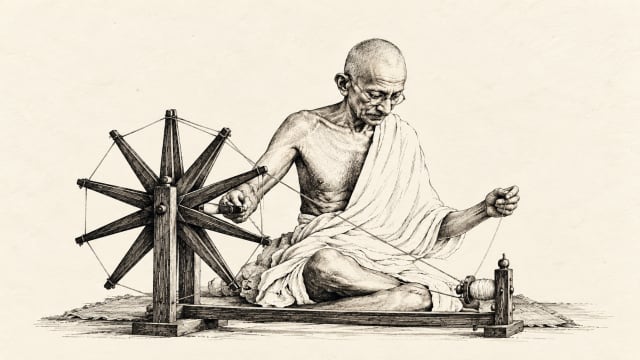
The Prize Gandhi Never Won
The Norwegian Nobel Committee considered Gandhi five times and never honoured him. Its reasons were serious, and they may say more about the meaning of peace than about the man.
What Did 1947 Actually Free Us From?
India's Independence ended colonial rule in 1947, but did it make Indians truly free? An essay on sovereignty, inequality and the unfinished meaning of freedom.
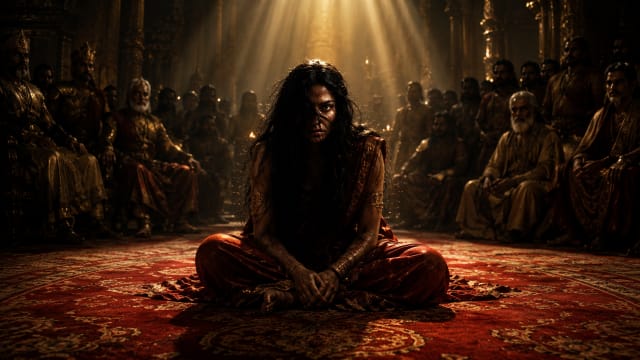
The Silence Around Draupadi
A powerful reflection on Draupadi’s humiliation, memory, rage, and moral clarity in the Mahabharata through a modern philosophical lens.

The Golden Sparrow: A Diagnostic of Indian History
Explore why India was called the Golden Sparrow and how wealth, culture and political fragmentation shaped Indian history for centuries.