The Black Death and the Illusion of Order
A reflection on the Black Death as more than a pandemic, showing how it exposed fragile systems, reshaped power, and revealed the illusion of stability.
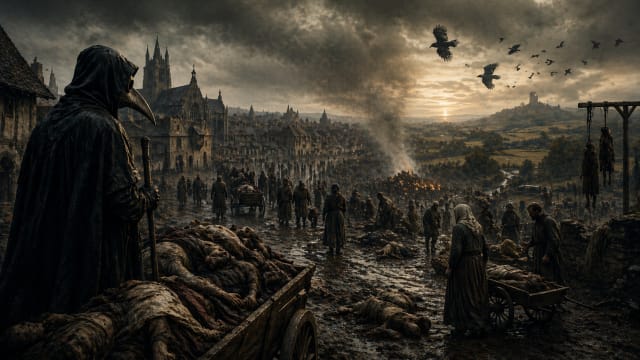
A bell tolls in a medieval town, and no one asks for whom. The streets are not empty, not yet, but something unseen has already arrived. It travels faster than rumor and settles deeper than fear. The Black Death does not announce itself with spectacle. It accumulates quietly, like a sentence forming in the dark, until suddenly the grammar of life itself begins to break.
The usual story frames the plague as catastrophe, a biological accident delivered by fleas, rats, and the expanding arteries of trade. This is accurate, but it is not the full account. The deeper structure of the Black Death lies in exposure. It revealed what had always been present but rarely acknowledged: fragile systems, rigid hierarchies, and a theology unprepared for randomness. Europe in the 14th century rested on an assumption of order. God governed the cosmos, kings governed men, and peasants sustained both. Then the plague cut through all three without discrimination. When death ignores rank, rank begins to look like fiction.
Consider the arithmetic of collapse. Between a third and a half of Europe's population disappeared within a few years. Fields lay unharvested. Workshops fell silent. Entire villages slipped into absence. Premise one: scarcity increases value. Premise two: labor became scarce. Conclusion: laborers gained leverage. This was not ideology. It was inevitability. Serfs demanded wages. Many simply left. The feudal contract, once presented as eternal, revealed itself as contingent. A pathogen, indifferent to politics, became an invisible negotiator, redistributing power without manifesto or debate.
Yet the psychological rupture ran deeper than economics. The medieval mind depended on coherence. Suffering was meant to fit into a moral order, a test, a punishment, or a path to salvation. The plague resisted interpretation. It killed the devout and the corrupt alike. Priests died administering last rites. Prayers did not alter outcomes. The result was not merely grief but epistemic shock. If the world no longer behaved according to divine logic, then perhaps it had never been fully governed by it. Faith did not vanish, but it changed. It became more anxious, more personal, and in some cases, more skeptical.
Some argue the Black Death was purely destructive, that it delayed progress and plunged Europe into superstition and violence. There is truth here. Pogroms erupted against marginalized communities. Flagellants marched, attempting to beat meaning back into a silent sky. Fear sought targets when explanations failed. But this view mistakes immediate reaction for historical consequence. Rupture does not only destroy. It clears. The same vacuum that bred panic also demanded innovation. Medical inquiry sharpened, if only because ignorance became unbearable. Cities reconsidered sanitation. Art turned toward mortality with a starkness that feels almost contemporary. Skulls appeared where halos once dominated.
The Renaissance, often narrated as a rebirth of classical ideals, did not emerge in isolation from this devastation. It grew in the space the plague opened. With labor scarce, individuals mattered more. With authority shaken, inquiry widened. The human being, once a small figure in a vast divine order, stepped slightly forward. Not fully free, not yet modern, but undeniably repositioned.
The unsettling insight is this: stability often depends on illusion. Systems endure because people believe in them, not because they are immune to disruption. The Black Death stripped away that belief. It showed that what appears permanent is often provisional, sustained by habit rather than necessity. When enough people disappear, the rules do not merely bend. They rewrite themselves.
We prefer to imagine progress as intentional, guided by vision, engineered by reason. The plague suggests a harsher truth. History often advances through rupture, not design. A microbe, invisible and indifferent, can achieve what revolutions cannot. It can reorder economies, unsettle faith, and force a civilization to confront its own assumptions without ceremony.
Perhaps that is why the bell still echoes across centuries. Not as a warning of disease alone, but as a reminder of contingency. The world feels stable only until something small decides otherwise. And when that moment arrives, what we call order reveals itself for what it has always been: a fragile agreement with chaos, signed in confidence, revised in crisis, and never quite permanent.
Discussion
Sign in to join the discussion.
More in Modern History

The Emperor Who Was Not Short
For two centuries the autopsy figure has been cited as proof that Napoleon was small. A look at the units, the cartoons and the nicknames tells a different story.
The Queen Who Never Offered Cake
Her most famous sentence was probably never hers. The story of how it stuck says more about the people who believed it.
Why the Berlin Wall Fell Because of a Miscommunication: An RC Inspired by IIM Indore
Gunter Schabowski had not been briefed. The decision he announced had not been implemented. The gates he declared open were still closed. Within hours, the Berlin Wall had ceased to exist.
The Press Did Not Start the Reformation: An RC Inspired by IIM Indore
The printing press spread the Reformation. It did not cause it. The soil was prepared long before Gutenberg printed a single page.