Can Males Be Mothers?
Can males be mothers? From pregnant seahorses to modern biology, science reveals how evolution challenges our ideas of parenthood.
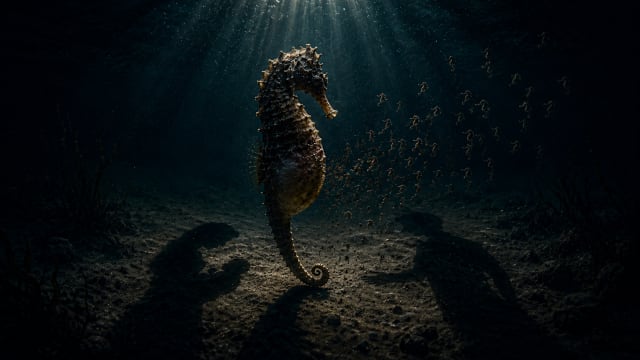
A male giving birth sounds like a biological impossibility. The very phrase appears to violate the grammar of nature. Across most species, motherhood and fatherhood seem neatly divided. Females produce eggs, carry offspring, and give birth. Males fertilize and depart. Yet in a quiet corner of evolution, the script has been rewritten. Male seahorses become pregnant.
In the tangled seagrass beds of tropical oceans, female seahorses deposit their eggs into a pouch on the male's body. The male fertilizes the eggs and carries them for weeks. During this period, he regulates oxygen levels, removes waste, controls salinity, and supplies nutrients to the developing embryos. When the young are fully formed, he undergoes powerful muscular contractions and releases dozens or even hundreds of offspring into the water.
The seahorse demonstrates that evolution is less concerned with categories than with outcomes.
The phenomenon has fascinated biologists for decades because it challenges one of the oldest assumptions about reproduction. If pregnancy and childbirth are defining features of motherhood, then what exactly should we call a male seahorse?
The modern scientific study of male pregnancy owes much to researchers such as Adam Jones of Texas A&M University. Jones and his colleagues demonstrated that pregnancy in seahorses and pipefish is far more than passive egg storage. The male brood pouch functions in ways strikingly similar to a mammalian uterus. It protects embryos, regulates their environment, and actively participates in their development.
Research by Camilla Whittington at the University of Sydney has pushed this comparison even further. In a landmark study published in the Proceedings of the Royal Society B, Whittington and her collaborators found that male seahorses express genes during pregnancy that resemble some of those involved in mammalian pregnancy. Although seahorses and mammals followed very different evolutionary paths, both evolved sophisticated biological systems for nurturing offspring before birth.
At first glance, this might suggest that male seahorses are simply mothers in disguise. Yet the answer is more complicated. The female still produces the eggs and contributes half of the offspring's genetic material. In the traditional biological sense, she remains the mother. The male contributes sperm and performs the gestational labor. He becomes both father and surrogate womb.
This ambiguity exposes a hidden assumption in the way humans think about reproduction. We often treat motherhood as a single role. In reality, it combines several distinct functions. There is genetic motherhood, gestational motherhood, nutritional motherhood, and parental motherhood. In mammals these functions usually belong to the same individual. In seahorses they are divided.
Nature does not consult dictionaries before inventing new possibilities.
Some biologists argue that the term "mother" should remain tied to egg production because it preserves a clear scientific distinction between the sexes. This position has practical value. Scientific language depends on consistency and precision. Yet it also risks overlooking what makes male pregnancy remarkable. The seahorse demonstrates that evolution is less concerned with categories than with outcomes. What matters is not who performs a task but whether the task helps offspring survive.
The deeper lesson extends far beyond marine biology. Humans often imagine nature as a system of fixed roles. We expect fathers to behave one way and mothers another. Evolutionary history tells a different story. Roles shift whenever circumstances reward change. In Darwin's frog, males carry developing tadpoles in their vocal sacs. In many bird species, fathers perform the majority of parental care. Across the animal kingdom, nature repeatedly experiments with alternative arrangements.
The male seahorse is therefore more than a biological curiosity. It is a reminder that categories are tools rather than laws. They help us organize reality, but reality is under no obligation to obey them. A pregnant seahorse swimming through a coral meadow does not merely challenge our understanding of parenthood. It reveals a broader truth about life itself. Evolution is endlessly inventive, and its greatest innovations often emerge where our certainties begin to break apart.
Discussion · 2
I think the options are longer in all the 4 questions otherwise the para is easily understandable
We usually think motherhood and fatherhood are fixed roles, but seahorses show that many functions involved in reproduction like genetic contribution, pregnancy, nurturing and protection can be divided between different individuals. Evolution is more concerned with offspring survival than human categories, so biological roles are often more flexible than we assume. - 07
Sign in to join the discussion.
More in Animals
The Emu War and the Problem Soldiers Could Not Shoot
In 1932 machine guns were sent against emus in Western Australia, and the birds won the first round. The story is usually told as comedy, yet it hides a real question about what kind of problem an army can solve.
The Cliff That Was Built - An RC Inspired by IIM Indore
A famous film showed lemmings marching to their deaths in 1958. The scene was staged, and the myth it fed says more about the audience than about the animal.

The Leopard That Moved Back to Mumbai: An RC Inspired by IIM Indore
47 leopards live inside Sanjay Gandhi National Park, entirely surrounded by Mumbai. They have killed more than thirty people since 2002. Neither the city nor the leopards are going anywhere.
The Parrot That Bets Everything on One Fig: An RC Inspired by IIM Indore
The Dracula Parrot eats almost nothing but figs from a single genus of tree. Its beauty is the product of extreme specialisation. So is its vulnerability.