Fragility as Strategy: How Aphids Master Systemic Survival
Beyond their fragility, aphids use asexual reproduction and ant-cooperation to turn individual weakness into a systemic, invincible survival strategy.
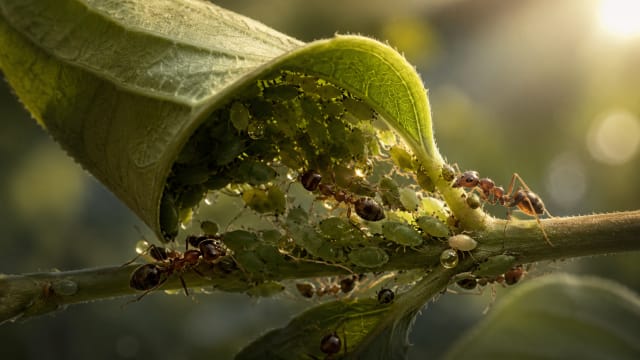
Aphids are among the most successful insects on Earth despite appearing almost absurdly fragile. Soft-bodied and barely a few millimeters long, they spend most of their lives attached to stems and leaves, feeding on plant sap. Yet agricultural scientists estimate that aphids damage billions of dollars worth of crops each year. Wheat, cotton, potatoes and soybean plants all remain vulnerable to infestations that often begin invisibly. A farmer may notice only a slight curling of leaves at first. Days later, an entire section of the crop weakens.
Researchers have long been fascinated by how such defenseless insects survive so effectively. One answer lies in reproduction. Many aphid species reproduce asexually during favorable seasons, meaning females can give birth without mating. Entomologist Stephen A. Marshall notes that under ideal conditions, aphid populations can expand with astonishing speed because every individual essentially becomes a reproductive unit. A single colony therefore behaves less like a collection of insects and more like a rapidly expanding system.
The Economics of Cooperation
Another reason for their success involves cooperation with ants. Aphids secrete a sugary liquid called honeydew while feeding. Ants consume this honeydew and, in return, protect aphids from predators such as ladybugs and lacewings. Biologists often describe the relationship as a form of mutualism. Researchers at Cornell University have documented cases in which ants physically transport aphids between plants and defend them aggressively from attacking insects. What appears to be a simple pest infestation is actually a coordinated ecological network.
Nature rarely rewards the strongest organism in isolation. More often, it rewards the species that learns how to cooperate, reproduce and adapt faster than everything around it.
The relationship becomes even stranger when viewed from the perspective of evolution. Most creatures survive through speed, strength or camouflage. Aphids survive through scale and adaptation. Their strategy depends less on individual intelligence than on collective persistence. If predators consume part of the colony, reproduction quickly restores the numbers. If one plant weakens, winged aphids migrate elsewhere. Fragility itself becomes sustainable when multiplied sufficiently.
The Fragility of Modern Agriculture
Yet aphids also reveal a paradox about modern agriculture. Industrial farming unintentionally creates ideal conditions for infestation. Vast monocultures provide endless uninterrupted food sources for pests. Ecologist Rachel Carson warned decades ago that excessive chemical dependence in agriculture could destabilize ecosystems by killing beneficial insects alongside harmful ones. When ladybugs and other aphid predators decline, aphid populations often rebound even more aggressively.
For this reason, many agricultural researchers now advocate integrated pest management rather than indiscriminate pesticide use. The goal is not complete extermination, which often proves impossible, but ecological balance. Farmers introduce predator insects, rotate crops and monitor infestation thresholds carefully before spraying chemicals. The philosophy resembles medicine more than warfare. A healthy ecosystem regulates itself better than constant intervention can.
Aphids therefore force an uncomfortable realization. Survival in nature rarely belongs to the loudest or most visually impressive species. It belongs to organisms that adapt quietly to systems larger than themselves. Beneath a curled leaf, an aphid colony demonstrates a truth that extends far beyond agriculture: persistence often defeats spectacle.
Discussion · 3
Aphids are defenseless creatures that reproduce rapidly. Their survival does not depend upon strength, but on multiplication. If one part of the colony is attacked, they reestablish it through reproduction. They are asexual creatures. Aphids also generate honeydew, which feeds ants, and in return, ants protect them from predators. This shows that survival in nature depends upon adaptability. Now humans use pesticides on farms, but when part of the aphid population dies, they reproduce quickly, resulting in greater crop loss. Completely removing them is not possible. Therefore, we need to create an ecosystem in which both farmers and insects benefit while causing less harm to each other.
The article is a great depiction of paradoxical idea. The evolutionary paradox of Aphids being physically weak and fragile organisms, yet they could be ecologically devastating. The article also highlights the significance of mutualism by citing the mutualistic behavior of ants and Aphids. The role of nature is rightfully highlighted stating how it does not allow individualistic domination through strength. However, with coordinated agility rapid replication, and through quick environmental adaptation, even the most fragile organisms can create havoc. The article also criticize the modern man-made farming system through Aphids. Over reliance on chemical pesticides and man made monocultures disrupted the natural balance, thereby accelerating pest infestations. Ultimately, it is nature that is supreme and through the example of Aphids it proves that persistence coul defeat any systematic spectacle.
I have one doubt here regarding the first question; repeatedly we have been told that in inference-based questions, we are to avoid the options that state the ideas of the passage directly. So, in the first question, isn't it given many times in the passage that survival depends more on adaptability? Now, my question is how do we decide which option to consider and which not to. Because I too wanted to go for option 2 but rejected it for the reasoning that it is explicitly mentioned in the passage? Or is it not? Please guide me here.
Sign in to join the discussion.
More in Animals
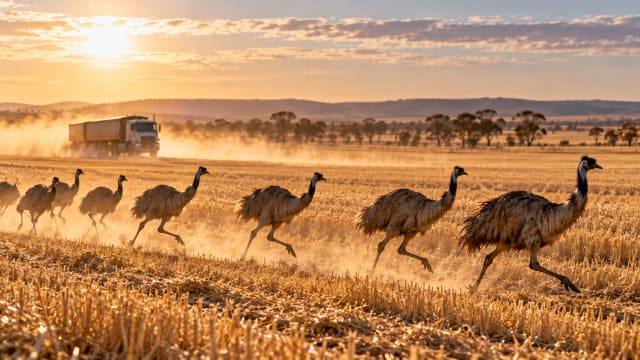
The Emu War and the Problem Soldiers Could Not Shoot
In 1932 machine guns were sent against emus in Western Australia, and the birds won the first round. The story is usually told as comedy, yet it hides a real question about what kind of problem an army can solve.

The Cliff That Was Built - An RC Inspired by IIM Indore
A famous film showed lemmings marching to their deaths in 1958. The scene was staged, and the myth it fed says more about the audience than about the animal.

The Leopard That Moved Back to Mumbai: An RC Inspired by IIM Indore
47 leopards live inside Sanjay Gandhi National Park, entirely surrounded by Mumbai. They have killed more than thirty people since 2002. Neither the city nor the leopards are going anywhere.
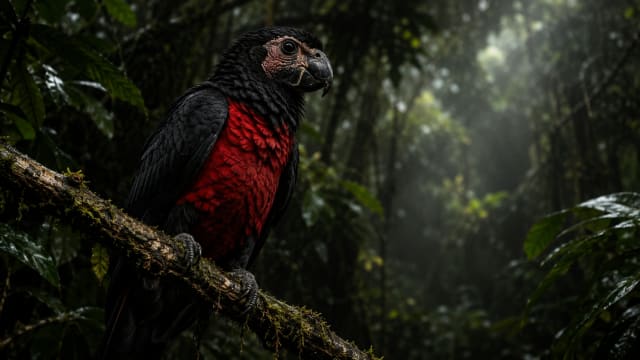
The Parrot That Bets Everything on One Fig: An RC Inspired by IIM Indore
The Dracula Parrot eats almost nothing but figs from a single genus of tree. Its beauty is the product of extreme specialisation. So is its vulnerability.