The Alien Intelligence of the Octopus
Explore the mysterious intelligence of octopuses and why these solitary sea creatures are reshaping how humans understand consciousness.
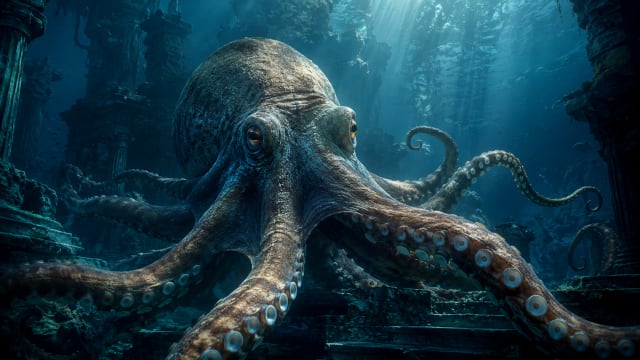
Octopuses are full of surprises. Marine biologists studying their behavior discovered that these soft-bodied creatures consistently display abilities associated with advanced intelligence. Unlike most intelligent animals, octopuses are solitary, short-lived, and biologically unlike anything humans instinctively recognize as “mind-like.” Yet they solve problems, adapt to unfamiliar situations, and often behave with startling unpredictability. Watching an octopus explore a tank can feel strangely theatrical, as though the creature is not merely reacting to the world but actively experimenting with it.
Much of what scientists know about octopus intelligence emerged through experiments that looked deceptively simple. In aquariums and laboratories, octopuses learned to unscrew jars to retrieve food hidden inside. Some navigated mazes, distinguished between shapes, and even recognized individual human caretakers. Aquarium workers frequently reported octopuses escaping their enclosures at night, crawling across floors to raid nearby tanks for food, and quietly returning before morning. Researchers described encounters with octopuses as feeling less like interactions with instinct-driven animals and more like meetings with improvisers. One scientist compared the experience to making contact with an intelligent extraterrestrial.
Part of the fascination lies in the octopus nervous system itself. Humans centralize intelligence inside one large brain. Octopuses distribute it. Around two-thirds of their neurons exist not in the brain, but across the eight arms. Each arm can process sensory information and coordinate movement with remarkable independence. An octopus arm can continue reacting to stimuli even after being separated from the body. Watching an octopus manipulate objects can therefore feel uncanny, almost as though the creature thinks with its entire body rather than from a single command center. Evolution produced a form of intelligence that seems decentralized, fluid, and radically unlike the mammalian model humans instinctively trust.
Scientists remain cautious about exaggerating these abilities. Clever behavior alone does not necessarily prove consciousness or self-awareness. Some researchers argue that octopus problem-solving may simply reflect highly sophisticated evolutionary programming rather than reflective thought. Human beings also possess a dangerous habit of projecting emotions and intentions onto animals. We see loyalty in dogs, arrogance in cats, and melancholy in whales because the human mind constantly searches for reflections of itself. Yet the octopus complicates that skepticism because it behaves intelligently while resembling almost nothing familiar. It has no facial expressions humans can easily read, no social bonding rituals that resemble our own, and no evolutionary history remotely close to mammals.
What makes this especially strange is that octopuses achieved such cognition without social life. Primates, dolphins, elephants, and crows all evolved intelligence within cooperative groups that required communication, hierarchy, and long-term relationships. Octopuses do not. Most species live alone, raise no young, and die shortly after reproduction. Their intelligence appears to emerge not from society, but from survival itself. A soft-bodied animal living among predators evolved camouflage, flexibility, memory, and rapid learning because the ocean demanded constant adaptation. In the violent uncertainty of coral reefs and open water, intelligence became less a luxury and more a biological defense mechanism.
Researchers increasingly suspect that intelligence may not be a rare evolutionary accident, but a recurring solution to complexity itself. The octopus offers a glimpse of what a mind can become when evolution starts from entirely different materials. It does not think like humans, behave like humans, or even possess a body remotely comparable to ours. Yet it still arrived at something uncannily close to intelligence. Perhaps the deeper lesson is not about octopuses at all. It is about humanity’s tendency to mistake familiarity for superiority. The octopus reminds us that evolution has been conducting experiments in consciousness for hundreds of millions of years, and humans are only one result among many.
Perhaps that is why octopuses unsettle people so deeply. They suggest that thought is not uniquely human. It is simply one more survival strategy nature keeps rediscovering.
Discussion
Sign in to join the discussion.
More in Animals

The Emu War and the Problem Soldiers Could Not Shoot
In 1932 machine guns were sent against emus in Western Australia, and the birds won the first round. The story is usually told as comedy, yet it hides a real question about what kind of problem an army can solve.
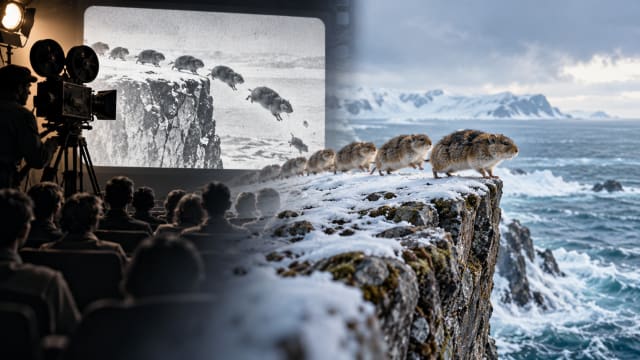
The Cliff That Was Built - An RC Inspired by IIM Indore
A famous film showed lemmings marching to their deaths in 1958. The scene was staged, and the myth it fed says more about the audience than about the animal.

The Leopard That Moved Back to Mumbai: An RC Inspired by IIM Indore
47 leopards live inside Sanjay Gandhi National Park, entirely surrounded by Mumbai. They have killed more than thirty people since 2002. Neither the city nor the leopards are going anywhere.
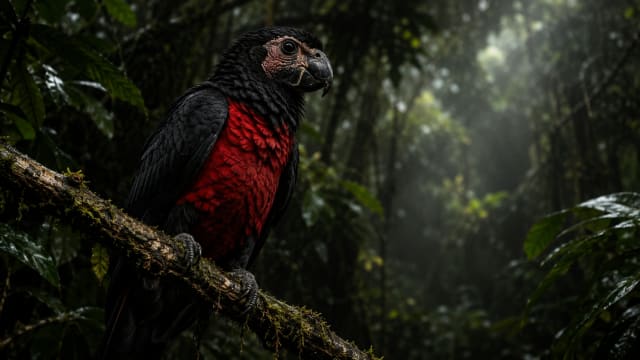
The Parrot That Bets Everything on One Fig: An RC Inspired by IIM Indore
The Dracula Parrot eats almost nothing but figs from a single genus of tree. Its beauty is the product of extreme specialisation. So is its vulnerability.