Why the World's Best Eyes Belong to a Shrimp
Why do mantis shrimp have the world's most complex eyes? The answer reveals how evolution shapes perception, communication, and reality itself.

A coral reef is a city built from light. Sunbeams shatter into blue fragments. Fish flash silver warnings. Corals glow with patterns invisible to human eyes. To us, the reef already appears dazzling. Yet a mantis shrimp moving through this underwater metropolis inhabits a reality far richer than anything we can perceive.
The mantis shrimp possesses the most complex visual system known in the animal kingdom. Humans rely on three photoreceptors that detect red, green, and blue wavelengths of light. Dogs manage with only two. Many birds possess four and can see ultraviolet light. The mantis shrimp, however, has up to sixteen photoreceptors. It can detect ultraviolet light, visible light, polarized light, and even circularly polarized light. Each eye moves independently and can judge depth on its own. If vision were a technological arms race, the mantis shrimp would appear to have won long ago.
Yet this remarkable visual machinery raises a puzzle. Why would evolution invest so heavily in sight? Why would a small crustacean require an optical system that seems to surpass birds, mammals, and even cephalopods?
The answer lies not in seeing more reality, but in seeing the right reality.
We often assume that perception evolves toward greater accuracy. Better eyes should produce a truer picture of the world. Nature tells a different story. Evolution does not reward organisms for discovering objective reality. It rewards them for surviving within a particular environment.
The coral reef is not simply a landscape. It is an arena crowded with information. Potential mates advertise their quality. Rivals broadcast threats. Predators search for vulnerabilities. Every flash of color, every shift in brightness, and every subtle reflection may contain information that determines whether an animal reproduces, fights, flees, or dies.
In such a world, vision becomes a communication network. Male mantis shrimp perform elaborate courtship displays and aggressive encounters that expose brightly colored patches across their bodies. These patches vary among individuals in brightness, reflectance, and ultraviolet properties. Researchers suspect that many of these signals remain invisible to other creatures inhabiting the reef. Mantis shrimp may therefore be exchanging messages through a private visual language hidden in plain sight.
The mystery deepens because scientists still do not fully understand how these animals use their extraordinary sensory abilities. One might assume that sixteen photoreceptors allow mantis shrimp to distinguish colors with breathtaking precision. Surprisingly, some evidence suggests otherwise. Humans possess only three color receptors, yet our brains perform enormous computational work to distinguish subtle shades and patterns. The mantis shrimp may rely less on sophisticated neural processing and more on direct categorization within the eye itself.
Humans and mantis shrimp may therefore represent two radically different solutions to the same problem. One strategy gathers limited information and allows the brain to interpret it. The other gathers abundant information and performs much of the sorting before conscious processing becomes necessary.
Nature did not build a better camera. It built a faster decision-making system.
This possibility challenges a deeply held assumption about intelligence. We often imagine that progress means collecting more information and building a more complete picture of reality. The mantis shrimp suggests that success may depend instead on filtering reality efficiently. In a fast-moving environment, speed can matter more than precision.
The broader implication reaches far beyond a coral reef. Every animal inhabits a sensory world shaped by its evolutionary history. A bee sees ultraviolet guides painted across flower petals. A shark navigates through electrical disturbances. A dog experiences landscapes composed largely of scent. None of these worlds is more real than another. Each reveals the information most useful to the creature experiencing it.
The mantis shrimp simply takes this principle to an extraordinary extreme. Hidden within the reef are ultraviolet flashes, rotating waves of polarized light, and signals exchanged through channels that humans cannot access. Entire conversations may be unfolding around us while we remain completely unaware of their existence.
Its eyes remind us that perception is not a window onto reality. It is a tool shaped by necessity. What we call the world is not the world itself. It is merely the narrow slice our senses allow us to notice.
Discussion
Sign in to join the discussion.
More in Animals

The Emu War and the Problem Soldiers Could Not Shoot
In 1932 machine guns were sent against emus in Western Australia, and the birds won the first round. The story is usually told as comedy, yet it hides a real question about what kind of problem an army can solve.
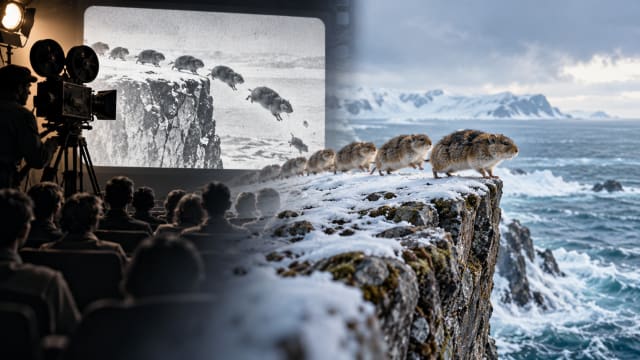
The Cliff That Was Built - An RC Inspired by IIM Indore
A famous film showed lemmings marching to their deaths in 1958. The scene was staged, and the myth it fed says more about the audience than about the animal.

The Leopard That Moved Back to Mumbai: An RC Inspired by IIM Indore
47 leopards live inside Sanjay Gandhi National Park, entirely surrounded by Mumbai. They have killed more than thirty people since 2002. Neither the city nor the leopards are going anywhere.
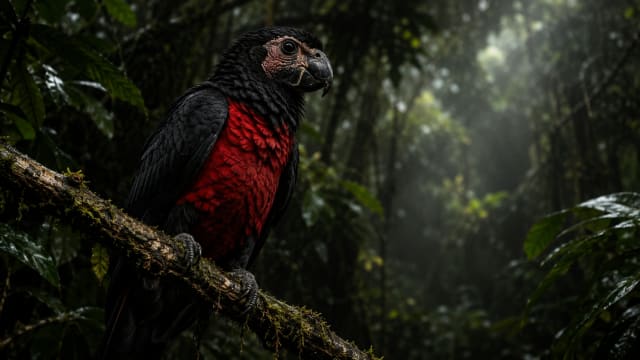
The Parrot That Bets Everything on One Fig: An RC Inspired by IIM Indore
The Dracula Parrot eats almost nothing but figs from a single genus of tree. Its beauty is the product of extreme specialisation. So is its vulnerability.