The Rivers the Court Made Persons
Two judges in Nainital gave two rivers the standing of living persons. A few months later the Supreme Court paused the order and left a harder question hanging.
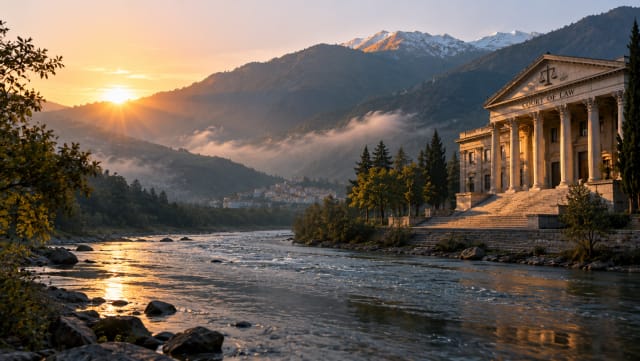
On 20 March 2017, two judges of the High Court of Uttarakhand at Nainital declared that the Ganga and the Yamuna were legal persons. The order, passed by Justices Rajiv Sharma and Alok Singh, gave the rivers the rights, duties and liabilities of a living person and named senior officials of the state as their guardians. In the same month, New Zealand recognised the Whanganui River as a legal person in its own law.
The idea sounded strange, but Indian law had accepted something like it before. A company can sue and be sued, and courts have long treated a Hindu idol as a juristic person that holds property through a human representative. Personhood in law is a status that the law confers and not a statement about whether a thing is alive.
The difficulty lay elsewhere. A person who can be wronged must be able to claim, and a person who can claim must be able to answer. The state reportedly objected that it could not manage rivers that flow through several states, and warned that officials who spoke for a river might be held liable when it flooded. In July 2017, less than four months after the order, the Supreme Court stayed it.
A person who can be wronged must be able to claim, and a person who can claim must be able to answer.
The episode shows that legal personhood is a tool and not a discovery. The law grants it where it helps to protect an interest that would otherwise have no voice, and withholds it where the burdens seem to outweigh the benefit. Whether a river can be a person may matter less than who will answer for the harm done to it, and the stay left that question open.
Discussion
Sign in to join the discussion.
More in Law & Justice

The Judgment That Freed One Man and Left Slavery Standing
Lord Mansfield's famous ruling of 1772 is remembered as the end of slavery in England. The real holding was far smaller, and its reach far greater.
The Reservoir That Burst and the Rule India Chose to Outgrow
An English reservoir gave the common law a rule about dangerous things. A gas leak in Delhi showed why India needed a stricter one.

The Conviction That Fell on a Technicality and the Law That Stayed
A Tennessee teacher was convicted in 1925 for teaching evolution, and the conviction was undone two years later for a reason that had nothing to do with science. The law that put him in court lived on.
The Acquittal That Did Not Mean Innocence
Lizzie Borden walked free in 1893, and the verdict shows what a court can and cannot declare.