The Myth of Blind Obedience
A famous result seemed to prove that ordinary people obey. The archive, and the participants themselves, suggest the proof was never as simple as the textbooks made it.
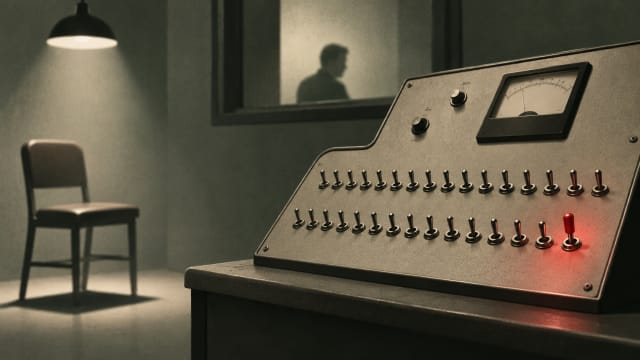
In the summer of 1961, a few months after the trial of Adolf Eichmann opened in Jerusalem, volunteers began arriving at a laboratory at Yale University. Each was seated before a shock generator with thirty switches that rose from 15 to 450 volts and told to punish a man in the next room whenever he gave a wrong answer. The man was an actor and the shocks were not real. In the version of the study most often cited, 26 of 40 participants went to the end of the scale.
The conclusion that followed became one of the most repeated in the social sciences. Stanley Milgram published his first report in 1963, the year Hannah Arendt's account of Eichmann introduced the phrase banality of evil to a wide audience, and the two seemed to explain each other. Ordinary people, it appeared, will inflict pain on a stranger if a person in a grey coat tells them that the experiment requires it. Within a few years the study was retold in textbooks and in Milgram's own film Obedience, and its lesson was taken to reach well beyond the laboratory.
The belief was also reasonable on the evidence. Milgram ran many variations, and obedience moved in the way a theory of authority would predict. When the experimenter left the room and gave instructions by telephone, far fewer participants reached 450 volts, and some reportedly claimed to deliver shocks they had in fact withheld. When the setting moved from Yale to a shabby office in Bridgeport, the figure fell but did not collapse, with 19 of 40 going to the end. Authority mattered, and the lower its prestige, the weaker its grip.
A second reason for belief was the sheer discomfort on display. Participants sweated, trembled and bit their lips, and some laughed nervously as they pressed the switches. Such distress seemed proof that they believed in the shocks and obeyed against conscience, which is exactly the conflict the theory needed.
The doubts came from the archive. Gina Perry, who studied Milgram's papers and recordings for a book published in 2012, reported that the experimenter often strayed from the script of four standard prods and pressed participants far harder than the published account suggests. She also found that many participants later said they had doubted that the shocks were real, which complicates any reading of their distress as proof of belief.
Authority mattered, and the lower its prestige, the weaker its grip.
A different challenge concerns the participants' reasons. Alexander Haslam and Stephen Reicher have argued that the volunteers were not mindless followers but people persuaded that science was worth some suffering, and that they were engaged by a cause they came to share. Analyses of the recorded prods point the same way. The one prod that sounded like a flat command, telling participants they had no other choice, is reported to have been followed by refusal in most cases.
If so, the famous figure measures something less simple than obedience. It may record trust in a university, belief in a worthy aim, doubt about the setup, or a mixture that no participant could have separated at the time. The people who left the room early and the people who stayed to the end may each have been answering a different question, and the dial in front of them did not say which one.
Discussion
Sign in to join the discussion.
More in Social Psychology

The Wisdom of Crowds
A Victorian scientist set out to prove that ordinary people judge badly and found a crowd that was almost exactly right. The trouble is what happens once the crowd starts to talk.

The Thirty Eight Witnesses Who Were Not There: An RC Inspired by IIM Indore
A newspaper once told New York that dozens of neighbours watched a murder and did nothing. The story built a famous theory, and then the story itself began to fall apart.

The Stanford Prison Experiment Was Directed: An RC Inspired by IIM Indore
In 1971 a Stanford basement became a prison, and the world learned that ordinary people turn cruel when given power. The archive suggests that somebody told the guards what the experiment wanted to see.

The Pebble Is Not a Love Letter
A penguin's pebble looks like a gift of love. It may actually be a signal of competence—a clue to how human courtship really works.