The Thirty Eight Witnesses Who Were Not There - An RC Inspired by IIM Indore
A newspaper once told New York that dozens of neighbours watched a murder and did nothing. The story built a famous theory, and then the story itself began to fall apart.

In the early hours of 13 March 1964, a young bar manager named Catherine Genovese, known to friends as Kitty, was stabbed to death near her apartment building in the Kew Gardens neighbourhood of Queens, New York. Two weeks later a newspaper report told the city that thirty eight respectable citizens had watched the attack from their windows and not one had called the police. Within months it had become the founding parable of modern social psychology, a tale about what ordinary people become when they are many.
Two psychologists, Bibb Latané and John Darley, took the parable into the laboratory. In their experiments, which began in the late 1960s, a person who believed that he or she was the only witness to an emergency usually helped. A person who believed that several others were also listening helped far less often. The pair named the pattern diffusion of responsibility, and later work called it the bystander effect. When help could come from anyone, it is easy to assume that it will come from someone else.
The trouble is that the parable at the centre of this finding appears to be badly damaged. Later researchers who returned to court records and interviews have argued that the attack unfolded in two or three separate episodes, on a cold street at night, and that few residents saw more than a fragment. Some heard only a shout and assumed a quarrel. At least one neighbour is reported to have telephoned the police, and another went down to the victim. The tidy number of witnesses seems to have been a journalist's compression of a messier truth.
The tidy number of witnesses seems to have been a journalist's compression of a messier truth.
A defender of the original lesson would say that none of this touches the laboratory evidence. The experiments stand on their own, and a myth about one street does not cancel a result measured across many participants. That reply is fair as far as it goes. Yet it leaves a question unanswered. The experiments measured behaviour in small rooms under controlled conditions, and the case was invoked to show that the same behaviour governs real streets. If the case proves less than claimed, the laboratory result has lost its most vivid proof of reach, though not its existence.
There is a further twist. A study of street camera footage from three cities has reported that in roughly nine of ten violent conflicts at least one onlooker stepped in. If crowds so often help, the parable may have taught generations of students to expect indifference where none was shown, and that expectation may itself shape conduct. A person who has learned that crowds fail may wait to see whether the crowd will act, which is exactly the hesitation the story warned against.
What remains is an odd circularity. A story about the failure of witnesses was itself accepted by a public that did not check it, and a profession that wished to explain cruelty found in it a lesson too neat to question. Whether the lesson is false, or merely misplaced, depends on what counts as help and who is allowed to count it. The street in Queens cannot now be heard from, and the people who stood at its windows have left no testimony that anyone has yet been able to weigh.
Discussion
Sign in to join the discussion.
More in Social Psychology

The Stanford Prison Experiment Was Directed - An RC Inspired by IIM Indore
In 1971 a Stanford basement became a prison, and the world learned that ordinary people turn cruel when given power. The archive suggests that somebody told the guards what the experiment wanted to see.
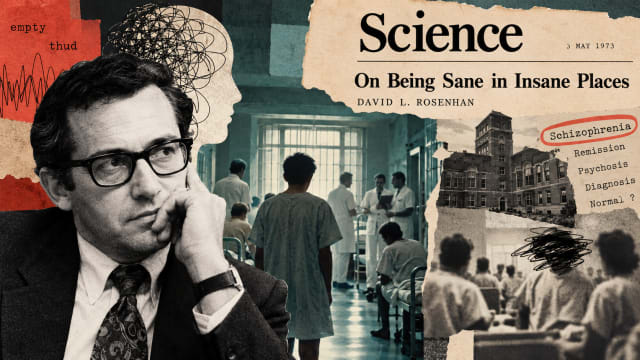
The Sane Who Were Never Caught - An RC Inspired by IIM Indore
In 1973 a Stanford psychologist reported that psychiatrists could not tell healthy people from the mentally ill. Half a century later, the study itself is proving hard to tell from fiction.

The Pebble Is Not a Love Letter
A penguin's pebble looks like a gift of love. It may actually be a signal of competence—a clue to how human courtship really works.

Machiavellianism and the Price of Power
A concise reflection on Machiavellianism that shows how power reshapes morality, revealing a quiet tension between survival and integrity.