The Sane Who Were Never Caught - An RC Inspired by IIM Indore
In 1973 a Stanford psychologist reported that psychiatrists could not tell healthy people from the mentally ill. Half a century later, the study itself is proving hard to tell from fiction.
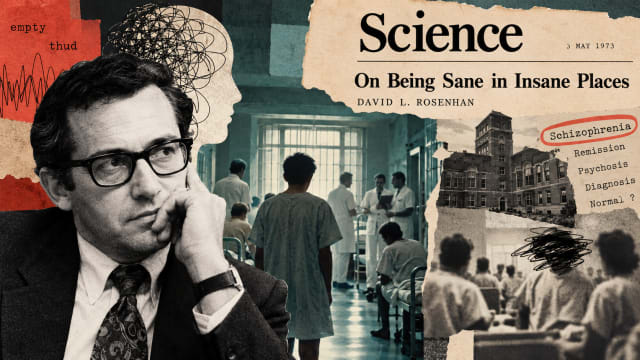
In 1973 the journal Science published a paper by the Stanford psychologist David Rosenhan reporting that eight healthy volunteers had presented themselves at twelve American psychiatric hospitals, claimed to hear voices saying words such as empty and thud, and been admitted. Once inside they acted normally and said the voices had gone. All but one were diagnosed with schizophrenia, and they stayed between seven and fifty two days before being discharged with the label of remission. Staff, Rosenhan wrote, never detected the deception, though some fellow patients did.
The paper arrived at a moment when doubts about psychiatry were already loud, and it fed them with a perfect story. Healthy people had been swallowed by institutions that could not see them, and the institutions had read ordinary behaviour as symptoms. Its title, On Being Sane in Insane Places, became shorthand in textbooks and lecture halls for the claim that diagnosis was less a discovery than a label. Reformers cited it in arguments for emptying asylums and for tightening the manuals that define mental illness.
A second part of the study sharpened the point. A teaching hospital that doubted such errors could happen was told to expect pseudopatients over the following months, and its staff rated nearly two hundred new admissions for the likelihood of being impostors. Dozens were judged suspect, yet Rosenhan revealed that he had sent no one. The lesson seemed plain. What clinicians saw depended on what they expected to see.
That plain lesson has since been complicated by the journalist Susannah Cahalan, who spent years examining Rosenhan's papers and tracing his volunteers. She could confirm very few of them, and the one she interviewed described an experience that differed from the published account. Rosenhan's own notes, she argued, suggested that some details had been shaped or invented. The study that exposed the unreliability of diagnosis may itself have been unreliable.
The study that exposed the unreliability of diagnosis may itself have been unreliable.
Defenders of the study reply that its central point survives, since later research has shown that clinicians can disagree about the same patient and that settings shape what is noticed. The reply is only partial. A finding can be true in general and still be misreported in particular, and the particulars are what made this study famous. Its force came from the image of honest people tricking trained professionals, and an image that never quite happened cannot borrow authority from other studies that did.
The irony is hard to ignore. A paper about labels overriding evidence became a label that overrode evidence for nearly fifty years, repeated by readers who found its conclusion too congenial to check. Whether the fault lay with a researcher who wanted a better story or with an audience that wanted the same story, the archive has not said, and it is unclear that any archive could. If the most persuasive proof that expectation shapes perception was itself shaped by expectation, it is difficult to say what, if anything, it proved.
Discussion
Sign in to join the discussion.
More in Social Psychology

The Thirty Eight Witnesses Who Were Not There - An RC Inspired by IIM Indore
A newspaper once told New York that dozens of neighbours watched a murder and did nothing. The story built a famous theory, and then the story itself began to fall apart.
The Stanford Prison Experiment Was Directed - An RC Inspired by IIM Indore
In 1971 a Stanford basement became a prison, and the world learned that ordinary people turn cruel when given power. The archive suggests that somebody told the guards what the experiment wanted to see.

The Pebble Is Not a Love Letter
A penguin's pebble looks like a gift of love. It may actually be a signal of competence—a clue to how human courtship really works.

Machiavellianism and the Price of Power
A concise reflection on Machiavellianism that shows how power reshapes morality, revealing a quiet tension between survival and integrity.