What Dark Matter Tells Us About Scientific Knowledge: An RC Inspired by IIM Indore
Dark matter has never been directly observed. We are nonetheless highly confident it exists. The gap between these two facts reveals something important about how science actually works.
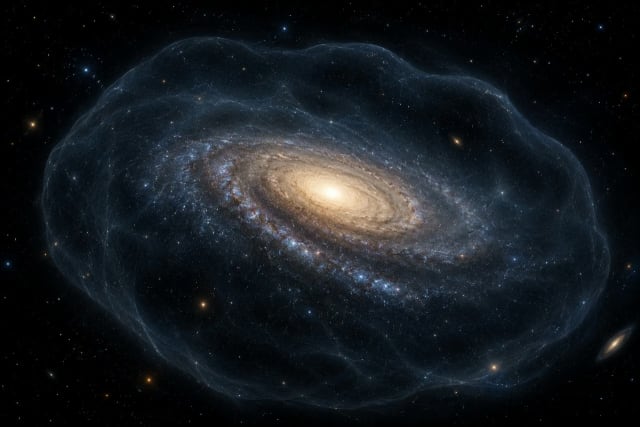
Nobody has ever seen dark matter. No instrument has detected it directly. No experiment has isolated a dark matter particle, measured its properties or confirmed its composition. Yet the scientific consensus holds that dark matter constitutes roughly twenty-seven percent of the total mass-energy content of the universe. This is not a tentative hypothesis held by a fringe of theorists. It is the working assumption of most cosmologists, embedded in the standard model of cosmology and used to make predictions that have repeatedly been confirmed by observation.
The justification for this confidence is indirect. Galaxies rotate at speeds that their visible mass cannot account for. If only the matter we can see were contributing to a galaxy's gravitational field, the outer regions of the galaxy should rotate more slowly than the inner regions. They do not. They rotate at roughly the same speed. Something else must be generating the gravitational pull that holds the outer regions in their orbits. That something, which interacts gravitationally but not electromagnetically and therefore cannot be seen, is called dark matter.
This is evidence, but it is evidence of a particular kind. It does not say what dark matter is. It says that something with certain gravitational properties must exist. The inference runs from observed effect to postulated cause. We see the rotation curve of a galaxy and conclude that an invisible mass must be responsible. The conclusion follows from the evidence, but the evidence does not identify what the invisible mass consists of.
Scientists are accustomed to this kind of reasoning. Much of what physics has established about the subatomic world was inferred before it was directly observed. The existence of Neptune was predicted from irregularities in the orbit of Uranus decades before a telescope confirmed it. The Higgs boson was a theoretical necessity of the Standard Model of particle physics for nearly fifty years before the Large Hadron Collider detected it. Indirect inference has an excellent track record.
Yet the dark matter case is more uncomfortable than these precedents suggest. Neptune and the Higgs boson were predicted with enough specificity that scientists knew what they were looking for and where. Dark matter remains genuinely unknown in its nature. Dozens of candidate particles have been proposed. Each has been searched for and not found. The absence of a positive detection does not refute the existence of dark matter, because we do not know precisely what properties to look for. But it does place us in an unusual epistemic position.
We are highly confident that something exists. We do not know what it is. We cannot rule out that our inference from gravitational effects to an invisible mass is correct but our models of what that mass consists of are entirely wrong. We cannot rule out that some modification of our theory of gravity would eliminate the need for the inference entirely.
Confidence, in science as elsewhere, is not always proportional to the directness of the evidence. It can be proportional to the absence of any better explanation.
Science is often described as a method for producing knowledge through observation and experiment. Dark matter is a reminder that some of the most confident claims science makes rest on inference rather than observation. Confidence, in science as elsewhere, is not always proportional to the directness of the evidence. It can be proportional to the absence of any better explanation.
That is a subtler claim than it first appears. It means that what we call scientific knowledge is sometimes less a description of what we have seen and more a description of what we cannot currently explain any other way.
Discussion
Sign in to join the discussion.
More in Space & Astronomy
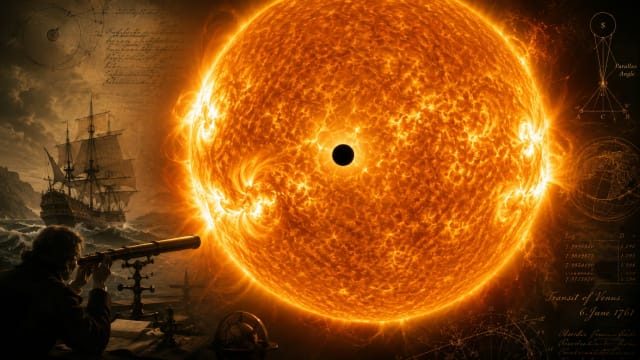
Chasing Shadows
A tiny shadow sent astronomers across oceans, empires into competition and science into a new age. The transit of Venus reveals the power of curiosity.
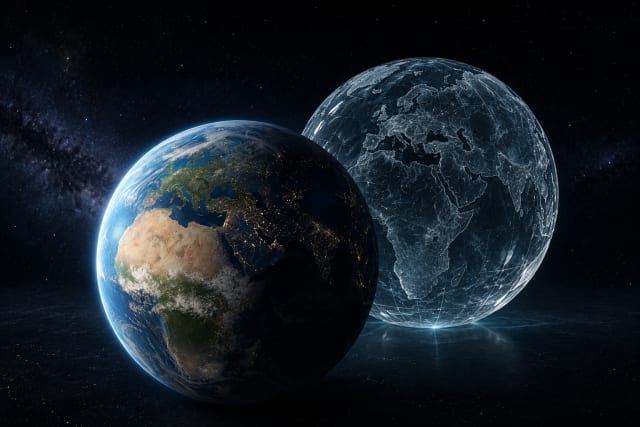
The Backup Planet Paradox
Is Mars colonization humanity's ultimate insurance policy, or a costly distraction from Earth's problems? Explore the backup planet paradox.
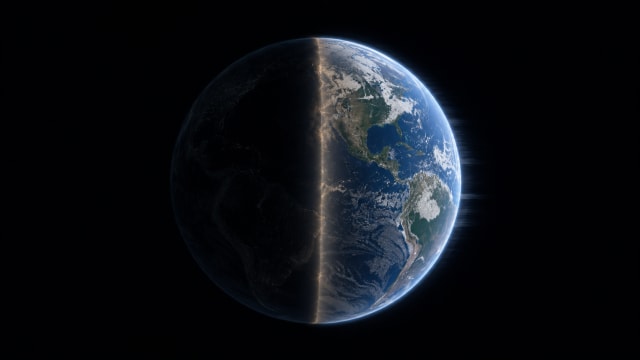
What If the Earth Stops Spinning?
What would happen if the Earth stopped spinning? Explore the science, climate chaos, and hidden forces that make life on our planet possible.
Gravity Is the Story of Love
As physicists explore the Big Rip, a deeper question emerges. Is gravity merely a force, or the universe's oldest form of connection?