What If the Earth Stops Spinning?
What would happen if the Earth stopped spinning? Explore the science, climate chaos, and hidden forces that make life on our planet possible.
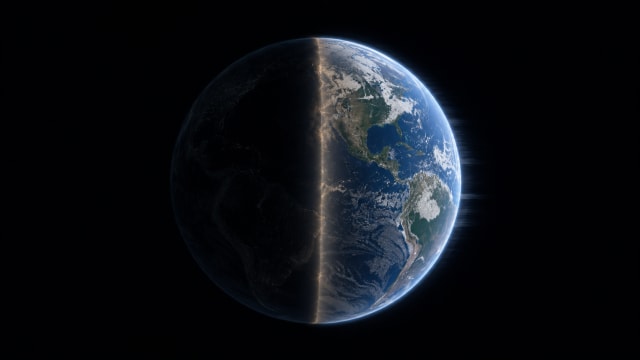
As a child, I was haunted by a question that appeared whenever I stared at the night sky. What if the Earth suddenly stopped spinning? I imagined people, buildings and oceans being flung tangentially into space like droplets escaping a spinning wheel. The image was terrifying. While other children feared monsters beneath their beds, I feared the possibility that the ground itself might stop moving. Years later, I learned that scientists had asked the same question. Not because they expected it to happen, but because it reveals how much of our world depends upon a motion we almost never notice.
The Earth completes one rotation every twenty four hours. At the equator, a person is moving eastward at more than 1,600 kilometres per hour. We feel perfectly still because everything around us shares the same motion. Physicists point out that if the Earth somehow stopped abruptly, inertia would continue to operate. The atmosphere would keep moving. The oceans would keep moving. So would everything not firmly anchored to the planet's crust.
The destruction would not result from the Earth stopping alone. It would result from everything else refusing to stop at the same instant.
The consequences would be devastating. Winds faster than the speed of sound would sweep across continents. Oceans would surge inland and erase coastlines. Cities would crumble beneath forces they were never designed to withstand. The destruction would not result from the Earth stopping alone. It would result from everything else refusing to stop at the same instant.
Fortunately, such a scenario belongs to the realm of thought experiments. Earth possesses enormous angular momentum. No known natural process could bring the planet to a sudden halt. Yet researchers have explored slower possibilities in which rotational speed declines over millions of years. These studies are valuable because they reveal the hidden influence of rotation on climate, geography and life.
A slowly rotating Earth would become a profoundly different world. Days would grow longer. Weather patterns would reorganize. Eventually, one side of the planet could experience prolonged sunlight while the opposite side endured extended darkness. Temperatures would diverge dramatically. The illuminated hemisphere would become increasingly hot. The dark hemisphere would become increasingly cold. Some climate scientists suggest that the most hospitable region might exist between these extremes. A narrow band of perpetual twilight could become the primary refuge for complex life.
Many observers argue that life would adapt. History seems to support that belief. Life has survived asteroid impacts, ice ages and mass extinctions. Yet this optimism overlooks an important fact. Life does not merely inhabit the Earth's environment. It is shaped by the Earth's rhythms. Circadian clocks govern sleep, migration, flowering, feeding and reproduction. Entire ecosystems depend upon the predictable cycle of day and night. Remove that cycle and countless evolutionary strategies lose their purpose.
The deeper lesson is surprisingly philosophical. Human beings often notice disruption while ignoring the systems that prevent disruption. We celebrate mountains because they rise above the landscape. We rarely think about the planetary motion that makes landscapes possible. The Earth's rotation shapes weather, ocean currents and our measurement of time. It quietly structures daily existence.
Perhaps that is why the question remains so fascinating. It appears to be a problem in astronomy. In reality, it is a lesson in dependence. The most important forces in our lives are often the least visible. The Earth spins beneath our feet every second of every day. We do not feel it. We barely think about it. Yet that silent motion helps sustain the world we call normal. Only when we imagine it stopping do we realize how much of existence depends upon its movement.
Discussion · 1
The Earth stopping is not really a question about astronomy but about understanding how much we depend on things we don't notice. Earth's rotation affects climate, oceans, weather and even the biological rhythms of life. The passage shows that many important systems quietly sustain our existence, and we only realize their importance when we imagine them disappearing. - 08
Sign in to join the discussion.
More in Space & Astronomy
What Dark Matter Tells Us About Scientific Knowledge: An RC Inspired by IIM Indore
Dark matter has never been directly observed. We are nonetheless highly confident it exists. The gap between these two facts reveals something important about how science actually works.
Chasing Shadows
A tiny shadow sent astronomers across oceans, empires into competition and science into a new age. The transit of Venus reveals the power of curiosity.
The Backup Planet Paradox
Is Mars colonization humanity's ultimate insurance policy, or a costly distraction from Earth's problems? Explore the backup planet paradox.
Gravity Is the Story of Love
As physicists explore the Big Rip, a deeper question emerges. Is gravity merely a force, or the universe's oldest form of connection?