Where Light Ends: The Human Obsession with Black Holes
Explore the mystery of black holes, where gravity bends spacetime, light cannot escape, and modern physics confronts the limits of human understanding.
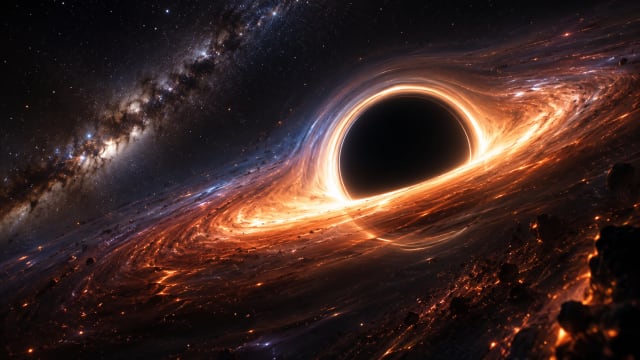
At the center of the Milky Way, stars move as though something invisible has gripped them by the throat. They whip around an empty point at impossible speed, tracing circles around a darkness that emits no light and yet outweighs millions of suns. Astronomers call it Sagittarius A*. The name sounds clinical, but the reality borders on myth. A hole in space. A wound in the fabric of existence. An object so dense that escape itself ceases to function.
Black holes entered physics almost by accident. Albert Einstein believed his own equations had produced a mathematical absurdity. Yet the universe, with its usual indifference to human intuition, built them anyway. A dying massive star collapses inward until matter loses its argument against gravity. The result is not merely a heavy object. It is a region where spacetime bends so sharply that every road leads inward. Cross the event horizon and even light, the fastest courier in nature, cannot return.
A black hole is the universe reminding us that reality obeys mathematics before it obeys common sense.
Popular culture imagines black holes as cosmic vacuum cleaners devouring galaxies like hungry beasts. The truth is stranger and calmer. If the Sun were replaced by a black hole of equal mass, Earth would continue orbiting almost normally. We would freeze, not fall. Gravity at a distance behaves the same. The terror of a black hole lies not in appetite but in proximity. Venture too close and tides of gravity would stretch the body atom by atom in a process physicists grimly call spaghettification. Medieval theologians imagined hell as fire. Modern physics imagines it as geometry.
Some physicists argue that black holes are less destructive than transformative. Information, according to quantum theory, cannot vanish completely. Yet black holes seem to erase it. This contradiction has sparked one of science’s fiercest intellectual wars. Stephen Hawking once claimed information disappears forever inside a black hole, implying the universe permits permanent forgetting. Others resisted because such a universe would resemble chaos more than law. The debate matters because it asks whether reality is ultimately intelligible or whether nature itself keeps secrets beyond recovery.
Perhaps that is why black holes fascinate us beyond astronomy. They function as metaphors for memory, grief, obsession, and power. Every civilization invents images for the unknown. Ancient sailors drew sea serpents at the edge of maps. We draw black holes. Yet unlike myth, these monsters are real. Telescopes have photographed their glowing edges. Equations predict their behavior with eerie precision. And still they remain fundamentally hidden. A black hole is both a triumph and a humiliation for human reason. We can detect its presence, measure its spin, even hear the collision of two black holes as ripples in spacetime, yet we cannot see beyond the horizon itself. The old religious imagination placed mystery beyond the clouds. Modern science found it folded inside the cosmos.
Discussion
Sign in to join the discussion.
More in Space & Astronomy
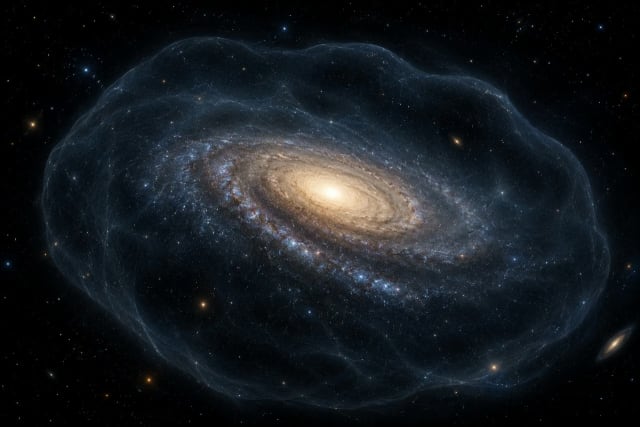
What Dark Matter Tells Us About Scientific Knowledge: An RC Inspired by IIM Indore
Dark matter has never been directly observed. We are nonetheless highly confident it exists. The gap between these two facts reveals something important about how science actually works.
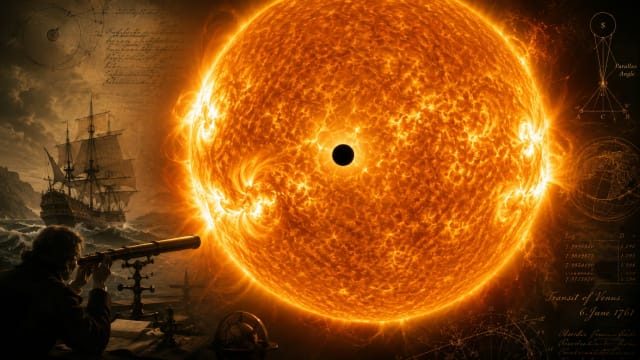
Chasing Shadows
A tiny shadow sent astronomers across oceans, empires into competition and science into a new age. The transit of Venus reveals the power of curiosity.
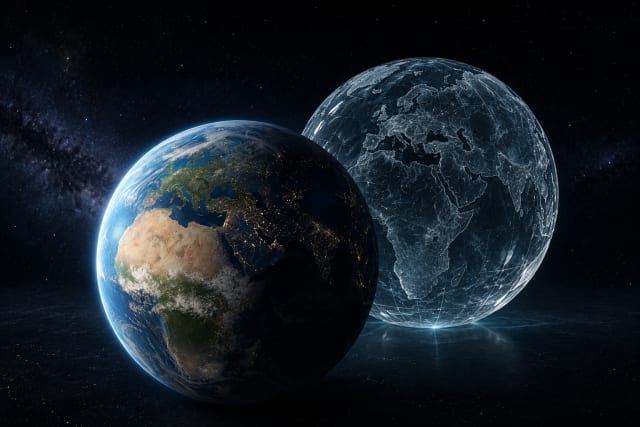
The Backup Planet Paradox
Is Mars colonization humanity's ultimate insurance policy, or a costly distraction from Earth's problems? Explore the backup planet paradox.
What If the Earth Stops Spinning?
What would happen if the Earth stopped spinning? Explore the science, climate chaos, and hidden forces that make life on our planet possible.