Ashwatthama | The Curse of Continuing
A reflection on immortality through Ashwatthama, showing how endless life becomes a burden of memory, consequence, and unfinished identity rather than a gift.
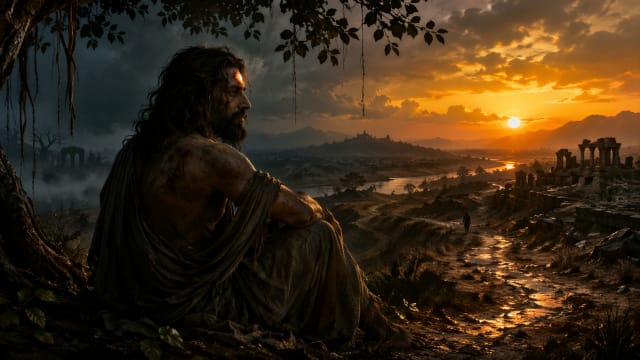
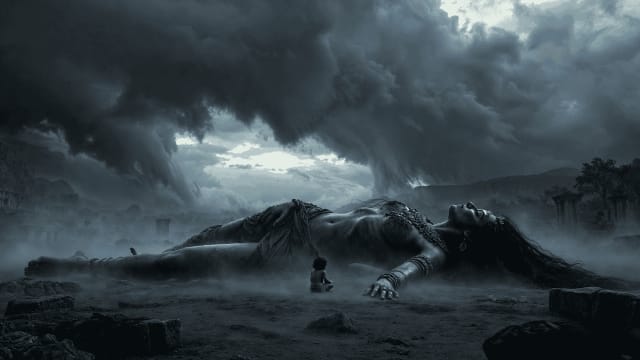
A man walks through centuries with a wound that refuses to close. Dust gathers on his skin, cities rise and fall around him, languages change their music, yet he remains. This is Ashwatthama, not alive in the way we understand life, not dead in the way we accept death, but suspended in a long unfinished sentence.
We usually treat immortality like a reward. The imagination dresses it in gold. Endless time, endless chances, endless becoming. It feels like an upgrade. A life without an expiry date looks like freedom. But Ashwatthama suggests something far less comforting. Immortality is not expansion. It is accumulation.
Every action leaves a trace. In ordinary life, time softens those traces. Memory fades. Regret loosens its grip. Even guilt becomes quieter as years pass. This fading is not a flaw. It is a design feature. It allows us to continue. Now imagine a life where nothing fades. Every mistake remains sharp. Every regret stays fresh. The past does not recede. It sits beside you, breathing.
Ashwatthama carries not just his body through time, but his consequences. That is the real weight. Not the years, but the unedited archive of self. He cannot step outside what he has done. He cannot close the chapter. The story refuses to end, so it refuses to resolve.
There is a seductive counter idea. Given enough time, one might argue, a person can correct anything. Infinite duration could allow infinite growth. One could atone, rebuild, transform. Perhaps immortality is not a curse but an extended classroom. Perhaps Ashwatthama is not trapped, but still learning.
It sounds persuasive. It also assumes that time guarantees change. It does not. Time offers exposure, not resolution. Change requires boundaries. It needs moments where something stops so something else can begin. Without endings, experiences pile up without shape. Lessons do not settle. They scatter.
Human life depends on selective forgetting. We do not remember every second, every feeling, every error. If we did, we would be crushed under the weight of our own continuity. Identity would become noise. To live is to edit. We keep some things, we release others. This quiet pruning gives the self its form.
Ashwatthama cannot prune. He is forced to remember in a way that humans are not built to endure. His immortality removes the mercy of erasure. He becomes a living archive without a librarian. Everything is stored, nothing is sorted. Over time, meaning does not deepen. It dissolves.
There is another layer to this discomfort. Mortality does more than end life. It gives life its structure. A beginning matters because there will be an end. Choices matter because time is limited. Love matters because it cannot be repeated endlessly. Remove the end, and urgency weakens. Without urgency, value blurs.
We like to think that more time would make us wiser. Sometimes it only makes us slower to decide. If every path can be walked eventually, then no path demands commitment now. Immortality stretches possibility so wide that it risks becoming meaningless.
Ashwatthama walks on, not because he chooses to, but because he cannot stop. That is the quiet horror. Not pain, not loneliness, but the absence of closure. A life that cannot conclude cannot fully cohere.
So the question shifts. It is no longer about how to live forever. It is about what makes living feel complete. The answer might be uncomfortable. It might be that finitude is not the enemy of meaning but its condition.
We fear death because it ends the story. Yet a story without an ending is not richer. It is unfinished in a way that prevents it from ever being understood. Ashwatthama is not just a figure from an old tale. He is a warning shaped like a man.
To continue without conclusion is not to win against time. It is to be claimed by it.
Discussion
Sign in to join the discussion.
More in Religion & Mythology
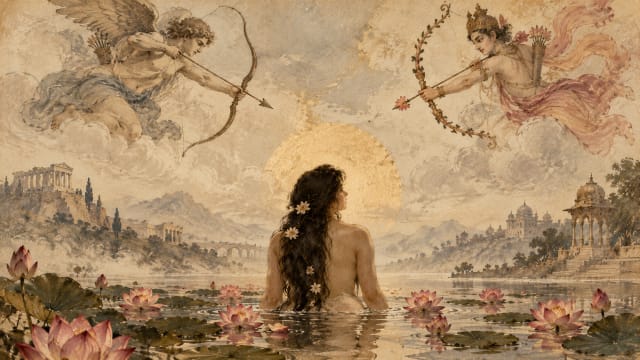
The Archer Nobody Can See
Eros began as a force older than the gods, Kamadeva as the first seed of mind. Somewhere along the way both became boys with bows, and nobody has explained why the wound still feels like it comes from outside.
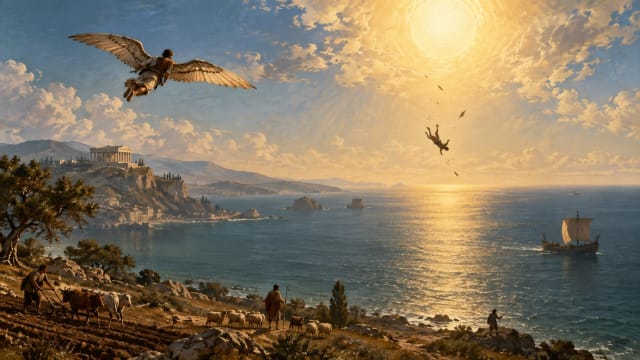
Why We Only Tell Icarus's Story: An RC Inspired by IIM Indore
Daedalus built the wings, warned his son, watched him fall, and flew safely to Sicily. He succeeded at everything Icarus failed at. The myth does not remember him.
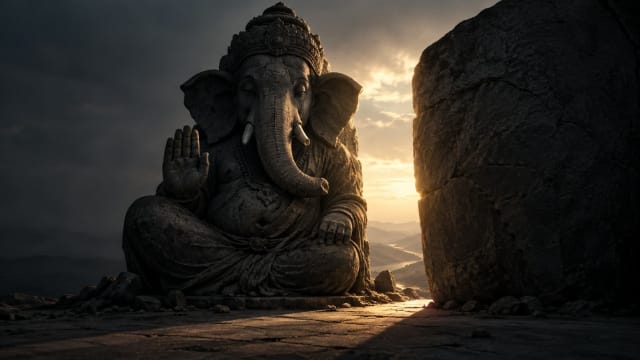
The God of Obstacles: An RC Inspired by IIM Indore
Ganesha removes obstacles. Ganesha places them. The same deity, the same tradition, the same prayer. This is not a contradiction. It may be the most honest theology ever written about the nature of difficulty.
The Strangest Mother in Indian Mythology
Putana came to kill Krishna with poisoned milk. He killed her instead. Then he gave her the status of a mother. The Mahabharata is not confused about this. It is making its hardest argument.