The Archer Nobody Can See
Eros began as a force older than the gods, Kamadeva as the first seed of mind. Somewhere along the way both became boys with bows, and nobody has explained why the wound still feels like it comes from outside.
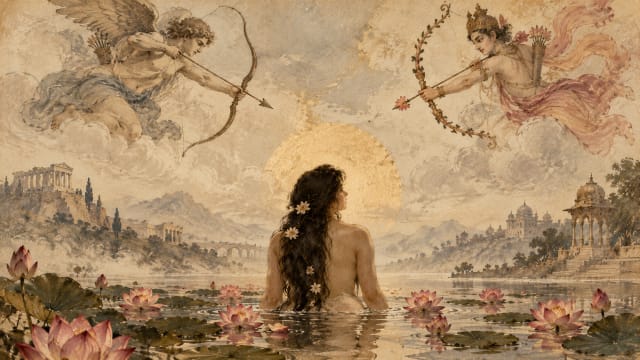
The earliest Greek account of the gods does not present Eros as a child. In Hesiod's Theogony, composed around 700 BCE, he is one of the first beings to exist, born beside Chaos and Earth, and he is said to unstring the limbs and overpower the judgement of gods and men alike. In India a Vedic creation hymn makes a stranger claim still. It says that desire arose first in the primal darkness and became the seed of mind. Peoples who developed these ideas largely apart both began with a love god who was not a decoration but a beginning.
Then the god shrinks. Hellenistic poets picture Eros as a winged boy with a bow, the son of Aphrodite. Romans rename him Cupid and blindfold him, and Apuleius gives him a tale in which he falls for a mortal woman named Psyche. In India Kamadeva becomes a handsome youth with a sugarcane bow, a string of bees and arrows tipped with flowers, and a parrot for a mount. A cosmic principle has been turned into a court archer.
Other societies gave the same force different tools. Mesopotamia entrusted desire to Inanna, who also presided over war, so that love and violence shared one altar. In China the matchmaking deity Yue Lao is said to bind the ankles of destined couples with an invisible red thread, which moves the unseen power from the arrow to the string. The instrument changes but the sense that someone else is doing the binding does not.
Yet the demotion never quite succeeds. In the best known Kama story, the god shoots Shiva during meditation so that he will notice Parvati, and Shiva opens his third eye and reduces him to ash. Kama survives as Ananga, the bodiless one, which is why desire has no visible body. Cupid's blindfold makes the same point in another idiom, since love strikes without regard for merit. Both traditions kept the boyish face while preserving the insight that desire arrives uninvited from somewhere unseen.
Plato pressed the point furthest. In the Symposium, Socrates reports the priestess Diotima's teaching that Eros is not a god of beauty at all but a restless spirit born of Poverty and Resource. He is always in want of what he lacks. Desire, on this view, is not possession but reaching. Diotima adds that this want drives a ladder of ascent, from love of one body to love of beauty itself, so that longing becomes a method of education and not merely a misfortune.
Desire, on this view, is not possession but reaching.
A sceptic will say that these comparisons flatten real differences. Hindu thought lists kama among the proper aims of life, while Greek writers often treat Eros as a threat to order, and the modern cherub on a greeting card threatens nothing. The objection is fair as far as it goes. But it explains only the varied moral weather around the figure and not the shared grammar beneath it, which is a weapon, a wound and a victim who did not choose.
That grammar raises a harder question. To blame an archer is to disown authorship of one's own longing, yet the same societies built marriage, law and poetry on the assumption that longing can be governed. Perhaps the arrow is an honest report of how desire feels from inside. Perhaps it is a convenient excuse. The old poets seem to have suspected both answers at once, and left the question open on purpose. If nobody can say who fires it, it is also unclear why the wounded so rarely wish to be healed.
Discussion
Sign in to join the discussion.
More in Religion & Mythology
Why We Only Tell Icarus's Story: An RC Inspired by IIM Indore
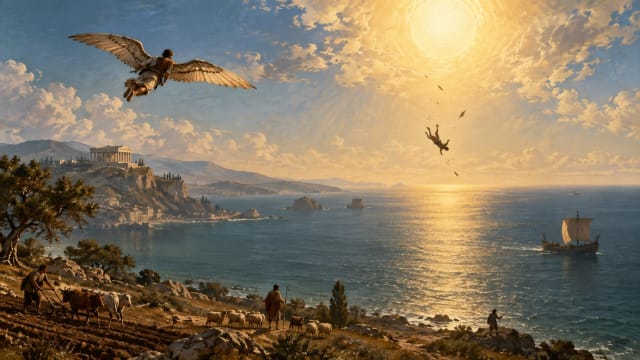
Daedalus built the wings, warned his son, watched him fall, and flew safely to Sicily. He succeeded at everything Icarus failed at. The myth does not remember him.
The God of Obstacles: An RC Inspired by IIM Indore
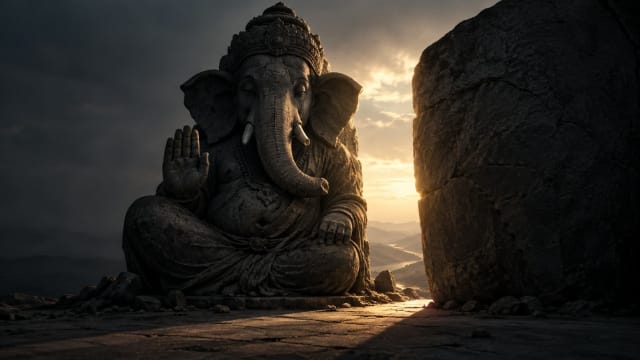
Ganesha removes obstacles. Ganesha places them. The same deity, the same tradition, the same prayer. This is not a contradiction. It may be the most honest theology ever written about the nature of difficulty.

The Strangest Mother in Indian Mythology
Putana came to kill Krishna with poisoned milk. He killed her instead. Then he gave her the status of a mother. The Mahabharata is not confused about this. It is making its hardest argument.

Her Name is Khan
A memoir of love, religious identity and Islamophobia, exploring how a Muslim name can become a category and a person can disappear behind it.