Why We Only Tell Icarus's Story: An RC Inspired by IIM Indore
Daedalus built the wings, warned his son, watched him fall, and flew safely to Sicily. He succeeded at everything Icarus failed at. The myth does not remember him.
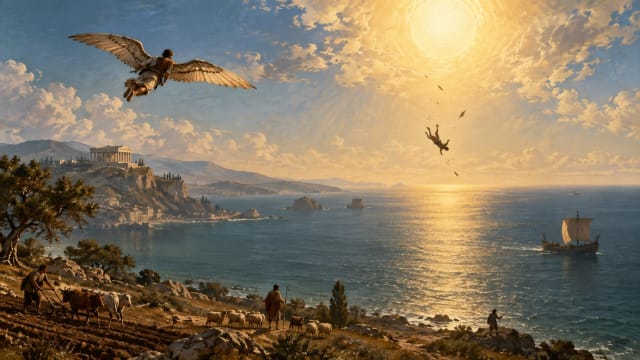
Daedalus survived. This is the fact that the myth of Icarus consistently fails to mention, not because it is unknown but because it is inconvenient. Daedalus built the wings. Daedalus warned his son not to fly too close to the sun. Daedalus watched his son fall into the sea. And then Daedalus flew on to Sicily, landed safely, built a temple to Apollo, and hung up his wings as an offering. He never flew again. By every reasonable measure, Daedalus succeeded at exactly what Icarus failed at. The myth remembers Icarus.
The standard explanation for Icarus's fall is hubris. He was warned, he ignored the warning, he paid the price. This reading is so deeply embedded in Western culture that the name Icarus has become shorthand for the danger of overreaching. Students are taught it. Motivational speakers invoke it as a caution. The image of the boy falling from the sky with melting wings has become one of the most recognisable symbols in the Western tradition. What this reading systematically ignores is that Daedalus gave Icarus two warnings, not one. He was told not to fly too close to the sun, where the heat would melt the wax. He was also told not to fly too low, where the moisture from the sea would weigh down the feathers. The lesson the myth actually contains is not that ambition kills. It is that the corridor of safety is narrow, and that flying perfectly requires a calibration that is nearly impossible to maintain.
Ovid, who wrote the most influential version of the myth, spends two lines on Icarus falling. He spends considerably more time on three figures who observe the flight from below: a fisherman, a shepherd, and a ploughman. Each of them looks up and sees Daedalus and Icarus in the air and concludes, reasonably, that they must be gods. Ovid is making a point that the cultural transmission of the myth has largely abandoned. The point is not about what happens when you fly too high. It is about how the impossible looks from the outside, and how observers interpret what they cannot understand.
The lesson the myth actually contains is not that ambition kills. It is that the corridor of safety is narrow, and that flying perfectly requires a calibration that is nearly impossible to maintain.
The counterargument is that Daedalus's survival is simply not as interesting as Icarus's fall. Drama requires failure. Tragedy requires loss. A story in which the careful craftsman executes his plan and lands safely in Sicily is not a story that travels across three thousand years. This argument is correct about narrative but incorrect about what it proves. The fact that Daedalus's story does not travel is itself the phenomenon that requires explanation. Every culture selects which stories to remember and which to let go. The selection is not random. It reflects what the culture needs its myths to confirm.
What Western culture has consistently needed the Icarus myth to confirm is that excess is punished. The myth became popular during periods of moral anxiety about ambition, about the reach of human capability, about the danger of transgressing the limits set by gods or nature or society. It was useful precisely because it could be read as a warning. Daedalus's story, the story of someone who built something extraordinary and used it carefully and survived, does not serve this function. It suggests that the extraordinary is achievable. That is a more difficult idea to live with than the alternative.
Pieter Bruegel the Elder painted the fall of Icarus in the sixteenth century. The painting shows a ploughman working in the foreground, a shepherd looking at the sky, a ship sailing calmly by. In the lower right corner, barely visible, a pair of legs disappears into the water. Icarus is falling and nobody is looking. W.H. Auden wrote a poem about the painting in which he observed that suffering occurs while someone else is eating or opening a window or just walking dully along. The painting and the poem are both about the same thing: how small the catastrophe looks from a distance, and how quickly the world moves on. Daedalus had already landed. The ploughman had a field to finish. The ship had somewhere to be. Icarus fell, and the world did not stop. It never does.
Discussion · 2
The essay explores the contrasting accounts of Daedalus and Icarus, highlighting how one achieved immortality while the other was lost to time, even though the former succeeded and the latter failed. It is widely believed that Icarus's hubris caused his fall, making his flight a classic cautionary tale against colossal ambition. However, he was actually warned about two distinct dangers: not to fly too close to the sun, and not to fly too near to the sea, as both extremes would hinder his flight. Through this, the myth conveys that the path to success is a narrow one.In his retelling, Ovid places more emphasis on the observer's interpretation than on the mechanics of Icarus's flight and subsequent fall. Meanwhile, the reason behind Daedalus's survival often comes up short-handed in cultural memory; his narrative survival is largely the result of cultural selection doing its work. Ultimately, both the painting and the poem convey how a passive tragedy can feel entirely insignificant when placed in front of the momentum of an active, everyday chore.
I love these lines tho. And Icarus laughed as he fell... For he knew to fall means to once have soared.
Sign in to join the discussion.
More in Religion & Mythology

The Archer Nobody Can See
Eros began as a force older than the gods, Kamadeva as the first seed of mind. Somewhere along the way both became boys with bows, and nobody has explained why the wound still feels like it comes from outside.
The God of Obstacles: An RC Inspired by IIM Indore
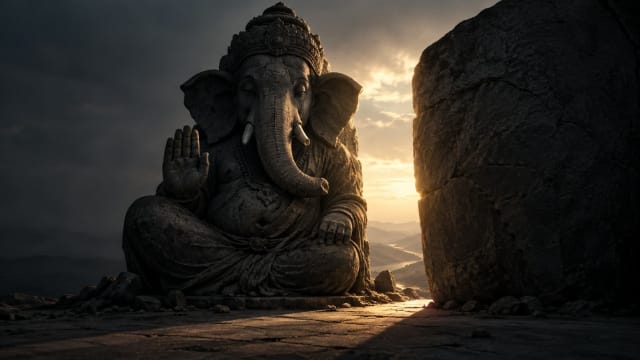
Ganesha removes obstacles. Ganesha places them. The same deity, the same tradition, the same prayer. This is not a contradiction. It may be the most honest theology ever written about the nature of difficulty.
The Strangest Mother in Indian Mythology
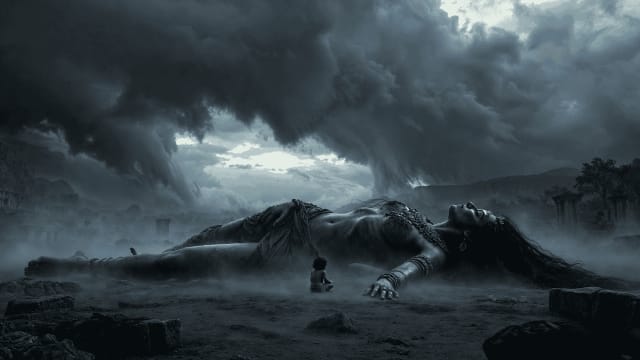
Putana came to kill Krishna with poisoned milk. He killed her instead. Then he gave her the status of a mother. The Mahabharata is not confused about this. It is making its hardest argument.

Her Name is Khan
A memoir of love, religious identity and Islamophobia, exploring how a Muslim name can become a category and a person can disappear behind it.