The Fruit That Genesis Never Called an Apple
The Bible names a tree and a crime but never the fruit. How the apple took the blame is a small case file with a suspect everyone likes and a date nobody can give.

The Book of Genesis, in its account of the garden of Eden, says that a woman took fruit from the tree of the knowledge of good and evil, ate it, and gave some to her husband. The Hebrew text names the tree and describes the effects of eating, but it does not name the fruit. Readers have nonetheless pictured an apple for centuries.
Early readers who tried to identify the fruit did not settle on an apple. Discussions preserved in the Talmud and in the midrash collection Genesis Rabbah are reported to have proposed wheat, the grape and the fig, and the fig has the support of the next verse, in which the pair sew fig leaves into coverings. Michelangelo's scene of the Fall on the Sistine Chapel ceiling is commonly described as showing a fig tree.
A suspect with a motive appears in Latin. In the Latin Bible associated with Jerome, completed around the year 405, the tree is the tree of the knowledge of good and evil, in a phrase that contains a form of the word malum, meaning evil. The Latin word for apple is spelled almost the same, differing only in the length of a vowel that a listener would have heard and a reader would not have seen. Writers have long suggested that this pun, easier to enjoy in a sermon than on a page, helped to fix the fruit in the imagination.
Some scholars doubt that a pun could have done all the work. Apples already carried charged meanings in the Mediterranean world. In Greek myth the golden apples of the Hesperides grew in a distant garden under guard, and a golden apple thrown among three goddesses by Eris, the spirit of discord, is the prize that leads in the story to the Trojan War. A fruit of desire and rivalry was ready and waiting.
Early readers who tried to identify the fruit did not settle on an apple.
What remains is a puzzle of timing. No single sermon, translation or painting is known to have decided the matter, and the apple seems to have arrived by degrees, helped by wordplay and by older tales of golden fruit. The pun makes a tidy answer, which may be a reason to trust it less. Only one fact is certain, that Genesis names no apple, while the date and cause of the apple's arrival remain, so far as the evidence shows, unfixed.
Discussion
Sign in to join the discussion.
More in Religion & Mythology

The Archer Nobody Can See
Eros began as a force older than the gods, Kamadeva as the first seed of mind. Somewhere along the way both became boys with bows, and nobody has explained why the wound still feels like it comes from outside.
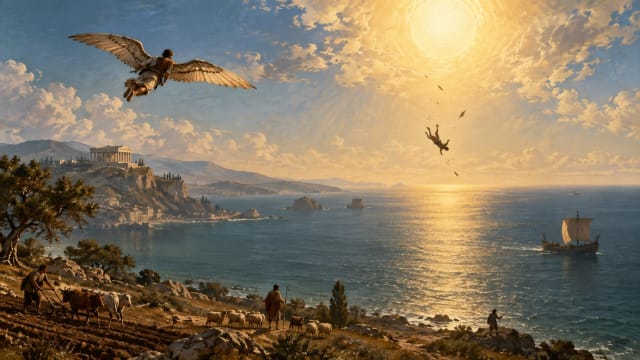
Why We Only Tell Icarus's Story: An RC Inspired by IIM Indore
Daedalus built the wings, warned his son, watched him fall, and flew safely to Sicily. He succeeded at everything Icarus failed at. The myth does not remember him.

The God of Obstacles: An RC Inspired by IIM Indore
Ganesha removes obstacles. Ganesha places them. The same deity, the same tradition, the same prayer. This is not a contradiction. It may be the most honest theology ever written about the nature of difficulty.

The Strangest Mother in Indian Mythology
Putana came to kill Krishna with poisoned milk. He killed her instead. Then he gave her the status of a mother. The Mahabharata is not confused about this. It is making its hardest argument.