Her Name is Khan
A memoir of love, religious identity and Islamophobia, exploring how a Muslim name can become a category and a person can disappear behind it.

I met Khan in a library. She was sitting opposite me with a book open on the table and a cup of coffee growing cold beside it. I had been looking for the same book, and she noticed me staring at it. We began talking. For several months afterwards, we talked about almost everything except religion. We discussed books, films, family, work and the ordinary anxieties that make two people believe they are beginning to understand one another. Eventually, friendship became affection, and affection became the possibility of marriage.
Her name is Khan.
I noticed the name when we first met, but I did not attach much significance to it. By then I knew enough about her to understand how little a surname could tell me. I knew which books she loved, what made her laugh, what frightened her and the particular silence that meant she wanted to leave a crowded room. I knew how she took her coffee. I did not know that when marriage entered the conversation, her surname would suddenly acquire a history.
Until then, religion had been almost invisible between us. Marriage made it visible. Would I convert? Would she? What would happen to our children? Which festivals would we celebrate? Would our families accept the marriage? These were not questions asked with hatred. Nobody called anybody backward. Nobody threatened anybody. There was no dramatic confrontation between a liberal son and a conservative family. There were simply two people discovering that the identities they had carried casually through friendship became considerably heavier when they had to construct a household together.
For a while, I thought this was simply the difficulty of an interfaith relationship. Then I began reading about what happens when religious identity enters places where it should have no bearing at all.
In France, Claire Adida, David Laitin and Marie Anne Valfort conducted a correspondence experiment comparing otherwise similar Muslim and Christian candidates. The Muslim candidate was 2.5 times less likely to receive a callback for a job interview. The significance of the experiment was that religion could be isolated from several of the factors that ordinarily make discrimination difficult to identify. The candidates were comparable in the relevant qualifications. What changed was the signal of religious identity.
A name, a religious signal, a small piece of information, could become enough.
Years later, Valfort conducted a larger field experiment involving more than 6,200 job applications. The results were more complicated. Non religious Muslims did not suffer a significant disadvantage relative to non religious Christians, while religious Muslims faced a substantial penalty. Religious Christian applicants experienced the opposite pattern. The findings suggested that the problem was not simply religion itself, but the way religiosity interacted with the assumptions made about different religious groups. The uncomfortable thing about these studies is that nobody in them had to say that they disliked Muslims. The discrimination could happen before a conversation began.
I began to think about Khan differently.
There is an important distinction in arguments about Islamophobia that is easily lost. Islam is a religion. Like Christianity, Judaism, Hinduism or any other system of belief, it contains doctrines and practices that can be questioned, criticised and rejected. A liberal society cannot protect religious freedom by making religious ideas immune from criticism.
Muslims, however, are people.
To argue that a doctrine is mistaken is not to argue that everyone who believes it is dangerous. To oppose a religious practice is not to establish the moral inferiority of those who practise it. Intellectual disagreement concerns propositions. Prejudice assigns characteristics to people before their individual conduct has been considered. The distinction matters because religious identity is complicated. Khan had inherited Islam through family, culture, language and memory. Yet inheritance did not make her beliefs beyond criticism. She could interpret them, question them, revise them or abandon them. At the same time, it would have been absurd to pretend that religion was simply an idea she had selected from a shelf. It was part of the architecture of her family and therefore part of the architecture of the life she imagined.
Perhaps that was what I had failed to understand. I had thought religion was something we believed. For Khan, it was also something she belonged to. And belonging is harder to negotiate than belief.
We eventually stopped discussing marriage. There was no single moment when the relationship ended. We simply became less certain that love could carry the weight we were asking it to carry. Perhaps we should have fought harder. Perhaps we would eventually have discovered that the walls surrounding us were thinner than we imagined. Perhaps they were not.
I still do not know. But I remember the first time I met her. Her name was not a political statement. It was not an argument. It was not evidence of what she believed, what she supported or what she might do.
It was simply her name.
Her name is Khan.
And perhaps that is where Islamophobia begins to reveal itself. Not necessarily in hatred, but in the moment a category becomes more visible than the person.
A name can tell us something about where someone comes from.
It cannot tell us who they are.
Discussion
Sign in to join the discussion.
More in Religion & Mythology
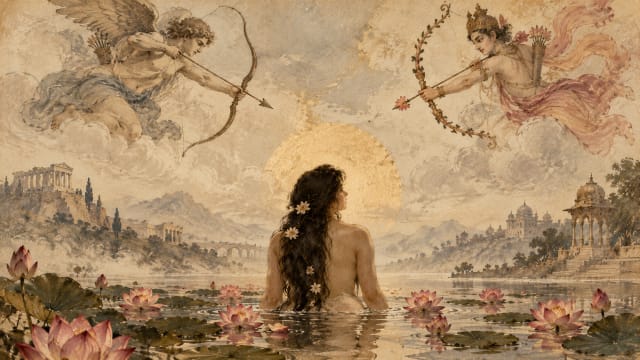
The Archer Nobody Can See
Eros began as a force older than the gods, Kamadeva as the first seed of mind. Somewhere along the way both became boys with bows, and nobody has explained why the wound still feels like it comes from outside.
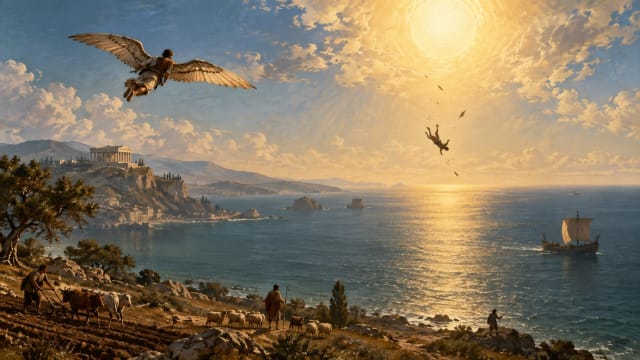
Why We Only Tell Icarus's Story: An RC Inspired by IIM Indore
Daedalus built the wings, warned his son, watched him fall, and flew safely to Sicily. He succeeded at everything Icarus failed at. The myth does not remember him.
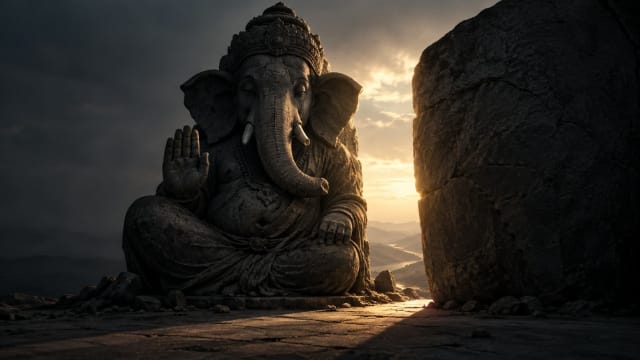
The God of Obstacles: An RC Inspired by IIM Indore
Ganesha removes obstacles. Ganesha places them. The same deity, the same tradition, the same prayer. This is not a contradiction. It may be the most honest theology ever written about the nature of difficulty.

The Strangest Mother in Indian Mythology
Putana came to kill Krishna with poisoned milk. He killed her instead. Then he gave her the status of a mother. The Mahabharata is not confused about this. It is making its hardest argument.