The Mermaids We Invent to Understand Ourselves
A reflective exploration of why mermaids endure in human imagination, revealing them not as sea creatures but as symbols of our own divided nature.
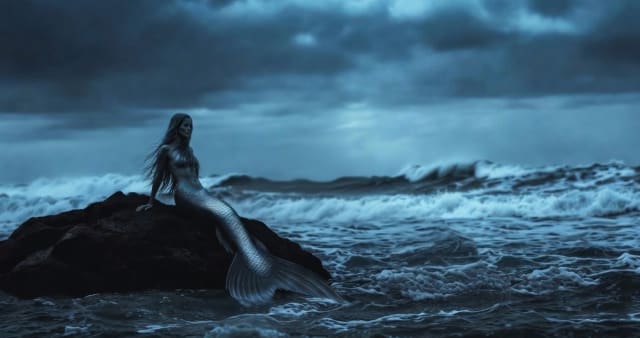
At the edge of old maps, where ink softened into blank water, sailors wrote a single word to steady their nerves. Mermaids. Not proof, not biology, but a story placed like a lighthouse in fog. A figure shaped from longing and fear. The mermaid endures because it solves a human problem. The ocean is vast, dark, and mostly hidden from sight. We stand at its surface, aware that something lives below, yet unable to see it. The mind resists such emptiness. It fills the void with something familiar, then alters it just enough to preserve danger. The upper body remains human, expressive, capable of voice and gaze, while the lower body becomes fish, silent and built for depths we cannot survive. This is a compromise that lets us approach the unknown without dissolving into it.
Accounts from early voyages suggest that the first mermaids were not fantasies in the usual sense. Sailors reported sightings that scholars later linked to manatees or dugongs. Long months at sea distort perception. Hunger, loneliness, and monotony sharpen the need for meaning. The eye sees a shape and the mind completes it. Research in perception shows that we do not passively receive reality. We construct it actively, assembling fragments into coherence . A curve becomes a face, a movement becomes intention, and the creature becomes a companion. What begins as misrecognition settles into narrative, and narrative hardens into belief.
Yet it feels insufficient to dismiss mermaids as simple mistakes. Mistakes fade once corrected, but mermaids did not. They traveled from ship logs into folklore, from folklore into paintings, and from paintings into modern storytelling. They evolved with us, which suggests a deeper role. Some argue that mermaids survive because they are beautiful fantasies that soften the harshness of the sea. Beauty does help memory linger, but beauty alone cannot explain their structure. The mermaid is not whole. She is divided. She belongs neither to land nor to sea, and cannot fully claim either world.
This division reveals the real function of the myth. The mermaid reflects the human condition itself. We are creatures split between instinct and thought, between what we are and what we imagine we could be. We build systems of order, yet feel drawn to what escapes them. We stand on land, yet remain fascinated by depths that would undo us. Like the mermaid, we inhabit a boundary that never settles. The myth does not describe the ocean as much as it dramatizes the tension within us.
The deeper insight arrives quietly. The mermaid is not about what lies beneath the ocean, but about what lies beneath awareness. When we imagine a being below the surface, we are also pointing to parts of ourselves that remain unseen. The sea becomes a stage where hidden impulses take form, where desire and fear move just beyond reach. This is why the story refuses to disappear. Each era reshapes the mermaid, yet preserves her division. The old maps were not naive. When they marked the unknown with mermaids, they admitted a limit not only of geography but of understanding. The real mystery was never only in the water. It was in the mind that looked at the water and needed it to mean something.
Discussion
Sign in to join the discussion.
More in Religion & Mythology
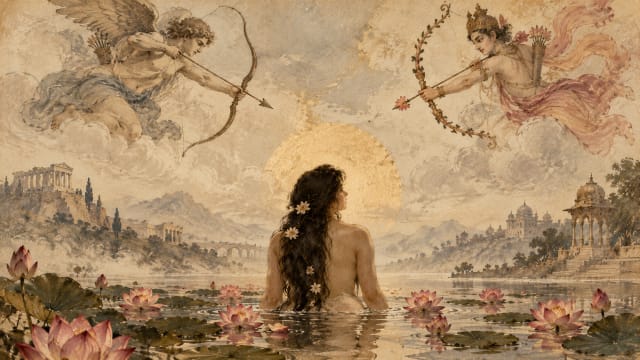
The Archer Nobody Can See
Eros began as a force older than the gods, Kamadeva as the first seed of mind. Somewhere along the way both became boys with bows, and nobody has explained why the wound still feels like it comes from outside.
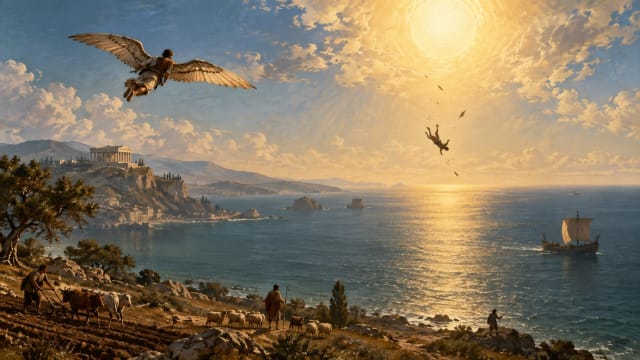
Why We Only Tell Icarus's Story: An RC Inspired by IIM Indore
Daedalus built the wings, warned his son, watched him fall, and flew safely to Sicily. He succeeded at everything Icarus failed at. The myth does not remember him.
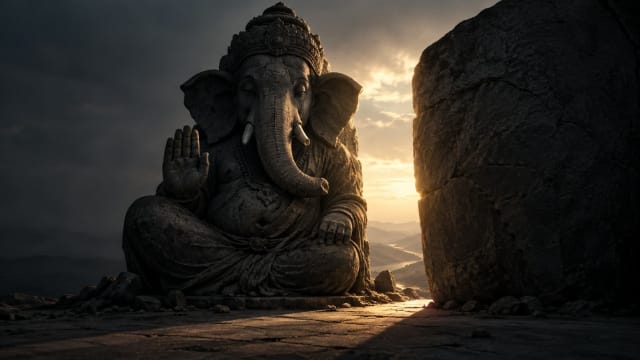
The God of Obstacles: An RC Inspired by IIM Indore
Ganesha removes obstacles. Ganesha places them. The same deity, the same tradition, the same prayer. This is not a contradiction. It may be the most honest theology ever written about the nature of difficulty.
The Strangest Mother in Indian Mythology
Putana came to kill Krishna with poisoned milk. He killed her instead. Then he gave her the status of a mother. The Mahabharata is not confused about this. It is making its hardest argument.